Investigation of elevated fear-avoidance beliefs for patients with low back pain: a secondary analysis involving patients enrolled in physical therapy clinical trials
- PMID: 18349490
- PMCID: PMC2881572
- DOI: 10.2519/jospt.2008.2647
Investigation of elevated fear-avoidance beliefs for patients with low back pain: a secondary analysis involving patients enrolled in physical therapy clinical trials
Abstract
Study design: Secondary analysis.
Objective: To investigate the Fear-Avoidance Beliefs Questionnaire (FABQ) for its ability to predict 6-month outcomes for patients with low back pain (LBP) participating in physical therapy clinical trials.
Background: Consistent evidence suggests that fear-avoidance beliefs are predictive of short-term outcomes for patients with LBP. However, proposed cut-off scores have not been widely investigated for longer-term outcomes in samples of patients receiving physical therapy.
Methods and measures: Subjects (n = 160) were participants in 2 separate randomized trials that used standard methodology and investigated the efficacy of physical therapy interventions for LBP. Subjects completed baseline measures of pain, disability, fear-avoidance beliefs, and physical impairment. They completed 4 weeks of randomly assigned physical therapy and were reassessed at 6 months with standard examination techniques. The accuracy of previously proposed cut-offs for elevated FABQ scores were determined by independent t tests and chi-square analysis on raw 6-month Oswestry Disability Questionnaire (ODQ) scores, 6-month ODQ change scores, and minimally clinical important difference (MCID) in ODQ scores (6 points). Next, a hierarchical regression model determined which FABQ scale better predicted 6-month ODQ scores after controlling for previously reported prognostic factors and relevant treatment parameters. Last, receiver operating characteristic curve analyses were planned to generate a range of FABQ cut-off scores that predicted 6-month MCID in the ODQ.
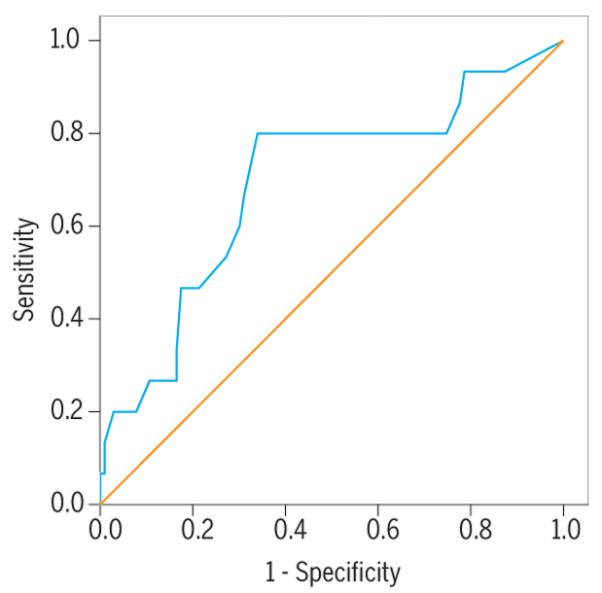
Results: The previously reported cut-off score for the FABQ physical activity scale (>14) resulted in 111 (69.4%) of 160 patients being classified as having elevated baseline scores, while the previously reported cut-off score for the FABQ work scale (>29) resulted in 19 (11.9%) of 160 patients being classified as having elevated baseline scores. Patients with elevated FABQ physical activity scale scores (>14) had no significant differences in 6-month ODQ outcomes. Patients with elevated FABQ work scale (>29) scores reported higher 6-month ODQ scores and were more likely to have reported no improvement in ODQ score. The final regression model explained 24.4% of the variance in 6-month ODQ scores, with only manipulation and exercise and the FABQ work scale as unique predictors. Fifteen of the subjects (12.7%) had a 6-month change in ODQ that indicated no improvement. The area under the receiver operating characteristic curve for the FABQ physical activity scale predicting this outcome was 0.562 (95% CI: 0.415-0.710) and for the FABQ work scale was 0.694 (95% CI: 0.542-0.846). Cut-off scores were explored for the FABQ work scale only, with positive likelihood ratios that ranged from 1.19 to 5.15 and negative likelihood ratios that ranged from 0.30 to 0.83.
Conclusions: The FABQ work scale was the better predictor of self-report of disability in this sample of patients participating in physical therapy clinical trials. Future studies are necessary to further test and refine the FABQ work scale as a screening tool alone, and in combination with other examination findings.
Figures
References
-
- Al-Obaidi SM, Beattie P, Al-Zoabi B, Al-Wekeel S. The relationship of anticipated pain and fear avoidance beliefs to outcome in patients with chronic low back pain who are not receiving workers’ compensation. Spine. 2005;30:1051–1057. - PubMed
-
- Beurskens AJ, de Vet HC, Koke AJ. Responsiveness of functional status in low back pain: a comparison of different instruments. Pain. 1996;65:71–76. - PubMed
-
- Burton AK, Waddell G, Tillotson KM, Summerton N. Information and advice to patients with back pain can have a positive effect. A randomized controlled trial of a novel educational booklet in primary care. Spine. 1999;24:2484–2491. - PubMed
-
- Childs JD, Fritz JM, Flynn TW, et al. A clinical prediction rule to identify patients with low back pain most likely to benefit from spinal manipulation: a validation study. Ann Intern Med. 2004;141:920–928. - PubMed
-
- Crombez G, Vlaeyen JW, Heuts PH, Lysens R. Pain-related fear is more disabling than pain itself: evidence on the role of pain-related fear in chronic back pain disability. Pain. 1999;80:329–339. - PubMed
Publication types
MeSH terms
Grants and funding
LinkOut - more resources
Full Text Sources
Medical
Miscellaneous