


Nessi: an EEG-controlled web browser for severely paralyzed patients
- PMID: 18350132
- PMCID: PMC2266985
- DOI: 10.1155/2007/71863
Nessi: an EEG-controlled web browser for severely paralyzed patients
Abstract
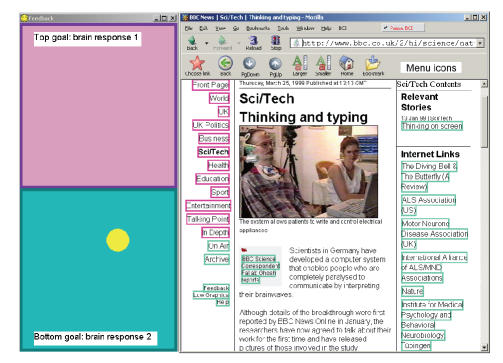
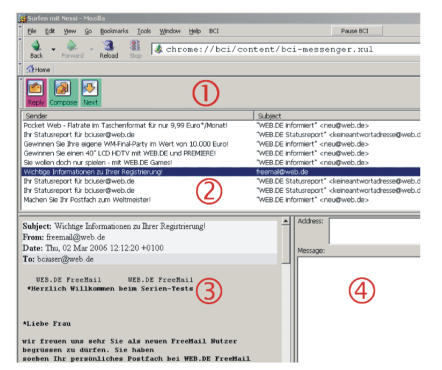
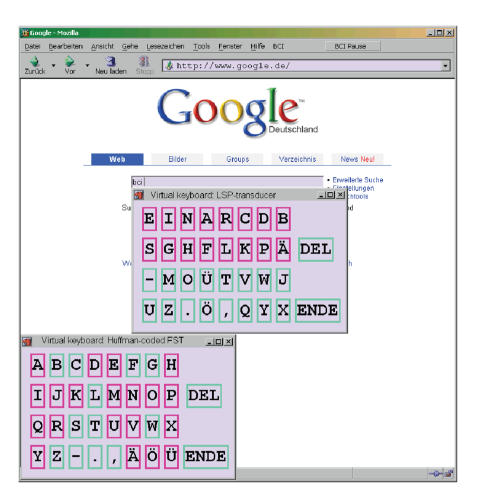
We have previously demonstrated that an EEG-controlled web browser based on self-regulation of slow cortical potentials (SCPs) enables severely paralyzed patients to browse the internet independently of any voluntary muscle control. However, this system had several shortcomings, among them that patients could only browse within a limited number of web pages and had to select links from an alphabetical list, causing problems if the link names were identical or if they were unknown to the user (as in graphical links). Here we describe a new EEG-controlled web browser, called Nessi, which overcomes these shortcomings. In Nessi, the open source browser, Mozilla, was extended by graphical in-place markers, whereby different brain responses correspond to different frame colors placed around selectable items, enabling the user to select any link on a web page. Besides links, other interactive elements are accessible to the user, such as e-mail and virtual keyboards, opening up a wide range of hypertext-based applications.
Figures
References
-
- Birbaumer N, Ghanayim N, Hinterberger T, et al. A spelling device for the paralysed. Nature. 1999;398(6725):297–298. - PubMed
-
- Birbaumer N, Kübler A, Ghanayim N, et al. The thought translation device (TTD) for completely paralyzed patients. IEEE Transactions on Rehabilitation Engineering. 2000;8(2):190–193. - PubMed
-
- Kübler A, Kotchoubey B, Salzmann H-P, et al. Self-regulation of slow cortical potentials in completely paralyzed human patients. Neuroscience Letters. 1998;252(3):171–174. - PubMed
-
- Peters BO, Pfurtscheller G, Flyvbjerg H. Automatic differentiation of multichannel EEG signals. IEEE Transactions on Biomedical Engineering. 2001;48(1):111–116. - PubMed
LinkOut - more resources
Full Text Sources
