


Learning strategy selection in the water maze and hippocampal CREB phosphorylation differ in two inbred strains of mice
- PMID: 18353993
- PMCID: PMC2327260
- DOI: 10.1101/lm.783108
Learning strategy selection in the water maze and hippocampal CREB phosphorylation differ in two inbred strains of mice
Abstract
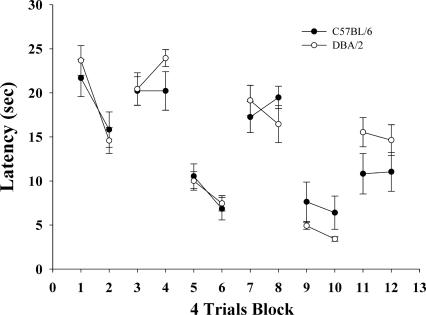
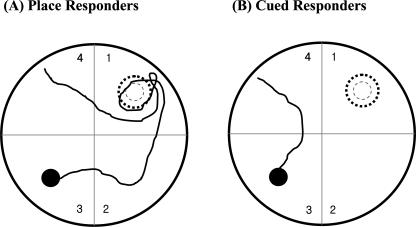
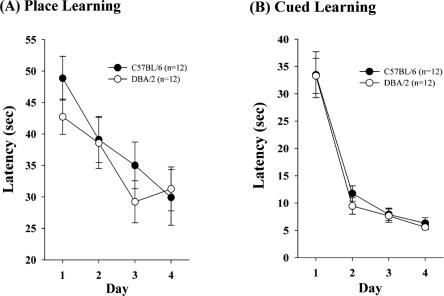
Learning strategy selection was assessed in two different inbred strains of mice, C57BL/6 and DBA/2, which are used for developing genetically modified mouse models. Male mice received a training protocol in a water maze using alternating blocks of visible and hidden platform trials, during which mice escaped to a single location. After training, mice were required to choose between the spatial location where the platform had been during training (a place strategy) and a visible platform presented in a new location (a cued/response strategy). Both strains of mice had similar escape performance on the visible and hidden platform trials during training. However, in the strategy preference test, C57BL/6 mice selected a place strategy significantly more often than DBA/2 mice. Because much evidence implicates the hippocampus and striatum as important neural substrates for spatial/place and cued/response learning, respectively, the engagement of the hippocampus was then assessed after either place or cue training by determining levels of cAMP response element-binding protein (CREB) and phosphorylated CREB (pCREB) in these two mouse strains. Results revealed that hippocampal CREB levels in both strains of mice were significantly increased after place in comparison to cued training. However, the relation of hippocampal pCREB levels to training was strain dependent; pCREB was significantly higher in C57BL/6 mice than in DBA/2 mice after place training, while hippocampal pCREB levels did not differ between strains after cued training. These findings indicate that pCREB, specifically associated with place/spatial training, is closely tied to differences in spatial/place strategy preference between C57BL/6 and DBA/2 mice.
Figures


References
-
- Abel T., Kandel E. Positive and negative regulatory mechanisms that mediate long-term memory storage. Brain Res. Brain Res. Rev. 1998;26:360–378. - PubMed
-
- Barber R.P., Vaughn J.E., Wimer R.E., Wimer C.C. Genetically-associated variations in the distribution of dentate granule cell synapses upon the pyramidal cell dendrites in mouse hippocampus. J. Comp. Neurol. 1974;156:417–434. - PubMed
-
- Bourtchuladze R., Frenguelli B., Blendy J., Cioffi D., Schutz G., Silva A.J. Deficient long-term memory in mice with a targeted mutation of the cAMP-responsive element-binding protein. Cell. 1994;79:59–68. - PubMed
-
- Brooks S.P., Pask T., Jones L., Dunnett S.B. Behavioural profiles of inbred mouse strains used as transgenic backgrounds. II: Cognitive tests. Genes Brain Behav. 2005;4:307–317. - PubMed
-
- Chen A., Muzzio I.A., Malleret G., Bartsch D., Verbitsky M., Pavlidis P., Yonan A.L., Vronskaya S., Grody M.B., Cepeda I., et al. Inducible enhancement of memory storage and synaptic plasticity in transgenic mice expressing an inhibitor of ATF4 (CREB-2) and C/EBP proteins. Neuron. 2003;39:655–669. - PubMed
Publication types
MeSH terms
Substances
Grants and funding
LinkOut - more resources
Full Text Sources
Other Literature Sources
Medical