


Future suicide attempt and responses to serotonergic challenge
- PMID: 18354392
- PMCID: PMC3055397
- DOI: 10.1038/npp.2008.28
Future suicide attempt and responses to serotonergic challenge
Abstract
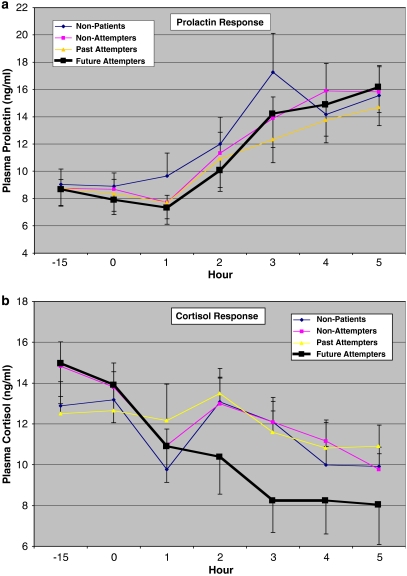
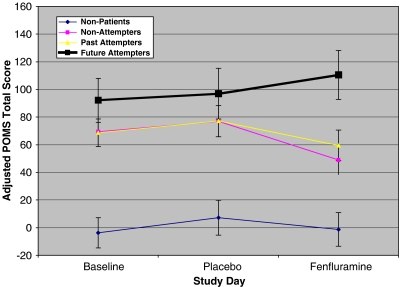
Blunted neurohormonal responses to serotonergic agents are found in major depression and suicidal behavior, but there have been no prospective studies of their relationship to later suicide attempt. In this study, healthy volunteers and depressed subjects were administered a fenfluramine (FEN) and placebo challenge test at baseline and then followed for 2 years. Seven subjects made suicide attempts within the follow-up period. Healthy volunteers, depressed non-attempters, depressed past suicide attempters, and depressed future attempters were compared on plasma prolactin and cortisol responses, as well as on mood (Profile of Mood States; POMS) and behavioral measures that were assessed at baseline and at the end of each challenge testing day. Both past and future attempters had lower total prolactin output (area under the curve) in response to FEN relative to non-patients. Future attempters had lower cortisol response relative to all other groups. All subject groups reported a decrease in POMS Fatigue subscale score and increase in finger tapping rate after receiving FEN. Depressed subjects reported a significant decline in POMS Total, Depression, and Tension/Anxiety scores, but future attempters' did not, showing a slight mean increase. Lower cortisol response correlated with greater suicidal ideation 3 months and 1 year post-study. Logistic regression revealed that blunting of cortisol response and worsening of mood after FEN, and younger age could be used to predict later suicide attempt in the majority of cases (4/7). Results suggest that blunted cortisol and unfavorable acute mood response to serotonergic challenge, in the context of the general activating effects of these drugs, may be a risk factor for later suicide attempt.
Figures
References
-
- Aardal-Eriksson E, Karlberg BE, Holm AC. Salivary cortisol—an alternative to serum cortisol determinations in dynamic function tests. Clin Chem Lab Med. 1998;36:215–222. - PubMed
-
- Barratt ES.1985Impulsiveness defined within a system model of personalityIn: Spielberger CD, Butcher JN (eds). Advances in Personality AssessmentVol. 5,Earlbaum: New York; 113–132.
-
- Barratt ES.1994Impulsivity and aggressionIn: Monahan J, Steadman HJ (eds). Violence and Mental Disorder: Developments in Risk Assessment University of Chicago Press: Chicago; 61–80.
-
- Beck AT, Beck R, Kovacs M. Classification of suicidal behaviors: I. Quantifying intent and medical lethality. Am J Psychiatry. 1975;132:285–287. - PubMed
-
- Beck AT, Kovacs M, Weissman A. Assessment of suicidal intention: the Scale for Suicide Ideation. J Consult Clin Psychol. 1979;47:343–352. - PubMed
Publication types
MeSH terms
Substances
Grants and funding
LinkOut - more resources
Full Text Sources
Miscellaneous
