


THE BACON not the bacon: how children and adults understand accented and unaccented noun phrases
- PMID: 18358460
- PMCID: PMC2518042
- DOI: 10.1016/j.cognition.2008.01.001
THE BACON not the bacon: how children and adults understand accented and unaccented noun phrases
Abstract
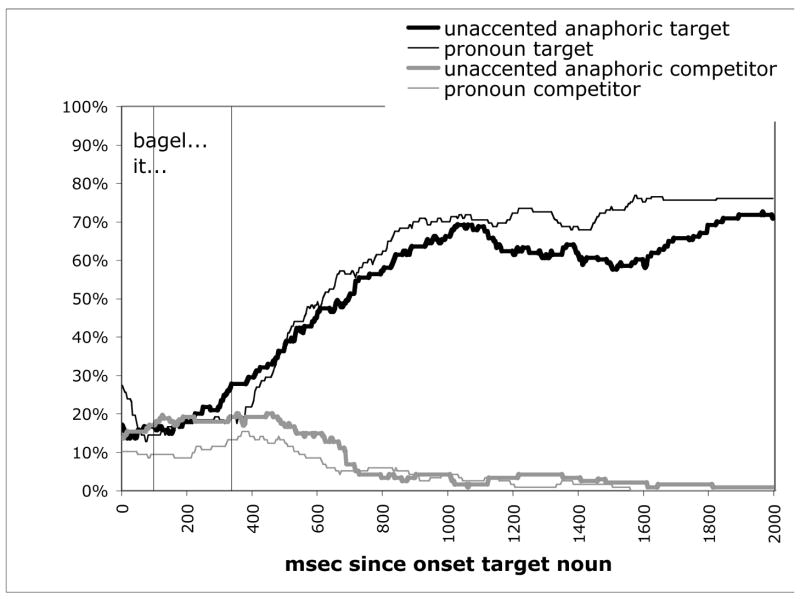
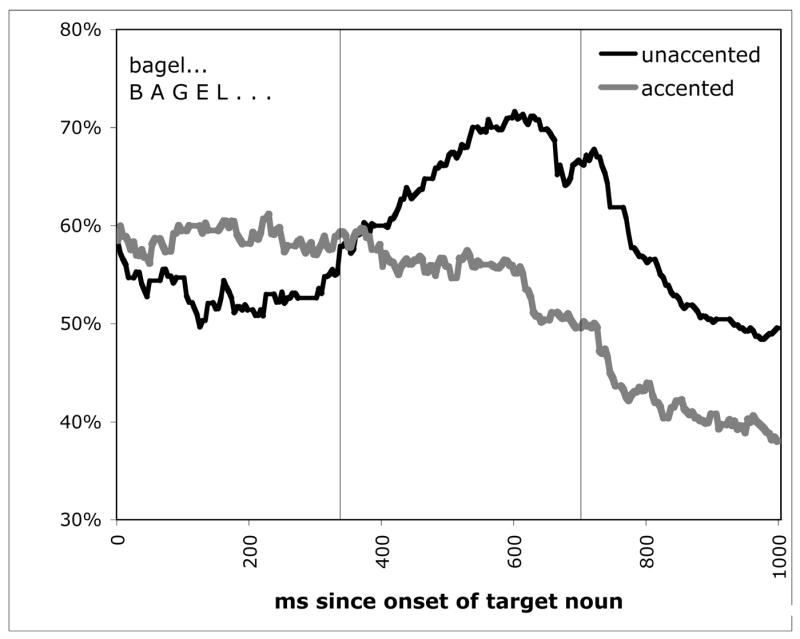
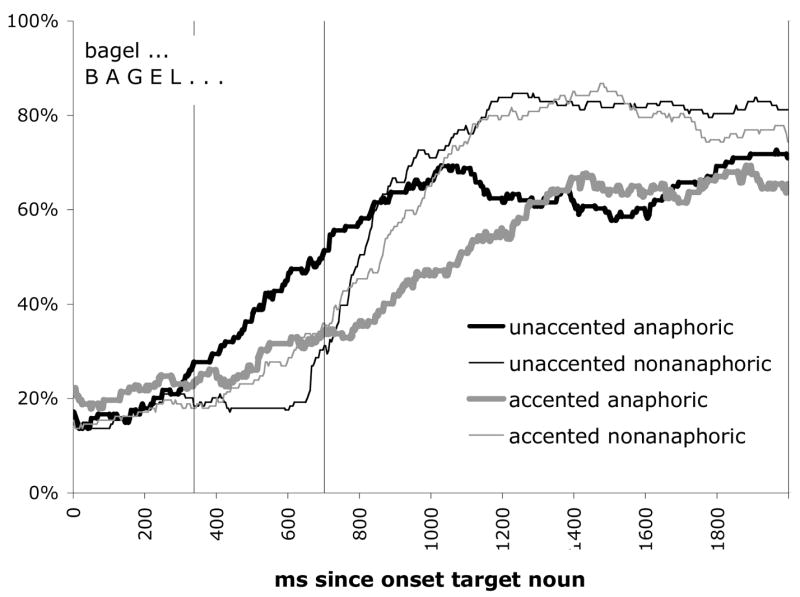
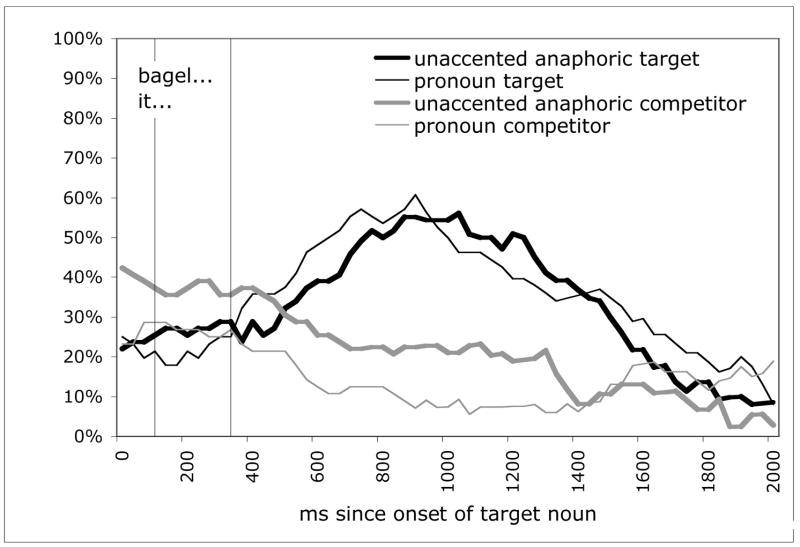
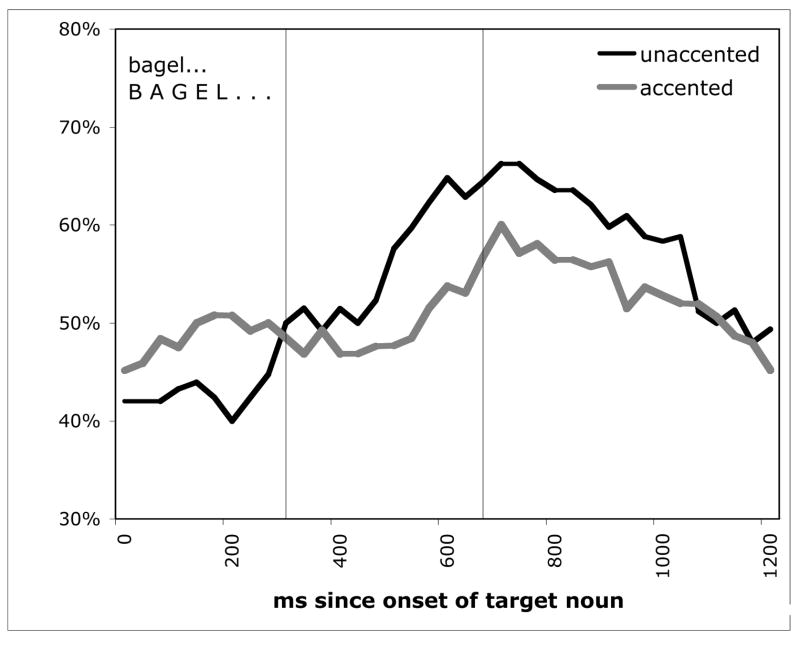
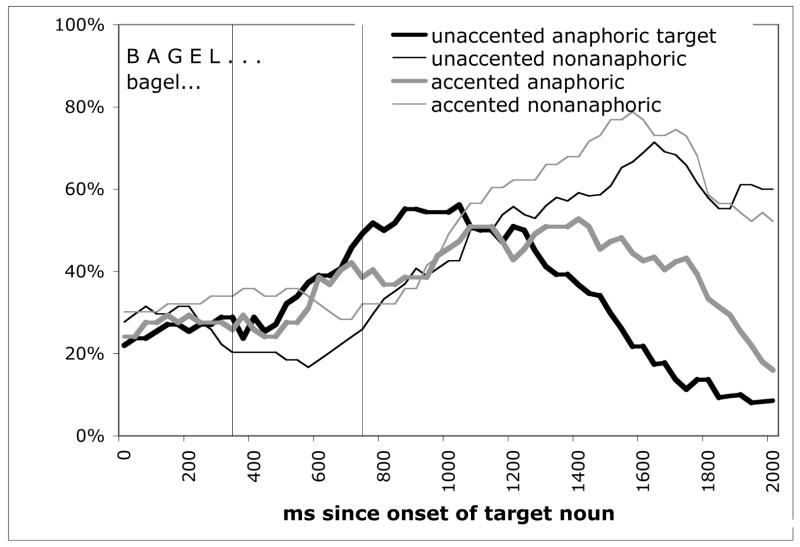
Two eye-tracking experiments examine whether adults and 4- and 5-year-old children use the presence or absence of accenting to guide their interpretation of noun phrases (e.g., the bacon) with respect to the discourse context. Unaccented nouns tend to refer to contextually accessible referents, while accented variants tend to be used for less accessible entities. Experiment 1 confirms that accenting is informative for adults, who show a bias toward previously-mentioned objects beginning 300 ms after the onset of unaccented nouns and pronouns. But contrary to findings in the literature, accented words produced no observable bias. In Experiment 2, 4 and 5 year olds were also biased toward previously-mentioned objects with unaccented nouns and pronouns. This builds on findings of limits on children's on-line reference comprehension [Arnold, J. E., Brown-Schmidt, S., & Trueswell, J. C. (2007). Children's use of gender and order-of-mention during pronoun comprehension. Language and Cognitive Processes], showing that children's interpretation of unaccented nouns and pronouns is constrained in contexts with one single highly accessible object.
Figures
References
-
- Allopenna PD, Magnuson JS, Tanenhaus MK. Tracking the time course of spoken word recognition using eye movements: Evidence for continuous mapping models. Journal of Memory and Language. 1998;38:419–439.
-
- Arnold JE. Reference form and discourse patterns (Doctoral dissertation, Stanford University, 1998) Dissertation Abstracts International. 1998;59:2950.
-
- Arnold JE. Reference production: Production-internal and addressee-oriented processes. Language and Cognitive Processes in press.
-
- Arnold JE, Brown-Schmidt S, Trueswell JC. Children’s use of gender and order-of-mention during pronoun comprehension. Language and Cognitive Processes in press.
-
- Arnold JE, Eisenband JG, Brown-Schmidt S, Trueswell JC. The rapid use of gender information: Evidence of the time-course of pronoun resolution from eyetracking. Cognition. 2000;76:B13–B26. - PubMed
MeSH terms
Grants and funding
LinkOut - more resources
Full Text Sources
