. 2008 May;147(1):179-87.
doi: 10.1104/pp.108.118430. Epub 2008 Mar 21.

Amino acid substitutions in homologs of the STAY-GREEN protein are responsible for the green-flesh and chlorophyll retainer mutations of tomato and pepper

Affiliations

Amino acid substitutions in homologs of the STAY-GREEN protein are responsible for the green-flesh and chlorophyll retainer mutations of tomato and pepper

Cornelius S Barry et al. Plant Physiol. 2008 May.

Abstract

Color changes often accompany the onset of ripening, leading to brightly colored fruits that serve as attractants to seed-dispersing organisms. In many fruits, including tomato (Solanum lycopersicum) and pepper (Capsicum annuum), there is a sharp decrease in chlorophyll content and a concomitant increase in the synthesis of carotenoids as a result of the conversion of chloroplasts into chromoplasts. The green-flesh (gf) and chlorophyll retainer (cl) mutations of tomato and pepper, respectively, are inhibited in their ability to degrade chlorophyll during ripening, leading to the production of ripe fruits characterized by both chlorophyll and carotenoid accumulation and are thus brown in color. Using a positional cloning approach, we have identified a point mutation at the gf locus that causes an amino acid substitution in an invariant residue of a tomato homolog of the STAY-GREEN (SGR) protein of rice (Oryza sativa). Similarly, the cl mutation also carries an amino acid substitution at an invariant residue in a pepper homolog of SGR. Both GF and CL expression are highly induced at the onset of fruit ripening, coincident with the ripening-associated decline in chlorophyll. Phylogenetic analysis indicates that there are two distinct groups of SGR proteins in plants. The SGR subfamily is required for chlorophyll degradation and operates through an unknown mechanism. A second subfamily, which we have termed SGR-like, has an as-yet undefined function.


Figures
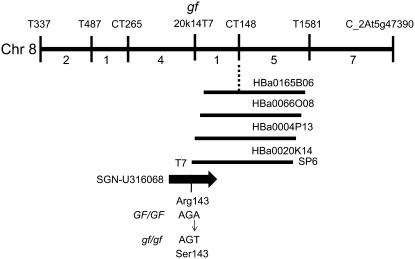
Figure 1.
Figure 1.
Structure of the gf locus. Genetic map of the gf locus, located on the long arm of tomato chromosome 8. Genetic markers and the number of recombinant individuals between adjacent markers from a total of 564 F2 plants are shown. The BAC clone HBa0165B06 has been fully sequenced and contains the genetic marker CT148. HBa0165B06 has been placed in a contig with three additional BAC clones. The genetic marker 20k14T7, derived from HBA0020K14, cosegregated with the gf mutant phenotype. 20k14T7 is identical in sequence to the unigene SGN-U316068 that has homology to the SGR protein of rice. Sequence analysis of this gene from wild type (GF/GF) and mutant (gf/gf) revealed a single A→T nucleotide change resulting in an amino acid substitution.
Figure 2.
Figure 2.
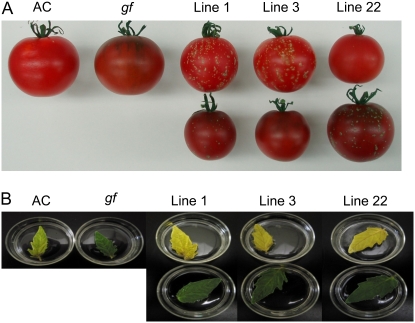
Complementation of the gf mutation. A, Fruit phenotype of segregating T1 progeny from three independent transgenic lines expressing a CaMV 35SGF construct in the gf/gf mutant background. Fruit in the top image contain the transgene and fruit in the bottom image have segregated out the transgene. Fruit of wild type (AC) and the gf mutant are shown for comparison. Photographs were taken at 10 d postbreaker. B, Leaf degreening assay in segregating T1 progeny described in A. Expanding leaves were detached and floated on water in darkness for 2 weeks.
Figure 3.
Figure 3.
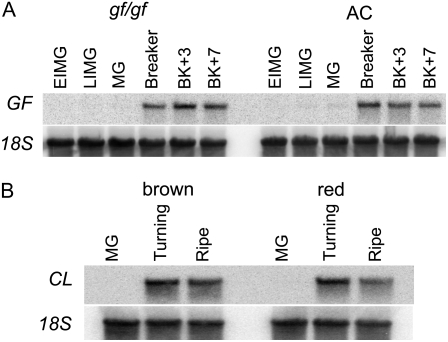
Ripening-related expression of GF and CL in tomato and pepper. A, GF expression during fruit development and ripening in gf/gf and wild-type (AC) genetic backgrounds. Northern-blot analysis of RNA extracted from tomato fruit harvested at the early immature green (EIMG), late immature green (LIMG), mature green (MG), breaker, breaker + 3 d (BK+3) and breaker +7 d (BK+7) stages of development. The term breaker reflects the onset of fruit ripening in tomato. B, CL expression during fruit ripening in brown (cl/cl) and red (CL/CL) genetic backgrounds. Northern-blot analysis of RNA extracted from pepper fruit harvested at the MG, turning, and ripe stages of development. Turning represents the onset of fruit ripening in pepper.
Figure 4.
Figure 4.
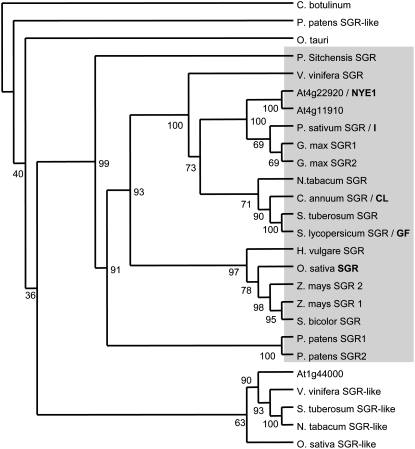
Phylogenetic analysis of the SGR family. Protein alignments based using N terminus deleted amino acid sequences were performed using ClustalX. Phylogenetic relationships between the proteins were analyzed using the PHYLIP 3.67 suite of programs (http://evolution.genetics.washington.edu/phylip.html). The maximum parsimony, distance matrix, and likelihood methods of the Protpars and Seqboot programs were utilized to estimate phylogenies. A nonrooted tree phylogenetic tree was generated using Consense and the Treeview package using the Clostridium botulinum protein as the outgroup. The single most parsimonious tree obtained in a heuristic search following 100 random sequence addition replicates is shown. Bootstrap percentage supports are indicated at the branches of the tree. Sequence identifiers and accession numbers are described in “Materials and Methods.” Proteins shown in bold indicate where a mutant phenotype has been described.
Figure 5.
Figure 5.
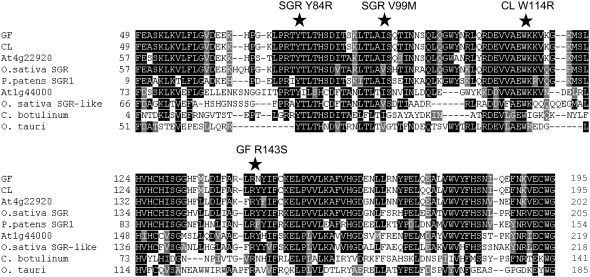
Amino acid alignment of SGR homologs. Protein alignments based on the highly conserved central core of the SGR proteins were performed using ClustalW. Conserved amino acids are indicated by shaded squares. Highly conserved amino acids that, when mutated, give rise to mutant phenotypes (rice, Y84C and V99M; pepper, W114R; and tomato, R143S) are indicated by stars. Accession numbers are as follows (in parentheses): GF (EU414632); CL (EU414631); rice SGR (EAZ09856); P. patens SGR1 (EDQ70701); rice SGR-like (NP_001054370); Clostridium botulinum (YP_001391480); Oryza tauri (CAL56489). The Arabidopsis sequences At1g44000 and At4g22920 are based on TAIR annotations (http://www.arabidopsis.org).

References

    1. Akhtar MS, Goldschmidt EE, John I, Rodoni S, Matile P, Grierson D (1999) Altered patterns of senescence and ripening in gf, a stay-green mutant of tomato (Lycopersicon esculentum Mill.). J Exp Bot 50 1115–1122
    1. Armstead I, Donnison I, Aubry S, Harper J, Hortensteiner S, James C, Mani J, Moffet M, Ougham H, Roberts L, et al (2006) From crop to model to crop: identifying the genetic basis of the staygreen mutation in the Lolium/Festuca forage and amenity grasses. New Phytol 172 592–597 - PubMed
    1. Armstead I, Donnison I, Aubry S, Harper J, Hortensteiner S, James C, Mani J, Moffet M, Ougham H, Roberts L, et al (2007) Cross-species identification of Mendel's/locus. Science 315 73. - PubMed
    1. Aubry S, Mani J, Hörtensteiner S (2008) Stay-green protein, defective in Mendel's green cotyledon mutant, acts independent and upstream of pheophorbide a oxygenase in the chlorophyll catabolic pathway. Plant Mol Biol (in press) - PubMed
    1. Barry CS, McQuinn RP, Thompson AJ, Seymour GB, Grierson D, Giovannoni JJ (2005) Ethylene insensitivity conferred by the Green-ripe and Never-ripe 2 ripening mutants of tomato. Plant Physiol 138 267–275 - PMC - PubMed

Publication types

LinkOut - more resources