


Amino acid substitutions in homologs of the STAY-GREEN protein are responsible for the green-flesh and chlorophyll retainer mutations of tomato and pepper
- PMID: 18359841
- PMCID: PMC2330295
- DOI: 10.1104/pp.108.118430
Amino acid substitutions in homologs of the STAY-GREEN protein are responsible for the green-flesh and chlorophyll retainer mutations of tomato and pepper
Abstract
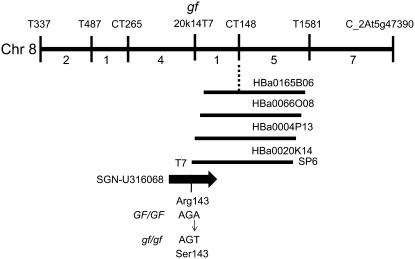
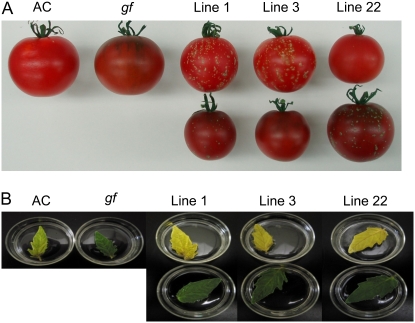
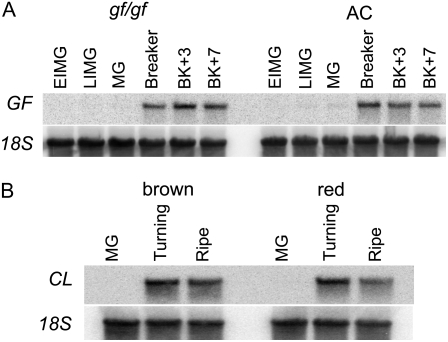
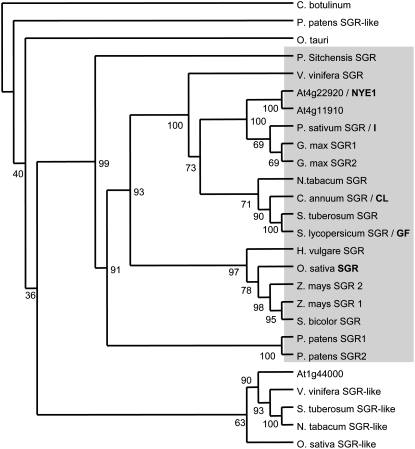
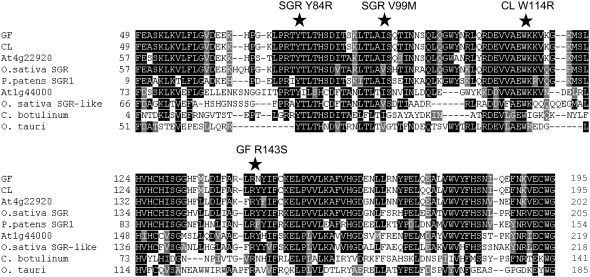
Color changes often accompany the onset of ripening, leading to brightly colored fruits that serve as attractants to seed-dispersing organisms. In many fruits, including tomato (Solanum lycopersicum) and pepper (Capsicum annuum), there is a sharp decrease in chlorophyll content and a concomitant increase in the synthesis of carotenoids as a result of the conversion of chloroplasts into chromoplasts. The green-flesh (gf) and chlorophyll retainer (cl) mutations of tomato and pepper, respectively, are inhibited in their ability to degrade chlorophyll during ripening, leading to the production of ripe fruits characterized by both chlorophyll and carotenoid accumulation and are thus brown in color. Using a positional cloning approach, we have identified a point mutation at the gf locus that causes an amino acid substitution in an invariant residue of a tomato homolog of the STAY-GREEN (SGR) protein of rice (Oryza sativa). Similarly, the cl mutation also carries an amino acid substitution at an invariant residue in a pepper homolog of SGR. Both GF and CL expression are highly induced at the onset of fruit ripening, coincident with the ripening-associated decline in chlorophyll. Phylogenetic analysis indicates that there are two distinct groups of SGR proteins in plants. The SGR subfamily is required for chlorophyll degradation and operates through an unknown mechanism. A second subfamily, which we have termed SGR-like, has an as-yet undefined function.
Figures
References
-
- Akhtar MS, Goldschmidt EE, John I, Rodoni S, Matile P, Grierson D (1999) Altered patterns of senescence and ripening in gf, a stay-green mutant of tomato (Lycopersicon esculentum Mill.). J Exp Bot 50 1115–1122
-
- Armstead I, Donnison I, Aubry S, Harper J, Hortensteiner S, James C, Mani J, Moffet M, Ougham H, Roberts L, et al (2006) From crop to model to crop: identifying the genetic basis of the staygreen mutation in the Lolium/Festuca forage and amenity grasses. New Phytol 172 592–597 - PubMed
-
- Armstead I, Donnison I, Aubry S, Harper J, Hortensteiner S, James C, Mani J, Moffet M, Ougham H, Roberts L, et al (2007) Cross-species identification of Mendel's/locus. Science 315 73. - PubMed
-
- Aubry S, Mani J, Hörtensteiner S (2008) Stay-green protein, defective in Mendel's green cotyledon mutant, acts independent and upstream of pheophorbide a oxygenase in the chlorophyll catabolic pathway. Plant Mol Biol (in press) - PubMed
Publication types
MeSH terms
Substances
LinkOut - more resources
Full Text Sources
Other Literature Sources
Molecular Biology Databases
