


Adverse drug reaction reporting in New Zealand: implications for pharmacists
- PMID: 18360558
- PMCID: PMC1661625
Item in Clipboard
Adverse drug reaction reporting in New Zealand: implications for pharmacists
Ther Clin Risk Manag.
2005 Sep.
Abstract
Adverse drug reactions (ADRs) are a significant cause of morbidity and mortality and contribute to the incidence of adverse events, resulting in increased healthcare costs. Healthcare providers need to understand their role and responsibility in the detection, management, documentation, and reporting of ADRs, all essential activities for optimizing patient safety. The purpose of this article is to summarize findings from important ADR literature reviews and describe the components, and extent of participation, of the national ADR reporting program available in New Zealand. A series of recommendations to increase the detection of ADRs is also described.
Figures
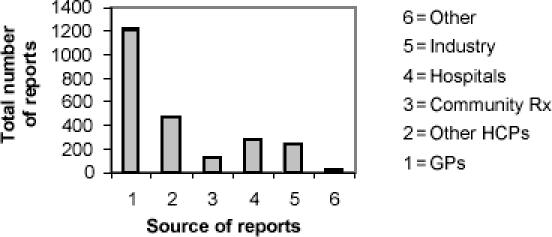
Sources of adverse drug reaction (ADR) reports in New Zealand, January–June 2004. Abbreviations: GPs, general practitioners; HCPs, healthcare professionals; Rx, pharmacists.
References
-
- Andrew I, Baker S, Chalmers A. Implementing a system for tackling under-reporting of adverse drug reactions within a district general hospital. Int J Pharm Pract. 2001;001(9 Suppl):R71.
-
- [ASHP] American Society of Health-System Pharmacists. 1995. Guidelines on adverse drug reaction monitoring and reporting [online]. Accessed Nov 2004. URL: www.ashp.org/bestpractices/MedMis/MedMis_Gdl_ADR.pdf
-
- Bates DW. Drugs and adverse drug reactions. How worried should we be? [editorial] JAMA. 1998;279:1216–17. - PubMed
-
- Brewer T, Colditz GA. Postmarketing surveillance and adverse drug reactions: current perspectives and future needs. JAMA. 1999;28:824–9. - PubMed
-
- Briant R, Ali W, Lay-Yee R, et al. Representative case series from public hospital admissions 1998. I: drug and related therapeutic adverse events. NZ Med J. 2004. [online]. Accessed Sep 2004. URL: http://www.nzma.org.nz/journal/117-1188/747/256d96007f6b4e/$FILE/Improvi... - PubMed
LinkOut - more resources
Full Text Sources
Research Materials