. 2008 Jun;76(6):2448-55.
doi: 10.1128/IAI.00767-07. Epub 2008 Mar 24.

Immunization with a single dose of a microencapsulated Brucella melitensis mutant enhances protection against wild-type challenge

Affiliations

Immunization with a single dose of a microencapsulated Brucella melitensis mutant enhances protection against wild-type challenge

Angela M Arenas-Gamboa et al. Infect Immun. 2008 Jun.

Abstract

The development of safe and efficacious immunization systems to prevent brucellosis is needed to overcome the disadvantages of the currently licensed vaccine strains that restrict their use in humans. Alginate microspheres coated with a protein of the parasite Fasciola hepatica (vitelline protein B [VpB]) and containing live Brucella melitensis attenuated mutant vjbR::Tn5 (BMEII1116) were evaluated for vaccine efficacy and immunogenicity in mice. A single immunization dose in BALB/c mice with the encapsulated vjbR mutant improved protection against wild-type B. melitensis 16M challenge compared to the nonencapsulated vaccine strain (P < 0.05). The encapsulated mutant was also shown to induce a sustained elevation of Immunoglobulin G levels. Cytokine secretion from spleen cells of mice vaccinated with the encapsulated vjbR::Tn5 revealed elevated secretion of gamma interferon and interleukin-12, but no interleukin-4, suggesting an induction of a T helper 1 response reflecting the enhanced immunity associated with microencapsulation. Together, these results suggest that microencapsulation of live attenuated organisms offers the ability to increase the efficacy of vaccine candidates.


Figures
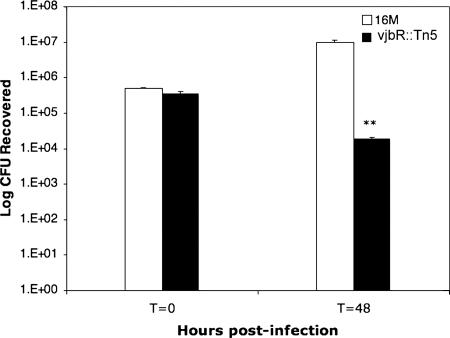
FIG. 1.
FIG. 1.
Survival of the B. melitensis vjbR::Tn5 mutant in J774A.1 macrophages. Wild-type strain 16M and the B. melitensis mutant vjbR::Tn5 were used to infect J774A.1 macrophages at a multiplicity of infection of 1:100. After 30 min of incubation, followed by 1 h of treatment with gentamicin, infected macrophages were further incubated for 0 or 48 h. Treated cells were lysed, serially diluted, and plated on TSA or TSA-kanamycin plates for CFU determination. The values are the means of three independent experiments ± the standard deviation. Differences in macrophage colonization by wild-type 16M and the vjbR::Tn5 mutant were analyzed by Student's t test (**, P < 0.005).
FIG. 2.
FIG. 2.
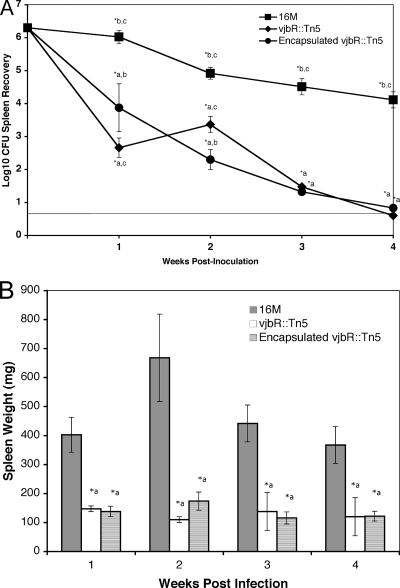
Kinetics of clearance and spleen weights in BALB/c mice during B. melitensis vjbR::Tn5 infection. Each BALB/c mouse (n = five animals/time point) was infected with 2 × 10⁶ CFU of wild-type 16M, the vjbR::Tn5 mutant or encapsulated vjb::Tn5. (A) At 1, 2, 3, and 4 weeks postinfection, mice were euthanized, and the spleens were assessed for bacterial colonization. The solid line represents the limit of detection, which is ≥5 CFU. (B) Spleens from the same mice and at the same time points were weighed to determine the degree of inflammation conferred by the mutant. For both sets of data, values are the means + SEM. Differences in colonization or spleen weights were compared by ANOVA followed by Tukey's honestly significant difference posttest to compare all groups to each other. *, P < 0.05, with a, b, and c indicating the M16, nonencapsulated vjb::Tn5 mutant, and encapsulated vjb::Tn5 mutant groups, respectively.
FIG. 3.
FIG. 3.
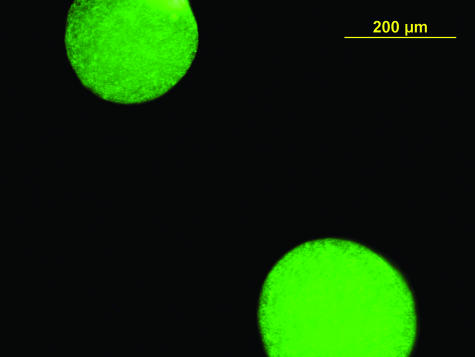
Fluorescence microscopy image of alginate microspheres loaded with wild-type 16M. B. melitensis wild-type 16M was transformed with a GFP-expressing plasmid and encapsulated into alginate microspheres. The bacterial presence inside the capsule and sphere morphology was assessed via fluorescence microscopy.
FIG. 4.
FIG. 4.
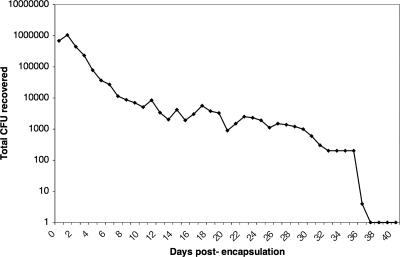
Kinetics of bacterial release in vitro from alginate microcapsules. Alginate microbeads were prepared containing 109 CFU of vjbR::Tn5 mutant/ml, and 1 ml of capsules was resuspended in peptone saline. Every day, the buffer was completely removed and new peptone saline was added. Aliquots (100 μl) of the buffer were serially diluted and plated onto TSA-kanamycin plates to determine the number of bacteria released into the buffer. The solid line represents the limit of detection, which is ≥5 CFU.
FIG. 5.
FIG. 5.
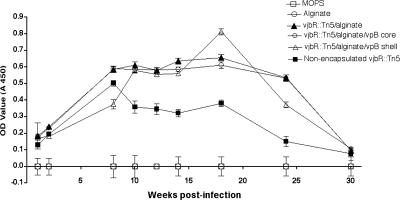
IgG anti-Brucella antibodies in serum from mice immunized with vjbR::Tn5 mutant. BALB/c mice (n = 10) were inoculated intraperitoneally with 105 CFU of either nonencapsulated B. melitensis vjbR::Tn5 mutant, encapsulated B. melitensis (vjbR::Tn5/alginate), encapsulated B. melitensis vjbR::Tn5 with VpB in the core (vjbR::Tn5/alginate/VpB/core), or encapsulated B. melitensis vjbR::Tn5 mutant with VpB in the shell (vjbR::Tn5/alginate/VpB/shell). Control groups received empty capsules or MOPS. At 0, 2, 4, 8, 10, 12, 14, 18, 24, and 30 weeks postvaccination, serum samples were collected and used at a 1:1,000 dilution for IgG determination by ELISA. The results are shown as means ± the standard deviations of the absorbance at A450.
FIG. 6.
FIG. 6.
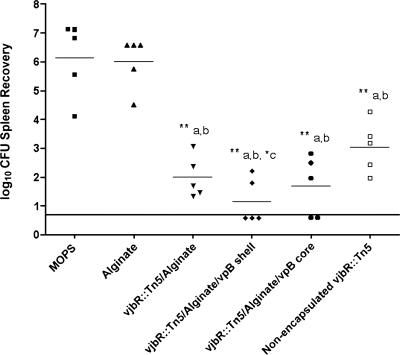
Immunization efficacy of B. melitensis vjbR::Tn5 vaccine formulations. BALB/c mice were immunized intraperitoneally with 105 CFU of either nonencapsulated B. melitensis vjbR::Tn5 mutant, encapsulated B. melitensis vjbR::Tn5/alginate, encapsulated B. melitensis vjbR::Tn5 mutant with VpB in the core (vjbR::Tn5/alginate/VpB core), or encapsulated B. melitensis vjbR::Tn5 mutant with VpB in the shell (vjbR::Tn5/alginate/VpB shell). Control groups received empty capsules or MOPS. After 31 weeks, mice were challenged intraperitoneally with 105 CFU of wild-type 16M. At 1 week postchallenge, mice were euthanized, spleens were harvested, and the bacterial load was determined. Values are reported as the log10 recovery of 16M from spleens, with individual mice in each treatment group represented. The solid line represents the limit of detection, which is ≥5 CFU. Differences in colonization between nonencapsulated and encapsulated groups were determined by ANOVA followed by Tukey's honestly significant difference posttest to compare all groups to each other. *, P < 0.05, and **, P < 0.005, with lowercase letters indicating the groups as follows: a, MOPS group; b, alginate group; c, vjb::Tn5/alginate group, d, vjb::Tn5/alginate/VpB shell group; e, vjb::Tn5/alginate/VpB core group; and f, nonencapsulated vjb::Tn5 group.
FIG. 7.
FIG. 7.
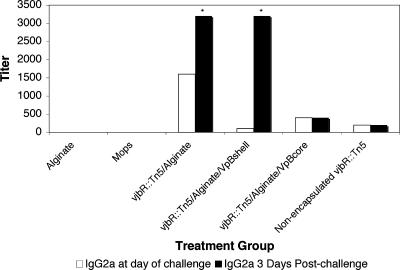
IgG2a recall response of B. melitensis vjbR::Tn5 vaccine formulations. BALB/c mice were immunized intraperitoneally with 105 CFU of either nonencapsulated B. melitensis vjbR::Tn5 mutant, encapsulated B. melitensis vjbR::Tn5/alginate mutant, encapsulated B. melitensis vjbR::Tn5 mutant with VpB in the core (vjbR::Tn5/alginate/VpB/core), or encapsulated B. melitensis vjbR::Tn5 mutant with VpB in the shell (vjbR::Tn5/alginate/VpB/shell). Control groups received empty capsules or MOPS. After 31 weeks, mice were challenged intraperitoneally with 105 CFU wild-type 16M. At 3 days postchallenge mice were bled, and IgG2a titers were determined by ELISA. Differences in responses between the nonencapsulated and the encapsulated groups were determined by Student's t test, comparing the changes in antibody titer on the day of challenge to that at 3 days postchallenge for each individual treatment group (*, P < 0.05).
FIG. 8.
FIG. 8.
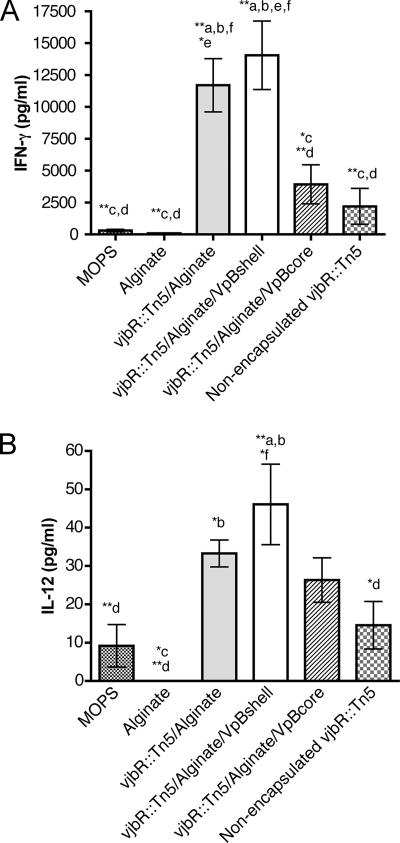
Production of cytokines in stimulated spleen cells from vjbR::Tn5-vaccinated BALB/c mice. Mice were vaccinated with 105 CFU of either nonencapsulated B. melitensis vjbR::Tn5 mutant, encapsulated B. melitensis vjbR::Tn5/alginate mutant, encapsulated B. melitensis vjbR::Tn5 mutant with VpB in the core (vjbR::Tn5/alginate/VpBcore), or encapsulated B. melitensis vjbR::Tn5 mutant with VpB in the shell (vjbR::Tn5/alginate/VpBshell). Control groups received empty capsules or MOPS. At 31 weeks postvaccination, mice were euthanized, and splenocytes were harvested and stimulated with heat-inactivated B. melitensis 16M or medium alone as a control. IFN-γ (A) and IL-12p70 (B) production (pg/ml) was detected after 72 h of stimulation by using a multiplex suspension array system (Bioplex). Cytokine production was expressed as the mean cytokine concentration ± SEM for each group of mice. Differences in colonization between the nonencapsulated and encapsulated groups were determined by ANOVA followed by Tukey's honestly significant difference posttest comparing all groups to each other. *, P < 0.05, and **, P < 0.01, with lowercase letters indicating the groups as follows: a, MOPS group; b, alginate group; c, vjb::Tn5/alginate group, d, vjb::Tn5/alginate/VpB shell group; e, vjb::Tn5/alginate/VpB core group; and f, nonencapsulated vjb::Tn5 group.
FIG. 9.
FIG. 9.
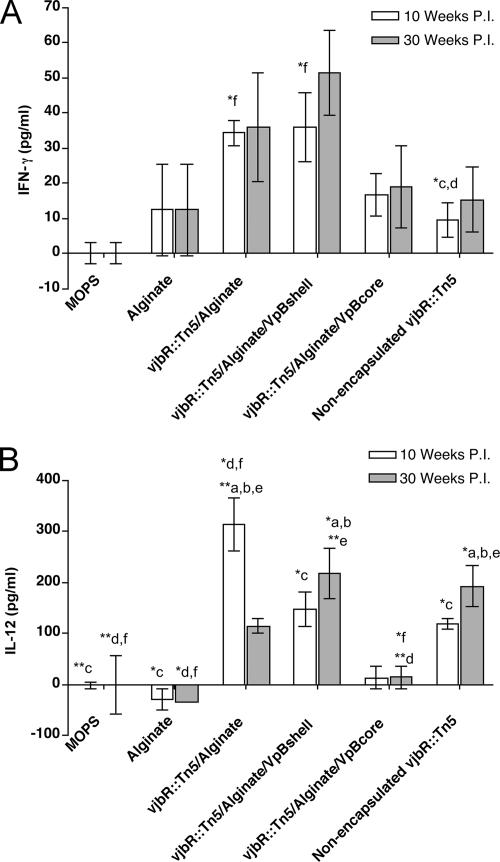
Cytokine production in the sera of BALB/c mice immunized with the vjbR::Tn5 mutant. Mice were vaccinated with 105 CFU of either nonencapsulated B. melitensis vjbR::Tn5 mutant, encapsulated B. melitensis vjbR::Tn5/alginate mutant, encapsulated B. melitensis vjbR::Tn5 mutant with VpB in the core (vjbR::Tn5/alginate/VpBcore), or encapsulated B. melitensis vjbR::Tn5 mutant with VpB in the shell (vjbR::Tn5/alginate/VpBshell). Control groups received empty capsules or MOPS. Mice were bled at 0, 10, and 30 weeks postvaccination. IFN-γ (A) or IL-12 (B) determination from the serum was performed by ELISA. The results are represented as the mean cytokine concentration ± SEM for each group of mice. Differences in colonization between the nonencapsulated and encapsulated groups were determined by ANOVA followed by Tukey's honestly significant difference posttest comparing all groups to each other. *, P < 0.05, and **, P < 0.01, with lowercase letters indicating the groups as follows: a, MOPS group; b, alginate group; c, vjb::Tn5/alginate group, d, vjb::Tn5/ alginate/VpB shell group; e, vjb::Tn5/alginate/VpB core group; and f, nonencapsulated vjb::Tn5 group.

References

    1. Abraham, S. M., R. F. Vieth, and D. J. Burgess. 1996. Novel technology for the preparation of sterile alginate-poly-l-lysine microcapsules in a bioreactor. Pharm. Dev. Technol. 163-68. - PubMed
    1. Aldwell, F. E., M. A. Baird, C. E. Fitzpatrick, A. D. McLellan, M. L. Cross, M. R. Lambeth, and G. S. Buchan. 2005. Oral vaccination of mice with lipid-encapsulated Mycobacterium bovis BCG: anatomical sites of bacterial replication and immune activity. Immunol. Cell Biol. 83549-553. - PubMed
    1. Allen, C. A., L. G. Adams, and T. A. Ficht. 1998. Transposon-derived Brucella abortus rough mutants are attenuated and exhibit reduced intracellular survival. Infect. Immun. 661008-1016. - PMC - PubMed
    1. Ashford, D. A., J. di Pietra, J. Lingappa, C. Woods, H. Noll, B. Neville, R. Weyant, S. L. Bragg, R. A. Spiegel, J. Tappero, and B. A. Perkins. 2004. Adverse events in humans associated with accidental exposure to the livestock brucellosis vaccine RB51. Vaccine 223435-3439. - PubMed
    1. Baldwin, C. L., and M. Parent. 2002. Fundamentals of host immune response against Brucella abortus: what the mouse model has revealed about control of infection. Vet. Microbiol. 90367-382. - PubMed

Publication types

MeSH terms

LinkOut - more resources