. 2008 Apr 1;105(13):5201-6.
doi: 10.1073/pnas.0801003105. Epub 2008 Mar 24.

IL-15 as a mediator of CD4+ help for CD8+ T cell longevity and avoidance of TRAIL-mediated apoptosis

Affiliations

IL-15 as a mediator of CD4+ help for CD8+ T cell longevity and avoidance of TRAIL-mediated apoptosis

Sangkon Oh et al. Proc Natl Acad Sci U S A. .

Abstract

CD4+ helper T cells contribute to the induction and maintenance of antigen-specific CD8+ T cells. Their absence results in short-lived antigen-specific CD8+ T cells and defective secondary CD8+ T cell responses because of tumor necrosis factor-related apoptosis-inducing ligand (TRAIL)-mediated apoptosis. Here, we show that IL-15 codelivered with vaccines can overcome CD4+ T cell deficiency for promoting longevity of antigen-specific CD8+ T cells and avoidance of TRAIL-mediated apoptosis. In both priming and secondary responses, IL-15 down-regulates proapoptotic Bax, an intermediate in TRAIL-mediated apoptosis, and increases anti-apoptotic Bcl-X(L) in CD8+ T cells. Thus, IL-15 is sufficient to mimic CD4+ T cell help. Antigen-specific CD4+ T cells induce dendritic cells (DCs) to produce IL-15. IL-15 is also necessary for optimal help, because helper cells do not deliver effective help through IL-15-/- DCs. Therefore, IL-15 codelivered with vaccines can overcome CD4+ helper T cell deficiency for induction of functionally efficient CD8+ T cells and maintenance of CD8+ cytotoxic T lymphocytes (CTLs), and IL-15 is probably one of the natural mediators of help. These findings suggest new vaccine strategies against infections and cancers, especially in individuals with CD4-deficiency.


Conflict of interest statement

The authors declare no conflict of interest.

Figures
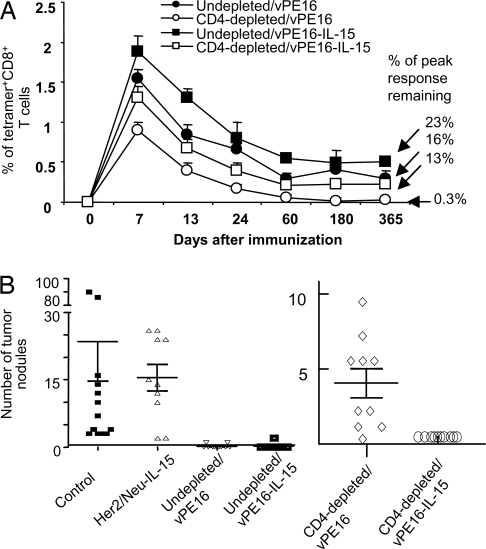
Fig. 1.
Fig. 1.
IL-15 codelivered with antigen can substitute for CD4+ helper T cells to induce long lasting memory CD8+ T cells that are functional in vivo. (A) Intact or CD4-depleted mice were immunized s.c. with 2–4 × 10⁶ pfu of vPE16 or vPE16-IL-15. Immunization dates were staggered so that all time points could be assayed on the same day for comparison. The frequency of P18-I10-specific CD8+ T cells measured over time by staining pooled spleen cells of 4–5 mice with anti-CD8 and H-2Dd-P18-I10 tetramer (mean ± SD of two experiments with similar results). As controls, in splenocytes from unimmunized animals, the frequency of tetramer positive CD8+ T cells was <0.01%. (B) IL-15 codelivered with vaccines can substitute for CD4 help to induce CD8+ T cells that prevent tumor growth in vivo. CD4-depleted and undepleted female BALB/c mice were immunized s.c. with 2–4 × 10⁶ pfu of vPE16 or vPE16-IL-15. Four weeks after priming, 10 mice in each group received 2 × 10⁵ 15–12RM tumor cells per mouse iv, and the number of tumor nodules in the lungs was counted 30 days after the challenge. The CD4-depleted/vPE16 group showed significantly more lung nodules than the undepleted mice immunized with vPE16 (P < 0.0008; Wilcoxon test) and the CD4-depleted mice given vPE16-IL-15 (P < 0.0002), which were completely protected. Two independent experiments showed similar results.
Fig. 2.
Fig. 2.
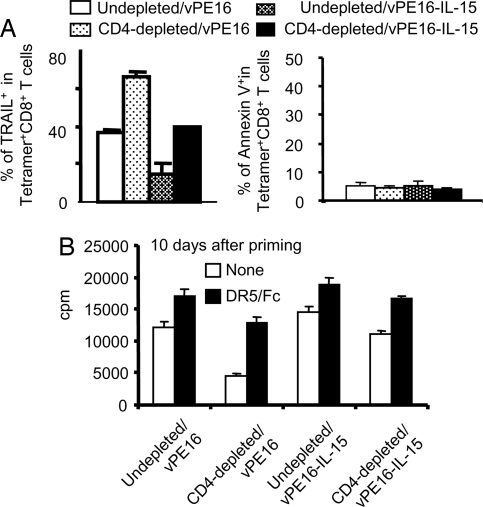
Antigen-specific CD8+ T cells induced by the vaccines codelivered with IL-15 express less TRAIL. (A) CD4+ T cell-depleted and undepleted animals were immunized s.c. with 2–4 × 10⁶ pfu of vPE16 or vPE16-IL-15. On day 5–7 after priming, pooled spleen cells of 4–5 mice were stained with anti-CD8, H-2Dd-P18-I10 tetramer, and anti-TRAIL antibody. TRAIL+ or annexin V+ cells were assessed on gated tetramer+ CD8+ T cells. Three repeat experiments showed similar results. (B) Antigen-specific CD8+ T cells were purified from the pooled spleens of 4–5 mice on day 10 after the immunization. 2 × 10⁵ CD8+ T cells were stimulated with 4 × 10⁵ syngeneic splenocytes pulsed with 0.001 μM P18-I10. On day 3, 1 μCi per well 3H-Thymidine was added overnight before harvesting. Five micrograms per well of anti-DR5/Fc fusion protein or control Fc was added into the 96-well culture plates where indicated. Data are mean ± SD of triplicate assays, and two repeat experiments showed similar results. The differences between the DR5/Fc and control Fc-untreated groups in the CD4-depleted animals were significant (P < 0.002) by a Student's t test.
Fig. 3.
Fig. 3.
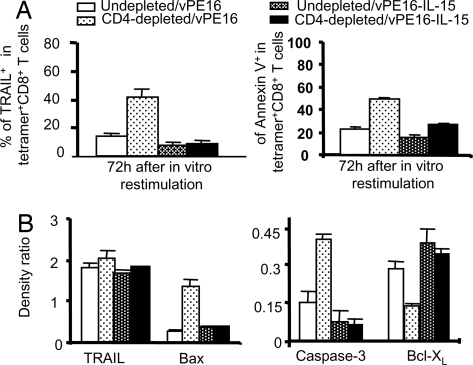
CD4+ help and IL-15 both induce longer-lived CD8+ T cells that escape apoptosis on secondary stimulation by up-regulating Bcl-XL and down-regulating Bax and surface TRAIL. (A) On day 10–12 after priming, purified antigen-specific CD8+ T cells from pooled spleen cells of 4–5 mice were restimulated with 0.001 μM P18-I10-pulsed splenocytes for 3 days in vitro. Data are mean ± SE of two independent experiments. CD8+ CTL from CD4-depleted mice immunized with vPE16-IL-15 expressed significantly less TRAIL (P < 0.001) and annexin V (P < 0.02) than those from mice immunized with vPE16. (B) Ten days after priming, mice were boosted with 2 × 10⁶ pfu vPE16 and P18-I10-specific CD8+ T cells from individual groups were purified. Cell lysates were analyzed by Western blot. Data show the density ratios from two separate experiments with similar results (mean ± SD). The difference in TRAIL expression between A and B reflects the difference between surface TRAIL in A and total TRAIL in B.
Fig. 4.
Fig. 4.
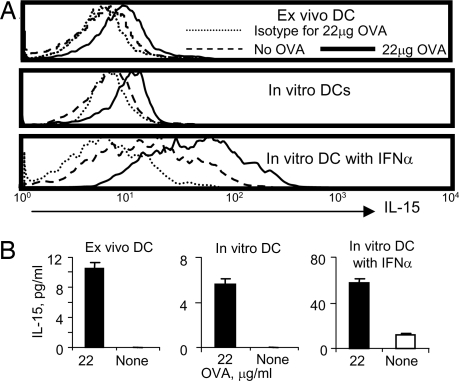
CD4+ T cells induce DCs to produce IL-15. (A) OT-II class II MHC restricted OVA-TCR transgenic mice were immunized with OVA in adjuvant. Splenocytes (5 × 10⁵ per well) were cultured in the presence or absence of 22 μg/ml of OVA for 16 h and stained with anti-CD11c and anti-IL-15 antibodies. IL-15 expression on CD11c positive cells was measured (Top). 5 × 10⁴ per well in vitro-cultured DCs loaded with 22 μg/ml of OVA (or not) were cultured with purified 5 × 10⁵ per well CD4+ T cells from OT-II transgenic mice without (Middle) or with (Bottom) 100 ng/ml IFNα. (B) IL-15 in the culture supernatants from the same three groups was measured by ELISA (bar graphs). Two repeated experiments showed similar results, and data in B represent mean ± SE.
Fig. 5.
Fig. 5.
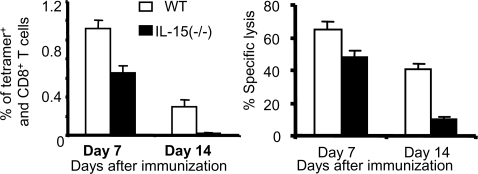
The ability of DCs presenting antigen to produce IL-15 is necessary for optimal delivery of CD4+ help to CD8+ T cells. Bone marrow-derived DCs from WT and IL-15−/− C57BL/6 mice were pulsed with SIINFEKL peptide (10 μM) and FCS as a source of helper epitopes and used to immunize WT C57BL/6 mice. On days 7 and 14 after priming, the frequency of peptide-specific CD8+ T cells in the pooled spleen of 3–5 mice was measured by tetramer staining (Left). CD8+ T cells at the same time points were also stimulated with syngeneic splenocytes pulsed with 0.001 μM peptide for 1 week, and lytic activity was measured against EL-4 target cells pulsed with 10 μM peptide in a 5h 51Cr release assay (Right).

References

    1. Sprent J, Surh CD. T cell memory. Annu Rev Immunol. 2002;20:551–579. - PubMed
    1. Kaech SM, Wherry EJ, Ahmed R. Effector and memory T-cell differentiation: Implications for vaccine development. Nat Rev Immunol. 2002;2:251–262. - PubMed
    1. Badovinac VP, Porter BB, Harty JT. Programmed contraction of CD8+ T cells after infection. Nat Immunol. 2002;3:619–626. - PubMed
    1. Van Stipdonk MJ, et al. Dynamic programming of CD8+ T lymphocyte responses. Nat Immunol. 2003;4:361–365. - PubMed
    1. Oh S, Berzofsky JA, Burke DS, Waldmann TA, Perera LP. Coadministration of HIV vaccine vectors with vaccinia viruses expressing IL-15 but not IL-2 induces long-lasting cellular immunity. Proc Natl Acad Sci USA. 2003;100:3392–3397. - PMC - PubMed

Publication types

MeSH terms