. 2008 Apr 1;105(13):5189-94.
doi: 10.1073/pnas.0706296105. Epub 2008 Mar 24.

Antigen kinetics determines immune reactivity

Affiliations

Antigen kinetics determines immune reactivity

Pål Johansen et al. Proc Natl Acad Sci U S A. .

Abstract

A current paradigm in immunology is that the strength of T cell responses is governed by antigen dose, localization, and costimulatory signals. This study investigates the influence of antigen kinetics on CD8 T cell responses in mice. A fixed cumulative antigen dose was administered by different schedules to produce distinct dose-kinetics. Antigenic stimulation increasing exponentially over days was a stronger stimulus for CD8 T cells and antiviral immunity than a single dose or multiple dosing with daily equal doses. The same was observed for dendritic cell vaccination, with regard to T cell and anti-tumor responses, and for T cells stimulated in vitro. In conclusion, stimulation kinetics per se was shown to be a separate parameter of immunogenicity. These findings warrant a revision of current immunization models and have implications for vaccine development and immunotherapy.


Conflict of interest statement

The authors declare no conflict of interest.

Figures

Fig. 1.
Fig. 1.
Exponentially increasing doses of both gp33 peptide and CpG enhance CD8 T cell response. C57BL/6 mice injected with 1 × 10⁶ TCR CD8 T cells (A) or C57BL/6 WT mice (B) were s.c. immunized with identical cumulative vaccine doses, but using the immunization schedules s1–s6 illustrated in C. s1, single dose of gp33 peptide (125 μg) and CpG (12.5 nmol); s2, equivalent doses of gp33 peptide and CpG; s3, exponentially decreasing doses of gp33 peptide and CpG; s4, exponentially increasing doses of gp33 peptide and CpG; s5, exponentially increasing doses of gp33 peptide and an initial single dose of CpG; s6, initial single dose of gp33 peptide and exponentially increasing doses of CpG; naive, untreated mice; LCMV, mice immunized with 250 pfu of LCMV i.v. on day 0. CD8 T cells were analyzed for IFN-γ production after in vitro restimulation of blood lymphocytes with gp33 peptide on day 6 (A), or day 8 (B). Values represent the means and SEM of four mice per group. The experiment was repeated twice.
Fig. 2.
Fig. 2.
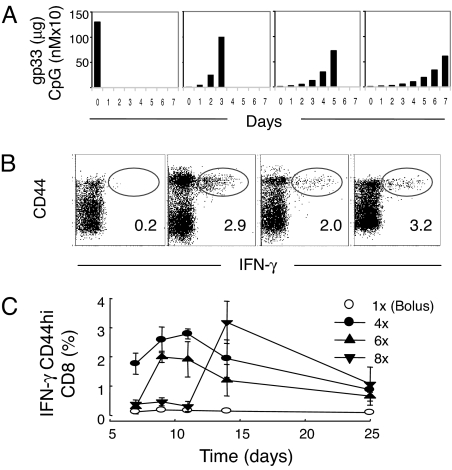
Four days of antigenic stimulation is necessary for optimal for CD8-T cell induction. C57BL/6 mice were immunized with fixed cumulative dose of 125 μg of gp33 peptide and 12.5 nmol of CpG according to different schedules (A) with peaks at day 0 (bolus), day 3, day 5, or day 7. At different time points thereafter, mice were bled, and the CD44 expression and the IFN-γ secretion of CD8 T cells after restimulation in vitro with gp33 peptide were analyzed (B and C). The FACS density blots illustrate the frequencies of CD44hi and IFN-γ-producing CD8-positive lymphocytes as measured by FACS at the peak of the immune response, and the numbers show the mean percentage of IFN-γ-producing CD44hi CD8+ T cells. The mean percentage of IFN-γ-producing CD44hi CD8+ T cells is also illustrated as a function of time (C). One of two similar experiments is shown (n = 3–4).
Fig. 3.
Fig. 3.
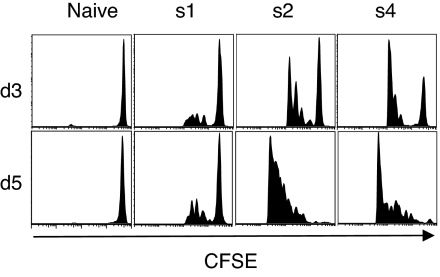
Exponential immunization favors prolonged T cell proliferation. C57BL/6 mice received by i.v. adoptive transfer 1.5 × 10⁶ CFSE-labeled and magnetic cell separation (MACS) selected CD8 cells from TCR318 spleens and LNs and 1 day later were immunized s.c. with fixed cumulative vaccine doses of gp33 peptide and CpG according to the immunization protocol s1, s2, s4 or left untreated as described above. Lymphocytes were isolated by tail bleeding and analyzed for CD8 expression and CFSE staining by flow cytometry.
Fig. 4.
Fig. 4.
Exponentially increasing doses of both gp33 peptide and CpG enhance antiviral CD8 T cell responses. C57BL/6 mice were s.c. immunized with fixed cumulative doses of gp33 peptide and CpG using the different immunization schedules (s1–s4; see also SI Table 1), left untreated (Naive), or immunized by i.p. injection of 250 pfu of LCMV on day 0 (n = 4). The mice were bled on day 10 and day 30 for analysis of gp33-specific effector or memory CTLs using gp33-MHC-tetramers and flow cytometry (A) or on day 30 for analysis of IFN-γ-producing CD8 T cells after restimulation in vitro with gp33 (B) (A describes on day 10 and day 30, from left to right, Naive, s1, s4, and LCMV). On day 30 (C), the mice were challenged i.p. with 250 pfu of LCMV (C). Alternatively, the mice were challenged on day 8 (D) or 24 (E) with 1.5 × 10⁶ pfu of vacc-gp. Four or five days later, spleens or ovaries were harvested for determination of LCMV or vaccinia titers, respectively.
Fig. 5.
Fig. 5.
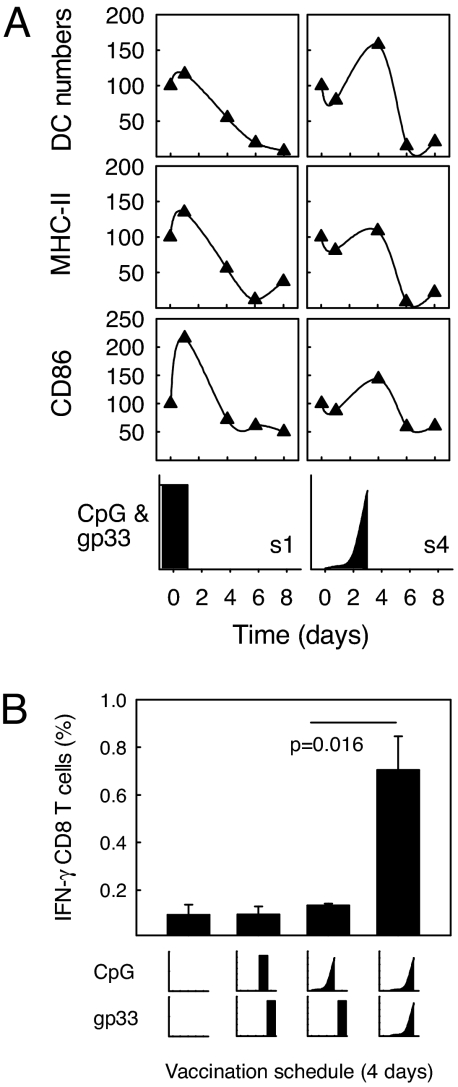
Exponential immunization delays DC recruitment. C57BL/6 mice were immunized with gp33 peptide and CpG according to the immunization protocol s1 (bolus injection) and s4 (exponentially increasing doses) as described in Fig. 1. The vaccines were administered s.c. in the inguinal region. After 1, 4, 6, and 8 days, the iLN were removed, and single cell suspensions thereof were analyzed by flow cytometry for the expression of the DC marker CD11c, as well as CD86 and the MHC class II marker I-Ab (A). The results in the Top are illustrated as the relative frequency of cells expressing both CD11c and I-Ab. The Middle illustrates the relative MFI of CD86 expression and the Bottom the relative MFI of I-Ab expression on DCs. In all cases, the results are normalized to that of naive controls (day 0) for which reason the starting point is always 100. Mice were also immunized with gp33 peptide and CpG according to modified protocols as illustrated (B). One group received a CpG bolus on day 3 and a gp33 peptide bolus on day 4. One group received exponentially increasing CpG doses on days 0–3 followed by a gp33 peptide bolus on day 4. The last group received exponentially increasing doses of gp33 peptide and CpG on days 1–4 as described above (s4). The frequency of IFN-γ-producing CD8 T cells was measured in peripheral blood on day 10. The results show means and SEM of one of two comparable experiments (n = 3).
Fig. 6.
Fig. 6.
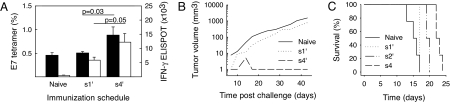
Exponential immunization with peptide-loaded DCs induces strong T cell and anti-tumor responses. Groups of 10 C57BL/6 mice were immunized by intralymphatic injection of bone-marrow-derived DCs loaded with HPV17 E7 peptide (A and B). The DCs were given as a bolus on day 1 (s1′) or equally (s2′) or exponentially increasingly distributed on day 1, day 3, and day 6 (s4′). Naive mice were used as negative controls. (A) On day 17 and on day 22, the frequency of E7-tetramer positive CD8 T cells in peripheral blood was analyzed by flow cytometry (means and SEM; n = 10), and IFN-γ ELISPOTs were analyzed from spleens (means and SEM; n = 7). (B) On day 21, three vaccinated mice and 10 naive mice were challenged with the HPV-transformed tumor cell line C3.43. Tumor progression was monitored by caliber measurements (mm) from which tumor volumes were calculated. (C) C57BL/6 mice were immunized by s.c. injection of DCs loaded with the VSV np53 peptide (n = 4). DCs (1.11 × 10⁵) were given as a bolus on day 1 (s1′) or as equal (s2′) or dose-escalating doses (s4′) on days 1, 3, and 6. Naive mice were used as controls. On day 14, all mice were challenged with 106 EL-4 N.1 cells i.p (50). Log-rank tests of Kaplan Meier curves: s4′ ≠ s2′, P = 0.0084; s2′≠ s1′: P = 0.0082; s1′ ≠ Naive, P = 0.401.
Fig. 7.
Fig. 7.
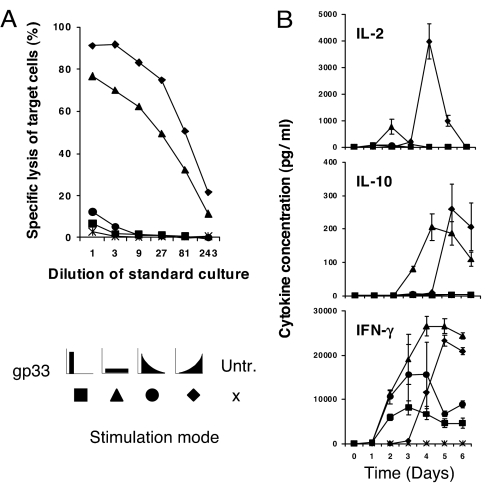
Exponential in vitro stimulation of CD8 T cells enhances IL-2 production and cytotoxicity. TCR318 T cells (1 × 10⁵) were cocultured with 2 × 10⁶ irradiated syngeneic splenocytes serving as feeder cells. Cultures were stimulated with the same total doses of gp33, but following different kinetics: ■, a single dose of 10−9 M at day 0; ▲, four equal doses of 0.25 × 10⁻⁹ M during 4 days; ●, four exponentially decreasing doses of 10−9, 10−10, 10−11, and 10−12 M at days 0, 1, 2, and 3, respectively; and ♦, four exponentially increasing doses of 10−12, 10−11, 10−10, and 10−9 M at days 0, 1, 2, and 3, respectively. ×, control culture without gp33 peptide. (A) After 6 days, CTL activity was measured by using gp33-pulsed EL-4 target cells in a 5-h 51Cr-release assay. Values represent means of duplicate cultures. One representative of two similar experiments is shown. (B) Supernatants were analyzed for IL-2, IL-10, and IFN-γ. Values represent means of triplicate culture wells, and one representative of two experiments is shown.

References

    1. Janeway CA., Jr Cold Spring Harb Symp Quant Biol. 1989;54:1–13. - PubMed
    1. Zinkernagel RM. Science. 1996;271:173–178. - PubMed
    1. Germain RN. Nat Med. 2004;10:1307–1320. - PubMed
    1. O'Hagan DT, Valiante NM. Nat Rev Drug Discov. 2003;2:727–735. - PMC - PubMed
    1. Johansen P, Senti G, Martinez Gomez JM, Storni T, von Beust BR, Wuthrich B, Bot A, Kundig TM. Clin Exp Allergy. 2005;35:1591–1598. - PubMed

Publication types