


Simvastatin restores ischemic preconditioning in the presence of hyperglycemia through a nitric oxide-mediated mechanism
- PMID: 18362595
- PMCID: PMC4378683
- DOI: 10.1097/ALN.0b013e3181672590
Simvastatin restores ischemic preconditioning in the presence of hyperglycemia through a nitric oxide-mediated mechanism
Abstract
Background: A growing body of evidence indicates that statins decrease perioperative cardiovascular risk and that these drugs may be particularly efficacious in diabetes. Diabetes and hyperglycemia abolish the cardioprotective effects of ischemic preconditioning (IPC). The authors tested the hypothesis that simvastatin restores the beneficial effects of IPC during hyperglycemia through a nitric oxide-mediated mechanism.
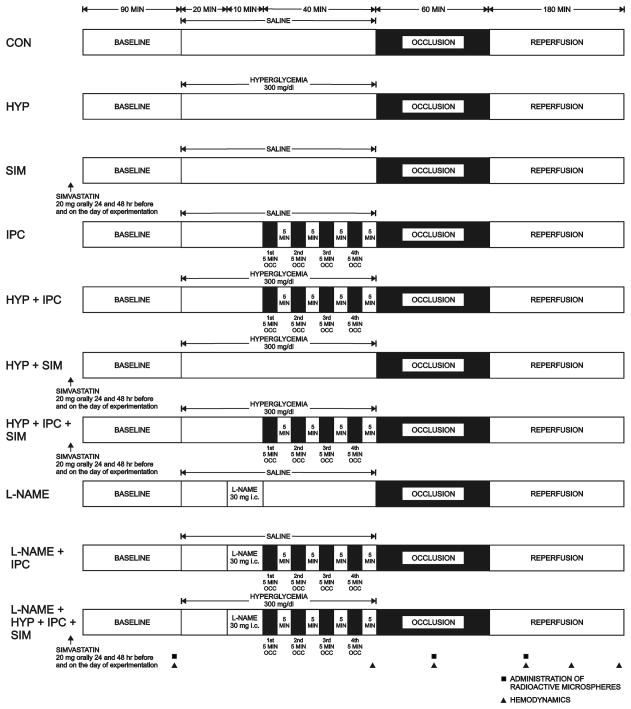
Methods: Myocardial infarct size was measured in dogs (n = 76) subjected to coronary artery occlusion and reperfusion in the presence or absence of hyperglycemia (300 mg/dl) with or without IPC in separate groups. Additional dogs received simvastatin (20 mg orally daily for 3 days) in the presence or absence of IPC and hyperglycemia. Other dogs were pretreated with N-nitro-l-arginine methyl ester (30 mg intracoronary) with or without IPC, hyperglycemia, and simvastatin.
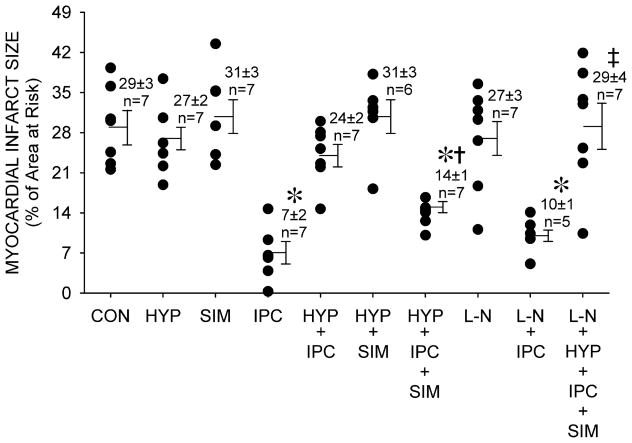
Results: Ischemic preconditioning significantly (P < 0.05) reduced infarct size (n = 7, 7 +/- 2%) as compared with control (n = 7, 29 +/- 3%). Hyperglycemia (n = 7), simvastatin (n = 7), N-nitro-l-arginine methyl ester alone (n = 7), and simvastatin with hyperglycemia (n = 6) did not alter infarct size. Hyperglycemia (n = 7, 24 +/- 2%), but not N-nitro-l-arginine methyl ester (n = 5, 10 +/- 1%), blocked the protective effects of IPC. Simvastatin restored the protective effects of IPC in the presence of hyperglycemia (n = 7, 14 +/- 1%), and this beneficial action was blocked by N-nitro-l-arginine methyl ester (n = 7, 29 +/- 4%).
Conclusions: The results indicate that simvastatin restored the cardioprotective effects of IPC during hyperglycemia by nitric oxide-mediated signaling. The results also suggest that enhanced cardioprotective signaling could be a mechanism for statin-induced decreases in perioperative cardiovascular risk.
Figures
References
-
- Randomised trial of cholesterol lowering in 4444 patients with coronary heart disease: the Scandinavian Simvastatin Survival Study (4S) Lancet. 1994;344:1383–9. - PubMed
-
- MRC/BHF Heart Protection Study of cholesterol lowering with simvastatin in 20,536 high-risk individuals: a randomized placebo-controlled trial. Lancet. 2002;360:7–22. - PubMed
-
- Pyorala K, Pedersen TR, Kjekshus J, Faergeman O, Olsson AG, Thorgeirsson G. Cholesterol lowering with simvastatin improves prognosis of diabetic patients with coronary heart disease. A subgroup analysis of the Scandinavian Simvastatin Survival Study (4S) Diabetes Care. 1997;20:614–20. - PubMed
-
- Lefer AM, Scalia R, Lefer DJ. Vascular effects of HMG CoA-reductase inhibitors (statins) unrelated to cholesterol lowering: new concepts for cardiovascular disease. Cardiovasc Res. 2001;49:281–7. - PubMed
-
- Kersten JR, Schmeling TJ, Orth KG, Pagel PS, Warltier DC. Acute hyperglycemia abolishes ischemic preconditioning in vivo. Am J Physiol Heart Circ Physiol. 1998;275:H721–5. - PubMed
Publication types
MeSH terms
Substances
Grants and funding
LinkOut - more resources
Full Text Sources
Other Literature Sources
Medical
