. 2008 May;7(5):2133-9.
doi: 10.1021/pr700894d. Epub 2008 Mar 26.

Cell-specific aptamer probes for membrane protein elucidation in cancer cells

Affiliations

Cell-specific aptamer probes for membrane protein elucidation in cancer cells

Dihua Shangguan et al. J Proteome Res. 2008 May.

Abstract

Disease biomarkers play critical roles in the management of various pathological conditions of diseases. This involves diagnosing diseases, predicting disease progression and monitoring the efficacy of treatment modalities. While efforts to identify specific disease biomarkers using a variety of technologies has increased the number of biomarkers or augmented information about them, the effective use of disease-specific biomarkers is still scarce. Here, we report that a high expression of protein tyrosine kinase 7 (PTK7), a transmembrane receptor protein tyrosine kinase-like molecule, was discovered in a series of leukemia cell lines using whole cell aptamer selection. With the implementation of a two-step strategy (aptamer selection and biomarker discovery), combined with mass spectrometry, PTK7 was ultimately identified as a potential biomarker for T-cell acute lymphoblastic leukemia (T-ALL). Specifically, the aptamers for T-ALL cells were selected using the cell-SELEX process, without any prior knowledge of the cell biomarker population, conjugated with magnetic beads and then used to capture and purify their binding targets on the leukemia cell surface. This demonstrates that a panel of molecular aptamers can be easily generated for a specific type of diseased cells. It further demonstrates that this two-step strategy, that is, first selecting cancer cell-specific aptamers and then identifying their binding target proteins, has major clinical implications in that the technique promises to substantially improve the overall effectiveness of biomarker discovery. Specifically, our strategy will enable efficient discovery of new malignancy-related biomarkers, facilitate the development of diagnostic tools and therapeutic approaches to cancer, and markedly improve our understanding of cancer biology.


Figures
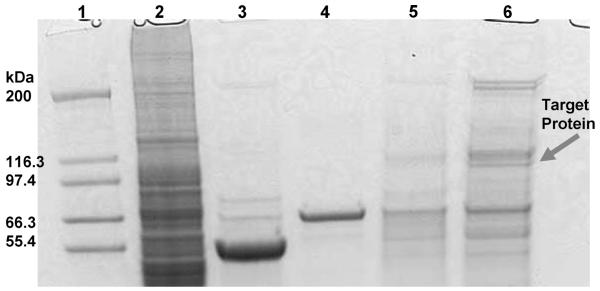
Figure 1
Figure 1
Colloidal Blue-stained SDS-PAGE (12%) used to analyze the aptamer-assisted target purification. Lane 1, molecular markers; lane 2, membrane extracts; lane 3, protein captured with the nonbinding sequence; lane 4, magnetic beads only; lane 5, protein captured with sequence sgc3b; lane 6, protein captured with aptamer sgc8c.
Figure 2
Figure 2
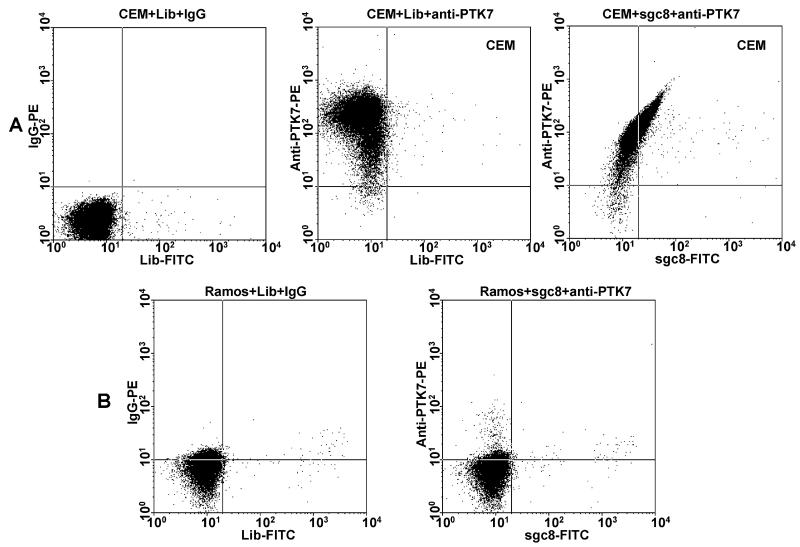
Flow cytometry assay of CEM (A, positive cells) and Ramos (B, negative cells) cells stained with anti-PTK7-PE and sgc8-FITC. FITC-labeled random DNA Library (Lib) and IgG-PE, which do not bind to cells, were used as negative control. A linear relationship was only shown on CEM cells stained with anti-PTK7-PE and sgc8-FITC (A, right).
Figure 3
Figure 3
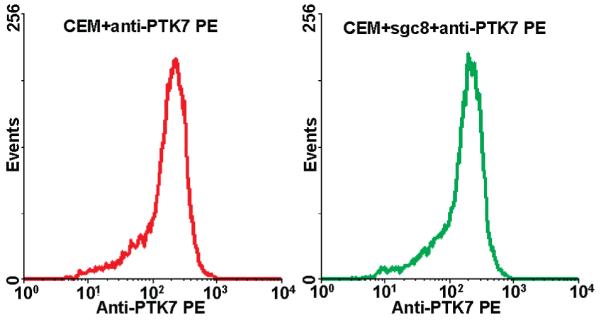
Absence of competition between anti-PTK7 and sgc8. Red curve, CEM cells binding with anti-PTK7-PE; green curve, CEM cells binding with anti-PTK7-PE after incubation with unlabeled sgc8 (2 μM). The Kd of sgc8 is 0.8 nM. High concentration of sgc8 did not affect the fluorescence intensity.
Figure 4
Figure 4
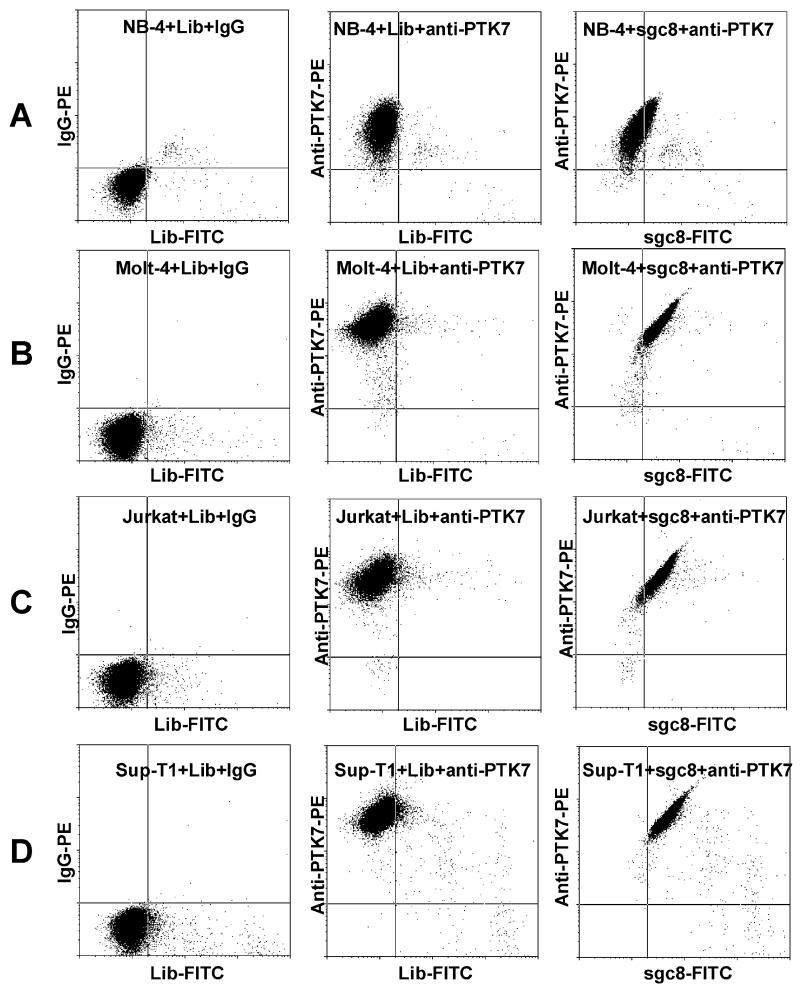
Flow cytometry assay of leukemia cells stained with anti-PTK7-PE and sgc8-FITC. (A) Acute promyelocytic leukemia, NB-4; (B) human acute lymphoblastic leukemia (T-cell line), Molt-4; (C) human acute T cell leukemia, Jurkat; (D) human lymphoblastic leukemia (T-cell line), Sup-T1. FITC-labeled random DNA Library (Lib) and IgG-PE, which do not bind to cells, were used as negative control.
Figure 5
Figure 5
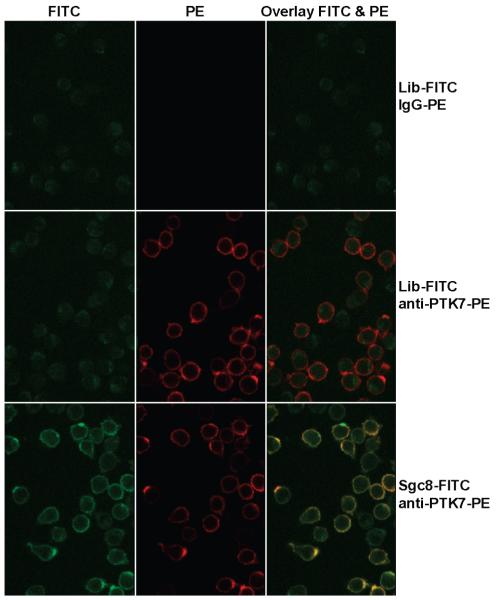
Fluorescence confocal images of CCRF-CEM cells incubated with FITC-labeled aptamer sgc8 and PE-labeled anti-PTK7. FITC-labeled unselected Library (Lib-FITC) and PE-labeled IgG, which do not bind to CCRF-CEM cells, were used as control. Column 1 is the FITC channel, column 2 is the PE channel, and column 3 is the overlay of the two channels. Cells in row 1 were incubated with Lib-FITC (control) and IgG-PE (control). Cells in row 2 were incubated with Lib-FITC (control) and anti-PTK7-PE. Cells in row 3 were incubated with sgc8-FITC and anti-PTK7-PE.
Figure 6
Figure 6
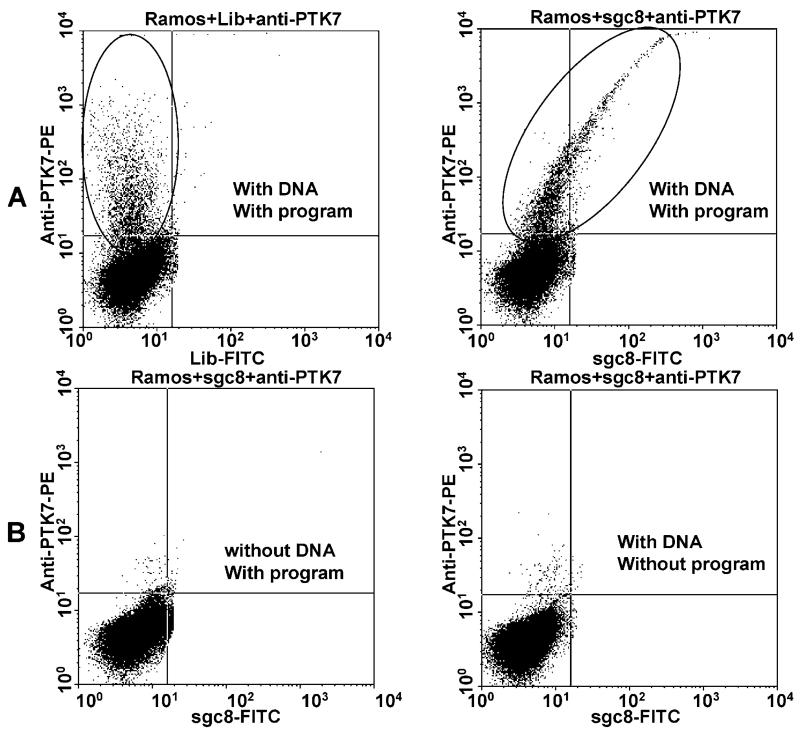
Flow cytometry assay of Ramos cells nucleofected with cDNA of PTK7. (A) Ramos cells nucleofected with plasma containing cDNA of PTK7: left, stained with anti-PTK7-PE; right, stained with anti-PTK7-PE and sgc8-FITC. The elliptical area represents the cells that expressed PTK7. (B) Negative control cells stained with anti-PTK7-PE and sgc8-FITC; left, Ramos cells without plasmid with nucleofection program; right, Ramos cells with plasmid without nucleofection program. The transfection efficiency is about 10%.

References

    1. Wu CC, Yates JR., III The application of mass spectrometry to membrane proteomics. Nat. Biotechnol. 2003;21(3):262–7. - PubMed
    1. Shangguan D, Li Y, Tang Z, Cao ZC, Chen HW, Mallikaratchy P, Sefah K, Yang CJ, Tan W. Aptamers evolved from live cells as effective molecular probes for cancer study. Proc. Natl. Acad. Sci. U.S.A. 2006;103(32):11838–43. - PMC - PubMed
    1. Ellington AD, Szostak JW. Selection in vitro of single-stranded DNA molecules that fold into specific ligand-binding structures. Nature. 1992;355(6363):850–2. - PubMed
    1. Morris KN, Jensen KB, Julin CM, Weil M, Gold L. High affinity ligands from in vitro selection: complex targets. Proc. Natl. Acad. Sci. U.S.A. 1998;95(6):2902–7. - PMC - PubMed
    1. Homann M, Goringer HU. Combinatorial selection of high affinity RNA ligands to live African trypanosomes. Nucleic Acids Res. 1999;27(9):2006–14. - PMC - PubMed

Publication types

MeSH terms