. 2008 Mar 26;3(3):e1873.
doi: 10.1371/journal.pone.0001873.

The deleted in brachydactyly B domain of ROR2 is required for receptor activation by recruitment of Src

Affiliations

The deleted in brachydactyly B domain of ROR2 is required for receptor activation by recruitment of Src

Shiva Akbarzadeh et al. PLoS One. .

Abstract

The transmembrane receptor 'ROR2' resembles members of the receptor tyrosine kinase family of signalling receptors in sequence but its' signal transduction mechanisms remain enigmatic. This problem has particular importance because mutations in ROR2 are associated with two human skeletal dysmorphology syndromes, recessive Robinow Syndrome (RS) and dominant acting Brachydactyly type B (BDB). Here we show, using a constitutive dimerisation approach, that ROR2 exhibits dimerisation-induced tyrosine kinase activity and the ROR2 C-terminal domain, which is deleted in BDB, is required for recruitment and activation of the non-receptor tyrosine kinase Src. Native ROR2 phosphorylation is induced by the ligand Wnt5a and is blocked by pharmacological inhibition of Src kinase activity. Eight sites of Src-mediated ROR2 phosphorylation have been identified by mass spectrometry. Activation via tyrosine phosphorylation of ROR2 receptor leads to its internalisation into Rab5 positive endosomes. These findings show that BDB mutant receptors are defective in kinase activation as a result of failure to recruit Src.


Conflict of interest statement

Competing Interests: The authors have declared that no competing interests exist.

Figures

Figure 1
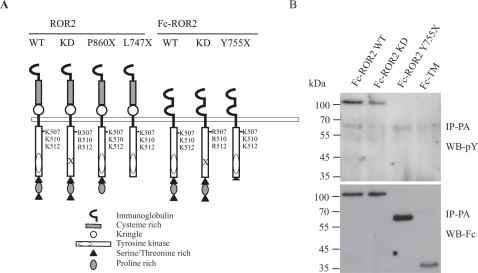
Figure 1. Fc-ROR2 WT is tyrosine phosphorylated.
A) A schematic diagram of the full length ROR2 and Fc-ROR2 chimeras used in this study. ‘Kinase dead’ (KD) mutants were constructed by mutating three Lysine residues within the ATP binding pocket to Argenine. B) Fc fusion chimeras of the intracellular domains from ROR2 WT, ROR2 KD, ROR2 Y755X and, as a control, the Fc-transmembrane domain of FGFR1 fusion were expressed in chondrocytes. The chimeric receptors were immunoprecipitated using Protein-A-sepharose (IP-PA) and analysed by Western blotting following 10% SDS-PAGE. Receptor phosphorylation was detected by a cocktail of phosphotyrosine antibodies (4G10/pY20; WB-pY, upper panel). The membrane was stripped and reprobed with anti-IgG1 antibody to compare receptor expression levels (WB-Fc, lower panel).
Figure 2
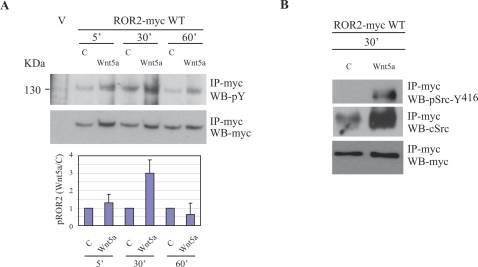
Figure 2. ROR2 receptor exhibits increased tyrosine phosphorylation and Src association upon Wnt5a stimulation.
A) Chondrocytes were either transfected with pcDNA3.1 (V, control) or pcDNA3.1 containing the myc-tagged, wild type, ROR2 construct (ROR2-myc WT). Following 1 hr of serum starvation in KHB, cells were either stimulated with 0.1% BSA carrier (C) or Wnt5a (1.6 µg/ml) for 5, 30 or 60 min. Control vector-transfected cells (V) were not stimulated. The receptor was immunoprecipitated using anti-myc antibody (IP-myc) and analysed by SDS-PAGE and subsequent Western blotting. The membrane was probed with an anti-phosphotyrosine cocktail (WB-pY), followed by stripping and re-probing with anti-myc antibody (WB-myc). The fold-increase of ROR2 receptor phosphorylation was determined by normalizing Wnt5a-induced phosphorylation to carrier-induced phosphorylation (mean±s.e.m., n = 3, lower panel). B) Chondrocytes expressing ROR2-myc WT were stimulated with either 0.1% BSA (C) or Wnt5a (1.6 µg/ml) for 30 min. The receptor was immunoprecipitated using anti-myc antibody (IP-myc) and probed with a phospho-Src antibody (WB-pSrc-Y416) to detect activated Src. The membrane was stripped and reprobed with anti-c-Src (WB-cSrc) and anti-myc (WB-myc).
Figure 3
Figure 3. Wnt5a-induced association of activated Src and the ROR2 receptor.
Chondrocytes were transfected with; A) ROR2-myc WT, B) ROR2-myc KD or C) ROR2-myc L747X and serum-starved for 1 hr in KHB prior to stimulation with either 0.1% BSA carrier or Wnt5a (1 µg/ml) plus heparin (10 µg/ml) for 30 min. The cells were fixed and stained with anti-myc, anti-phospho-Src (Y416) and Hoechst.
Figure 4
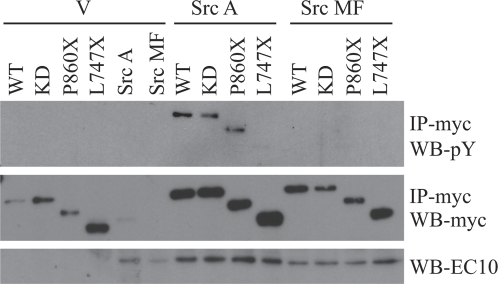
Figure 4. ROR2 receptor is a substrate for Src.
Chondrocytes were co-transfected with myc-tagged ROR2 WT, ROR2 KD and myc-tagged deletion mutants ROR2 P860X and ROR2 L747X and either vector alone (V), constitutively active Src (Src A) or inactive Src (Src MF). Lanes 5 and 6 are controls for Src A and Src MF, respectively. The receptor constructs were immunoprecipitated with anti-myc (IP-myc) and probed with anti-phosphotyrosine antibodies (WB-pY, upper panel) then stripped and reprobed with anti-myc (loading control, WB-myc). Src A and MF expression was confirmed on whole cell lysate prior to immunoprecipitation using anti-chicken Src antibody (WB-EC10, lower panel).
Figure 5
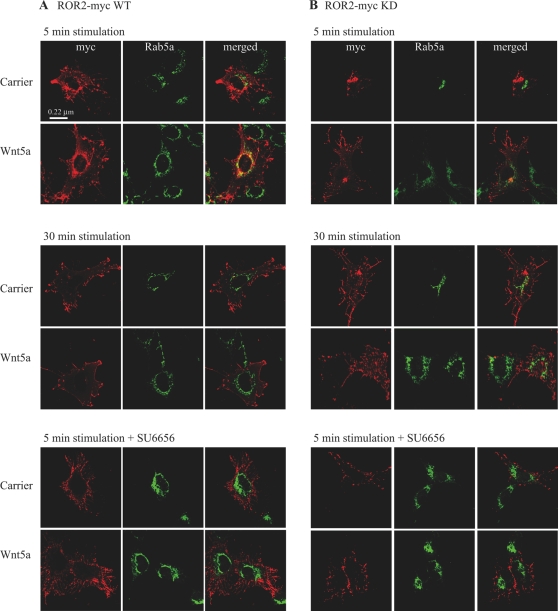
Figure 5. ROR2 is targeted into Rab5A-positive endosomes upon Wnt5a stimulation.
A) ROR2-myc WT and B) ROR2-myc KD transfected chondrocytes were serum-starved in KHB for1 hr. Cells were stimulated with either 0.1% BSA carrier or Wnt5a (1 ug/ml) plus heparin (10 µg/ml) for 5 min (upper panels), 30 min (middle panels) or 5 min in the presence of 24 µM SU6656 (lower panels). The cells were fixed and subsequently stained with anti-myc and anti-Rab5A antibodies.

References

    1. Masiakowski P, Carroll RD. A novel family of cell surface receptors with tyrosine kinase-like domain. J Biol Chem. 1992;267:26181–26190. - PubMed
    1. Afzal AR, Rajab A, Fenske CD, Oldridge M, Elanko N, et al. Recessive Robinow syndrome, allelic to dominant brachydactyly type B, is caused by mutation of ROR2. Nat Genet. 2000;25:419–422. - PubMed
    1. Oldridge M, Fortuna AM, Maringa M, Propping P, Mansour S, et al. Dominant mutations in ROR2, encoding an orphan receptor tyrosine kinase, cause brachydactyly type B. Nat Genet. 2000;24:275–278. - PubMed
    1. Schwabe GC, Tinschert S, Buschow C, Meinecke P, Wolff G, et al. Distinct mutations in the receptor tyrosine kinase gene ROR2 cause brachydactyly type B. Am J Hum Genet. 2000;67:822–831. - PMC - PubMed
    1. van Bokhoven H, Celli J, Kayserili H, van Beusekom E, Balci S, et al. Mutation of the gene encoding the ROR2 tyrosine kinase causes autosomal recessive Robinow syndrome. Nat Genet. 2000;25:423–426. - PubMed

Publication types

MeSH terms