


Reliable identification of mycobacterial species by PCR-restriction enzyme analysis (PRA)-hsp65 in a reference laboratory and elaboration of a sequence-based extended algorithm of PRA-hsp65 patterns
- PMID: 18366704
- PMCID: PMC2323382
- DOI: 10.1186/1471-2180-8-48
Reliable identification of mycobacterial species by PCR-restriction enzyme analysis (PRA)-hsp65 in a reference laboratory and elaboration of a sequence-based extended algorithm of PRA-hsp65 patterns
Abstract
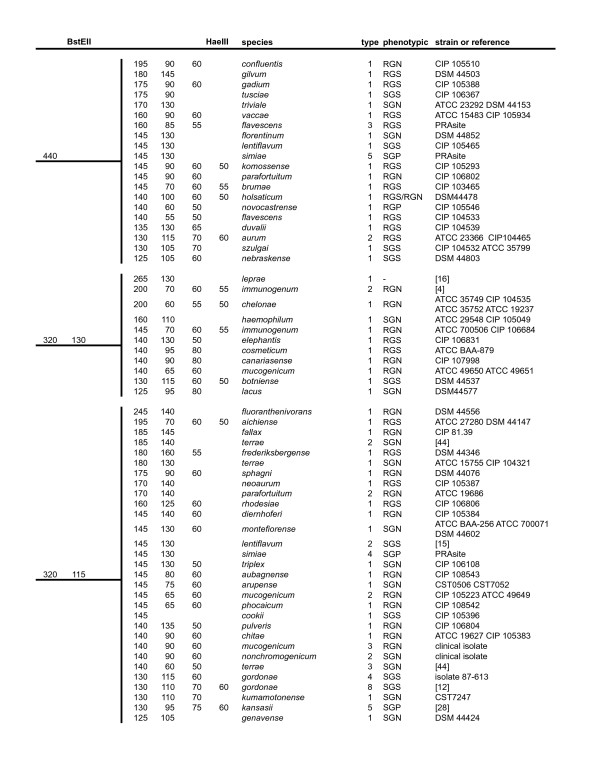
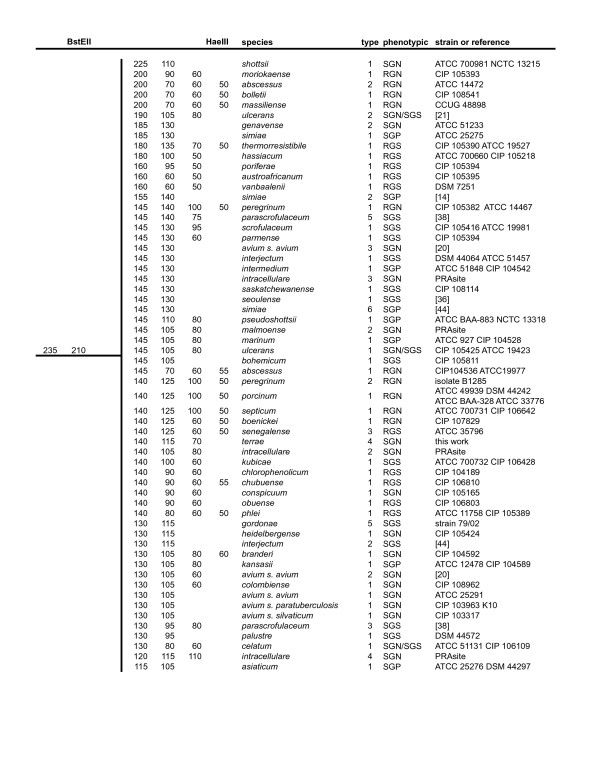
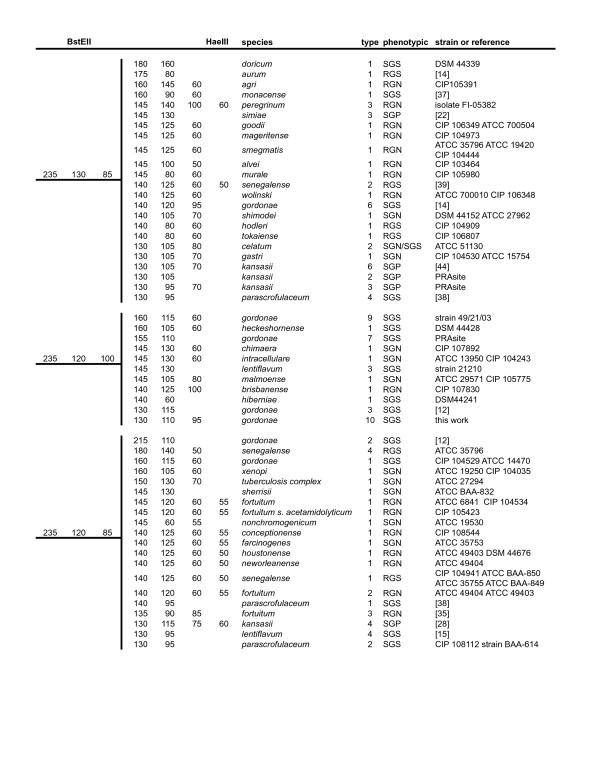
Background: Identification of nontuberculous mycobacteria (NTM) based on phenotypic tests is time-consuming, labor-intensive, expensive and often provides erroneous or inconclusive results. In the molecular method referred to as PRA-hsp65, a fragment of the hsp65 gene is amplified by PCR and then analyzed by restriction digest; this rapid approach offers the promise of accurate, cost-effective species identification. The aim of this study was to determine whether species identification of NTM using PRA-hsp65 is sufficiently reliable to serve as the routine methodology in a reference laboratory.
Results: A total of 434 NTM isolates were obtained from 5019 cultures submitted to the Institute Adolpho Lutz, Sao Paulo Brazil, between January 2000 and January 2001. Species identification was performed for all isolates using conventional phenotypic methods and PRA-hsp65. For isolates for which these methods gave discordant results, definitive species identification was obtained by sequencing a 441 bp fragment of hsp65. Phenotypic evaluation and PRA-hsp65 were concordant for 321 (74%) isolates. These assignments were presumed to be correct. For the remaining 113 discordant isolates, definitive identification was based on sequencing a 441 bp fragment of hsp65. PRA-hsp65 identified 30 isolates with hsp65 alleles representing 13 previously unreported PRA-hsp65 patterns. Overall, species identification by PRA-hsp65 was significantly more accurate than by phenotype methods (392 (90.3%) vs. 338 (77.9%), respectively; p < .0001, Fisher's test). Among the 333 isolates representing the most common pathogenic species, PRA-hsp65 provided an incorrect result for only 1.2%.
Conclusion: PRA-hsp65 is a rapid and highly reliable method and deserves consideration by any clinical microbiology laboratory charged with performing species identification of NTM.
Figures
References
-
- Roth A, Reischl U, Streubel A, Naumann L, Kroppenstedt RM, Habicht M, Fischer M, Mauch H. Novel diagnostic algorithm for identification of mycobacteria using genus-specific amplification of the 16S-23S rRNA gene spacer and restriction endonucleases. J Clin Microbiol. 2000;38:1094–1104. - PMC - PubMed
-
- Sampaio JL, Chimara E, Ferrazoli L, da Silva Telles MA, Del Guercio VM, Jerico ZV, Miyashiro K, Fortaleza CM, Padoveze MC, Leao SC. Application of four molecular typing methods for analysis of Mycobacterium fortuitum group strains causing post-mammaplasty infections. Clin Microbiol Infect. 2006;12:142–149. doi: 10.1111/j.1469-0691.2005.01312.x. - DOI - PubMed
Publication types
MeSH terms
Substances
LinkOut - more resources
Full Text Sources
Other Literature Sources
Medical
Research Materials
