Comparative Study
. 2008 Mar 25:9:139.
doi: 10.1186/1471-2164-9-139.

Construction of a BAC library and mapping BAC clones to the linkage map of Barramundi, Lates calcarifer

Affiliations
Comparative Study

Construction of a BAC library and mapping BAC clones to the linkage map of Barramundi, Lates calcarifer

Chun Ming Wang et al. BMC Genomics. .

Abstract

Background: Barramundi (Lates calcarifer) is an important farmed marine food fish species. Its first generation linkage map has been applied to map QTL for growth traits. To identify genes located in QTL responsible for specific traits, genomic large insert libraries are of crucial importance. We reported herein a bacterial artificial chromosome (BAC) library and the mapping of BAC clones to the linkage map.

Results: This BAC library consisted of 49,152 clones with an average insert size of 98 kb, representing 6.9-fold haploid genome coverage. Screening the library with 24 microsatellites and 15 ESTs/genes demonstrated that the library had good genome coverage. In addition, 62 novel microsatellites each isolated from 62 BAC clones were mapped onto the first generation linkage map. A total of 86 BAC clones were anchored on the linkage map with at least one BAC clone on each linkage group.

Conclusion: We have constructed the first BAC library for L. calcarifer and mapped 86 BAC clones to the first generation linkage map. This BAC library and the improved linkage map with 302 DNA markers not only supply an indispensable tool to the integration of physical and linkage maps, the fine mapping of QTL and map based cloning genes located in QTL of commercial importance, but also contribute to comparative genomic studies and eventually whole genome sequencing.


Figures
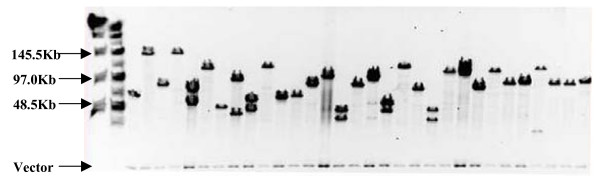
Figure 1
Figure 1
DNA analysis of 31 random BAC clones from the L. calcarifer HindIII BAC library by pulse-field gel electrophoresis. DNA samples digested with NotI were separated on 1% agarose gel in 0.5 × TBE buffer for 16 h under the following conditions: ramp pulse time of 5–15 s at 6 V/cm, temperature at 14°C. Markers used are Lambda Ladder PFG Marker (outside lanes) and MidRange II PFG Marker (NEB, SG, Singapore). The 8 kb common band is the pCC1BAC Vector (Epicentre, WI, USA).
Figure 2
Figure 2
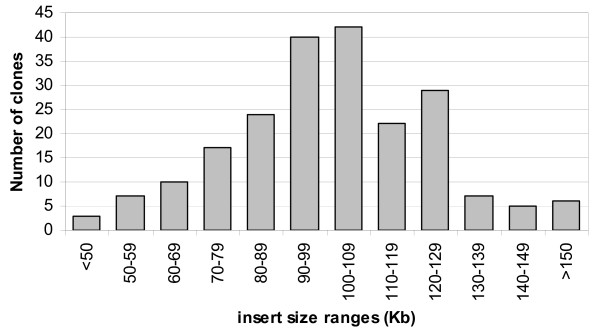
Insert size distribution of 212 L. calcarifer BAC clones. DNA samples of the 212 clones randomly picked from the L. calcarifer HindIII BAC library were analyzed and grouped. Results indicate that the average insert size is 98 kb with over 80% of the clones > 80 kb.
Figure 3
Figure 3
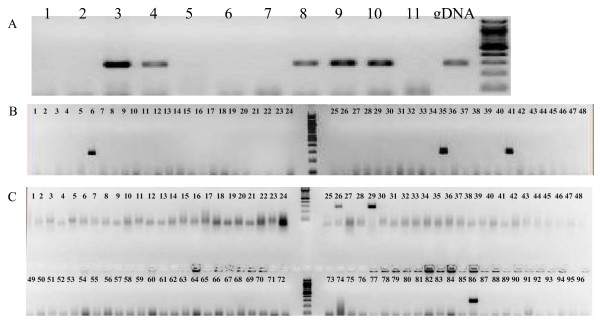
Hierarchical PCR screening of the superpools and pools of the BAC library of L. calcarifer. A First round PCR screening in 11 superpools representing the entire library or 128 384-well microtiter plates. Lanes 1–11: superpools 1–11 and lane 12: genomic DNA as positive control. Each superpool contains DNA of 12 plates or 4,608 individual BAC clones. In five superpools (3, 4, 8, 9 and 10), PCR product was amplified by the marker Lca064. B Second round PCR screening in 48 pools from the superpool number 3. Three pools (6, 35 and 41) showed a signal amplified by the marker Lca064. C Third round PCR screening in a 96-well plate from the pool number 6. Three positive clones (26, 29 and 86) were detected in the plate by the marker Lca064.
Figure 4
Figure 4
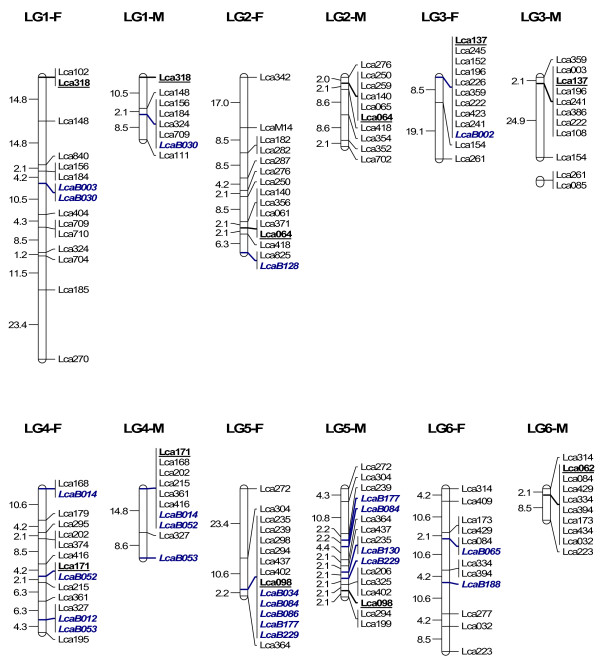
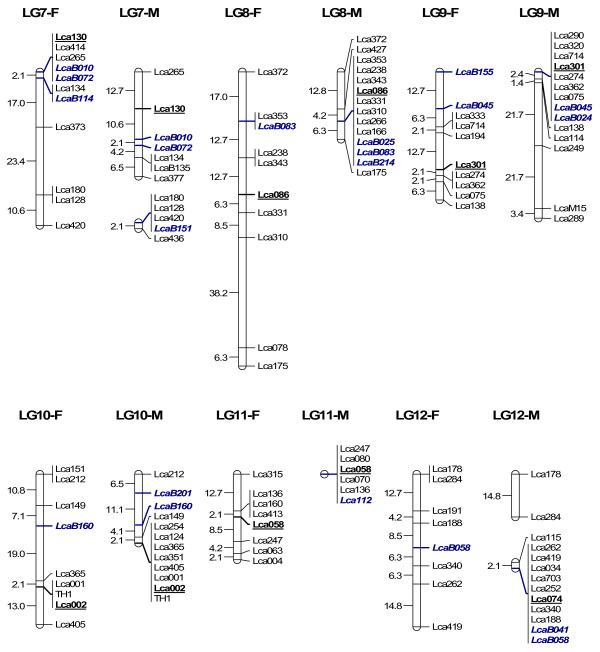
A microsatellite linkage map of L. calcarifer anchored by 86 BAC clones-LG 1–6. F: linkage map for female. M: linkage map for male. Markers underlined represent microsatellites selected from each LG for screening the BAC library. Markers in italic (initiated with LcaB) represent microsatellites isolated from BAC clones and newly mapped to the map.
Figure 5
Figure 5
A microsatellite linkage map of L. calcarifer anchored by 86 BAC clones-LG 7–12. See detailed explanation in Figure 4
Figure 6
Figure 6
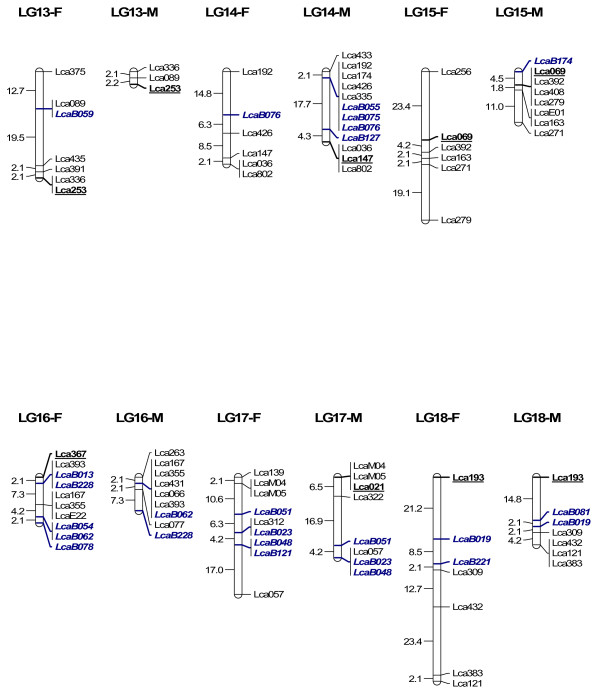
A microsatellite linkage map of L. calcarifer anchored by 86 BAC clones-LG 13–18. See detailed explanation in Figure 4
Figure 7
Figure 7
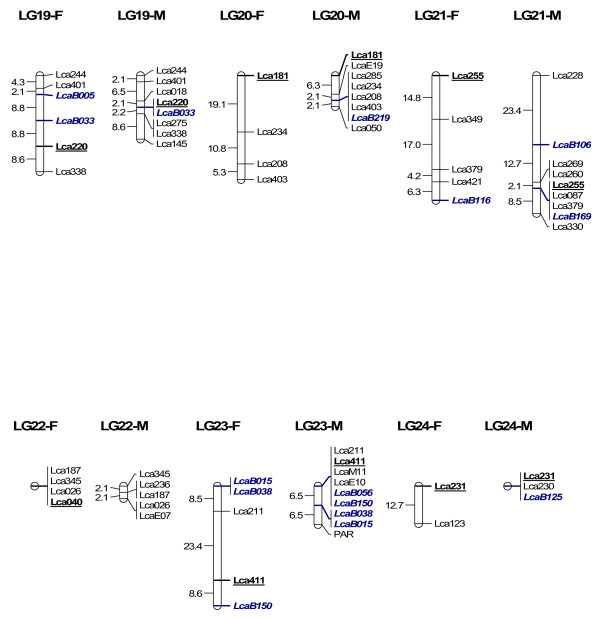
A microsatellite linkage map of L. calcarifer anchored by 86 BAC clones-LG 19–24. See detailed explanation in Figure 4

References

    1. Nelson J. In: Fishes of the world. Sons JW, editor. New York ; 1994 .
    1. Berra TM. San Diego , Academic Press; 2001. Freshwater Fish Distribution.
    1. Zhu ZY, Lin G, Lo LC, Xu YX, Feng F, Chou R, Yue GH. Genetic analyses of Asian seabass stocks using novel polymorphic microsatellites. Aquaculture. 2006;256:167–173. doi: 10.1016/j.aquaculture.2006.02.033. - DOI
    1. Andersson L. Genetic dissection of phenotypic diversity in farm animals. Nat Rev Genet. 2001;2:130–130. doi: 10.1038/35052563. - DOI - PubMed
    1. Carrey G, Mather P. Karyotypes of four species Melanotaenia duboulayi; Bidyanus bidyanus, Macquaria novemaculeata and Lates calcarfer. Cytobios. 1999;100:137–146.

Publication types

LinkOut - more resources