Rapid detection of the mosaic structure of the Neisseria gonorrhoeae penA Gene, which is associated with decreased susceptibilities to oral cephalosporins
- PMID: 18367575
- PMCID: PMC2395096
- DOI: 10.1128/JCM.01800-07
Rapid detection of the mosaic structure of the Neisseria gonorrhoeae penA Gene, which is associated with decreased susceptibilities to oral cephalosporins
Abstract
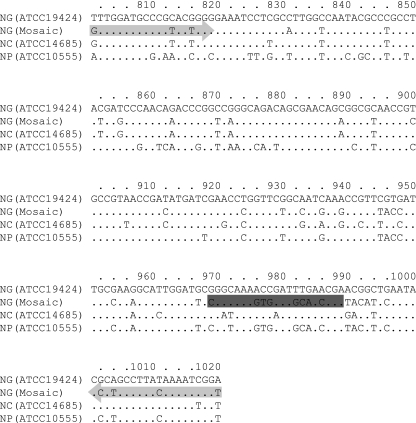
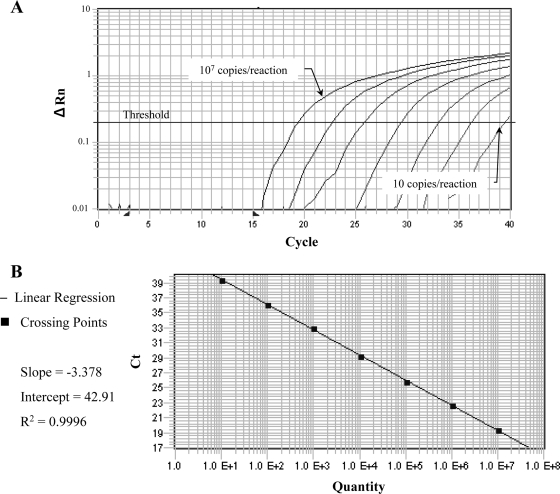
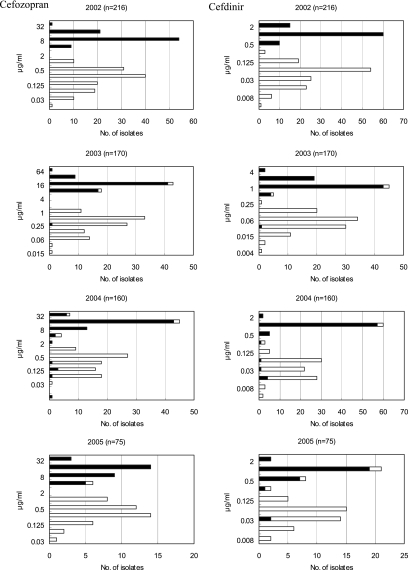
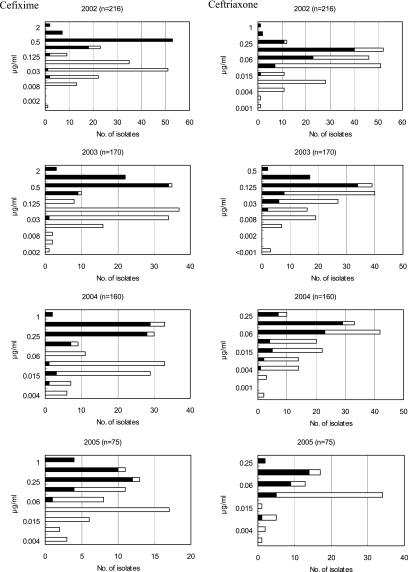
In Neisseria gonorrhoeae, the mosaic structure of the penA gene (encoding penicillin-binding protein 2 [PBP 2]), which is composed of fragments of the penA genes from Neisseria cinerea and Neisseria perflava, has been significantly associated with decreased susceptibility to cephalosporins, particularly oral cephalosporins. The aim of this study was to develop a rapid assay for the detection of mosaic PBP 2 of N. gonorrhoeae by real-time PCR. This assay successfully detected the mosaic penA gene of N. gonorrhoeae, and its sensitivity was >or=10(1) copies/reaction. Six hundred twenty-one clinical strains were examined by this assay for the presence of mosaic PBP 2, which was detected in 85 (39.4%) of 216 strains from 2002, 69 (40.6%) of 170 strains from 2003, 71 (44.4%) of 160 strains from 2004, and 31 (41.3%) of 75 strains from 2005. The MICs of cephalosporins for strains with the mosaic PBP 2 detected by the assay were statistically higher than those for strains without the mosaic PBP 2. One hundred sixty-six (64.8%) of 256 strains with the mosaic PBP 2 exhibited cefixime MICs of >or=0.5 microg/ml. The emergence and spread of strains with mosaic PBP 2 could be a threat to the cefixime treatment of gonorrhea. This real-time PCR assay for the detection of mosaic PBP 2 of N. gonorrhoeae is thus useful in the prediction of decreased susceptibilities to oral cephalosporins.
Figures
References
-
- Akasaka, S., T. Muratani, Y. Yamada, H. Inatomi, K. Takahashi, and T. Matsumoto. 2001. Emergence of cephem- and aztreonam-high-resistant Neisseria gonorrhoeae that does not produce beta-lactamase. J. Infect. Chemother. 749-50. - PubMed
-
- Brannigan, J. A., I. A. Tirodimos, Q. Y. Zhang, C. G. Dowson, and B. G. Spratt. 1990. Insertion of an extra amino acid is the main cause of the low affinity of penicillin-binding protein 2 in penicillin-resistant strains of Neisseria gonorrhoeae. Mol. Microbiol. 4913-919. - PubMed
-
- Clinical and Laboratory Standards Institute. 2006. Performance standards for antimicrobial susceptibility testing; 16th informational supplement. M100-S16. Clinical and Laboratory Standards Institute, Wayne, PA.
Publication types
MeSH terms
Substances
LinkOut - more resources
Full Text Sources
Other Literature Sources
Medical
Molecular Biology Databases
Research Materials
Miscellaneous