. 2008 Mar 26;28(13):3468-73.
doi: 10.1523/JNEUROSCI.4195-07.2008.

Functional imaging of decision conflict

Affiliations

Functional imaging of decision conflict

Jean-Baptiste Pochon et al. J Neurosci. .

Abstract

Decision conflict occurs when people feel uncertain as to which option to choose from a set of similarly attractive (or unattractive) options, with many studies demonstrating that this conflict can lead to suboptimal decision making. In this article, we investigate the neurobiological underpinnings of decision conflict, in particular, the involvement of the anterior cingulate cortex (ACC). Previous studies have implicated the ACC in conflict monitoring during perceptual tasks, but there is considerable controversy as to whether the ACC actually indexes conflict related to choice, or merely conflict related to selection of competing motor responses. In a functional magnetic resonance imaging study, we dissociate the decision and response phases of a decision task, and show that the ACC does indeed index conflict at the decision stage. Furthermore, we show that it does so for a complex decision task, one that requires the integration of beliefs and preferences and not just perceptual judgments.


Figures
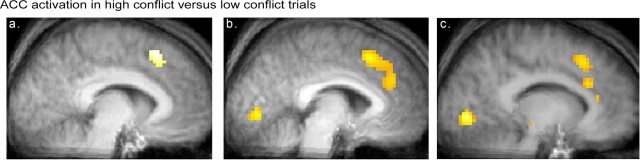
Figure 1.
Figure 1.
Sagittal brain section illustrating ACC activation in high-conflict versus low-conflict trials. A, High versus low conflict, all trials. B, High versus low conflict, only no-response trials. C, Conflict directly assessed by using participants' ratings of similarity of attractiveness for each pair. These ratings account for the covariates design in the SPM general linear model (parametric analysis). Only no-response trials are included.
Figure 2.
Figure 2.
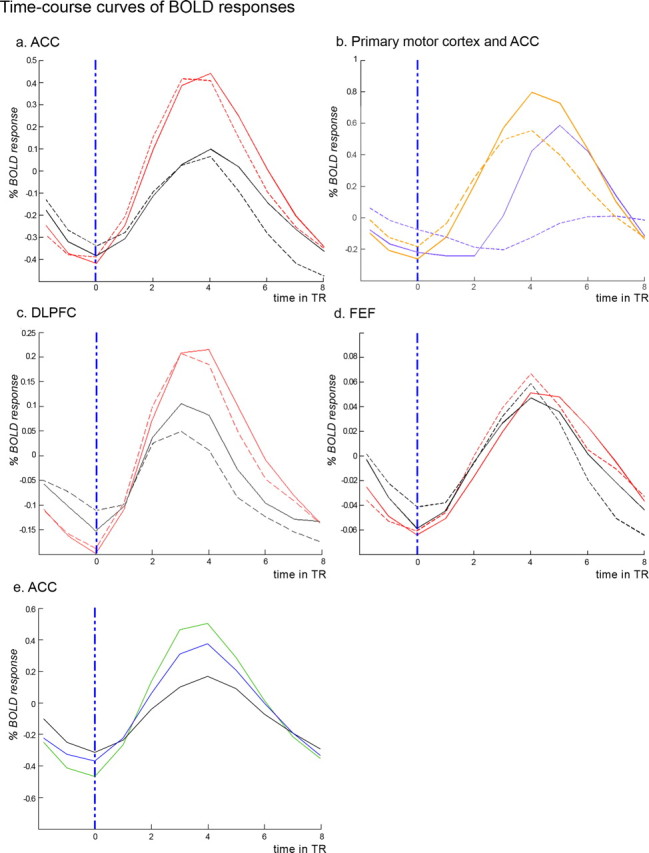
Averaged and fitted time course curves of fMRI signal (BOLD response). In all panels, the vertical blue dashed line corresponds to the appearances of the faces. TR, 1.8 s. A, Signal within the ACC for the no response trials (red, high conflict; black, low conflict). Solid lines show activation for all trials combined, with dashed lines showing activation only for trials with the shortest decision phase duration (3.6 s). B, Signal within the ACC (orange) and the primary motor cortex face area (purple); solid lines correspond to trials where a verbal motor response is required and dashed lines to trials without an overt response. C, Signal within dorsolateral prefrontal cortex (DLPFC) for the no response trials (red, high conflict; black, low conflict. Solid lines show activation for all trials combined, with dashed lines showing activation only for trials with the shortest decision phase duration (3.6 s). D, Signal within FEF for the no response trials (red, high conflict; black, low conflict). Solid lines show activation for all trials combined, with dashed lines showing activation only for trials with the shortest decision phase duration (3.6 s). E, Signal within the ACC for the no response trials [green, high conflict (attractive); blue, high conflict (unattractive); black, low conflict].

References

    1. Barch DM, Braver TM, Sabb FW, Noll DC. Anterior cingulate and the monitoring of response conflict: Evidence from an fMRI study of overt verb generation. J Cogn Neurosci. 2000;12:298–309. - PubMed
    1. Botvinick MM, Braver TS, Carter CS, Barch DM, Cohen JD. Conflict monitoring and cognitive control. Psychol Rev. 2001;108:624–652. - PubMed
    1. Cohen MX, Heller AS, Ranganath C. Functional connectivity with anterior cingulate and orbitofrontal cortices during decision-making. Cognitive Brain Res 2. 2005;3:61–70. - PubMed
    1. De Martino B, Kumaran D, Seymour B, Dolan RJ. Frames, biases, and rational decision-making in the human brain. Science. 2006;313:684–687. - PMC - PubMed
    1. Dhar R. Consumer preference for a no-choice option. J Consumer Res. 1997;24:215–231.

Publication types