. 2008 Apr 8;105(14):5507-12.
doi: 10.1073/pnas.0800587105. Epub 2008 Mar 26.

SGX393 inhibits the CML mutant Bcr-AblT315I and preempts in vitro resistance when combined with nilotinib or dasatinib

Affiliations

SGX393 inhibits the CML mutant Bcr-AblT315I and preempts in vitro resistance when combined with nilotinib or dasatinib

Thomas O'Hare et al. Proc Natl Acad Sci U S A. .

Abstract

Imatinib inhibits Bcr-Abl, the oncogenic tyrosine kinase that causes chronic myeloid leukemia. The second-line inhibitors nilotinib and dasatinib are effective in patients with imatinib resistance resulting from Bcr-Abl kinase domain mutations. Bcr-Abl(T315I), however, is resistant to all Abl kinase inhibitors in clinical use and is emerging as the most frequent cause of salvage therapy failure. SGX393 is a potent inhibitor of native and T315I-mutant Bcr-Abl kinase that blocks the growth of leukemia cell lines and primary hematopoietic cells expressing Bcr-Abl(T315I), with minimal toxicity against Bcr-Abl-negative cell lines or normal bone marrow. A screen for Bcr-Abl mutants emerging in the presence of SGX393 revealed concentration-dependent reduction in the number and range of mutations. Combining SGX393 with nilotinib or dasatinib preempted emergence of resistant subclones, including Bcr-Abl(T315I). These findings suggest that combination of a T315I inhibitor with the current clinically used inhibitors may be useful for reduction of Bcr-Abl mutants in Philadelphia chromosome-positive leukemia.


Conflict of interest statement

Conflict of interest statement: The sponsor is a consultant for the biotech company whose compound is reported in this manuscript. The sponsor receives less than $10,000 per year in consulting fees. S.B., K.H., K.A.J., C.T., H.A.L., R.D.R., and S.K.B. are employees of SGX Pharmaceuticals, Inc.

Figures
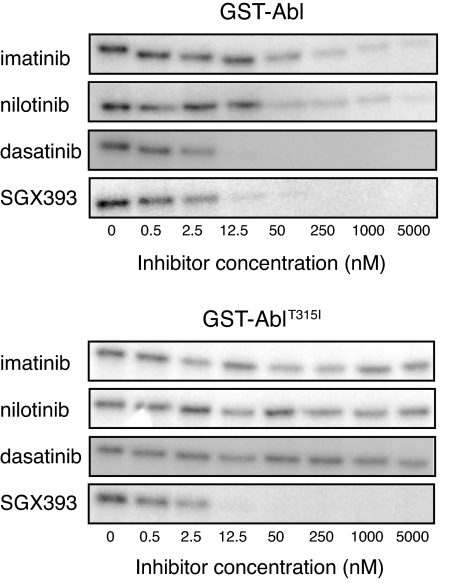
Fig. 1.
Fig. 1.
Inhibition of GST-Abl and GST-AblT315I enzymatic activity by SGX393. Inhibition of in vitro autophosphorylation of purified GST-Abl and GST-AblT315I by imatinib, nilotinib, dasatinib, and SGX393. After incubation of purified, tyrosine-dephosphorylated enzyme with the indicated inhibitors in the presence of [γ-32P]-ATP and separation by gel electrophoresis, signal intensity was measured by autoradiography.
Fig. 2.
Fig. 2.
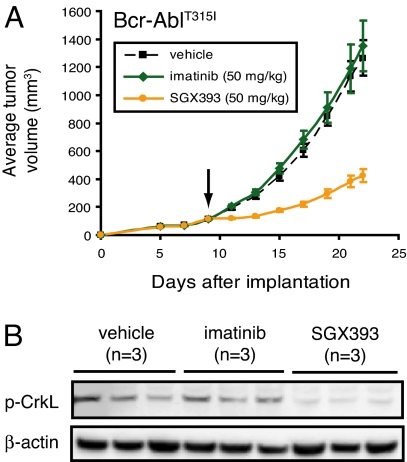
Efficacy of SGX393 against Bcr-AblT315I in a murine xenograft model. (A) SGX393 mitigates increase in Bcr-AblT315I-driven tumor volume. Ba/F3 cells expressing Bcr-AblT315I were s.c. implanted in nude mice (2 × 10⁶ cells per mouse). At a tumor volume of 100 mm3, treatment by i.p. injection was initiated with vehicle (black; 50% PEG400, 50% saline), imatinib (green), or SGX393 (orange) at 50 mg/kg every 2 days for 12–13 days. At study end, plasma levels of SGX393 were measured. (B) SGX393 inhibits phosphorylation of CrkL in a Bcr-AblT315I-driven tumor model. Two hours after administering vehicle or inhibitor for the final time in the study described in A, tumors from three mice per condition were collected and subjected to immunoblot analysis for CrkL phosphorylation status with an anti-phospho-CrkL antibody. β-actin was the loading control.
Fig. 3.
Fig. 3.
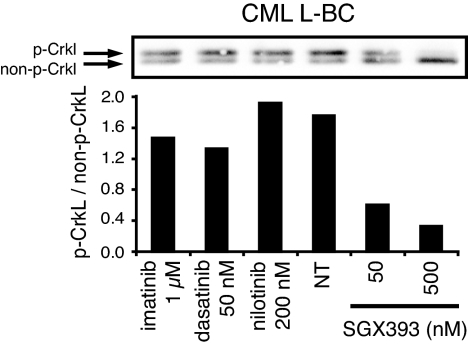
Inhibition of tyrosine phosphorylation by SGX393 in primary Bcr-AblT315I cells. Bcr-AblT315I CML lymphoid blast crisis (CML L-BC) mononuclear cells incubated with SGX393, imatinib, dasatinib, or nilotinib overnight were subjected to immunoblot analysis with a total CrkL-specific antibody (Upper), and the ratio of phosphorylated CrkL to nonphosphorylated CrkL was determined by densitometry (Lower).
Fig. 4.
Fig. 4.
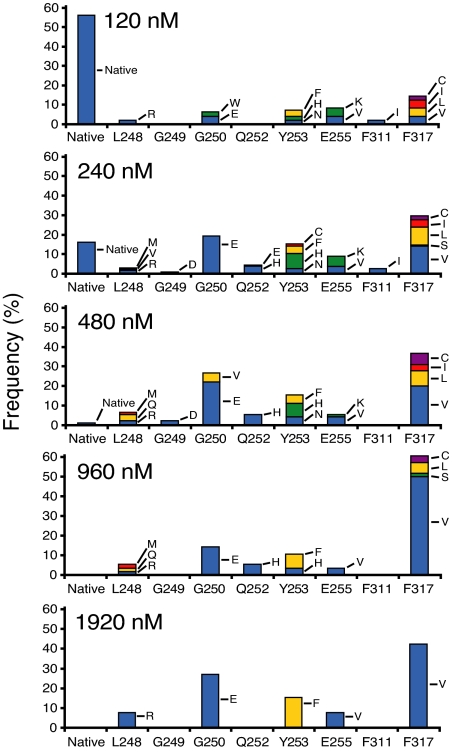
Distribution of Bcr-Abl kinase domain mutations in subclones resistant to SGX393. ENU-treated Ba/F3 cells expressing native Bcr-Abl were cultured with graded concentrations of SGX393. Each bar represents the relative percentage of the indicated mutant among recovered subclones. Because the percentage of surviving resistant subclones and the concentration of SGX393 are inversely related, a different number of sequenced subclones is represented in the graph for each concentration of SGX393 (SI Table 2). The greatest number of resistant subclones was analyzed at 240 nM SGX393 [resolution of detection: one occurrence per 204 kinase domain-mutant-positive wells (0.5%)]. The detection limits for the remaining SGX393 concentrations are: 120 nM (2.1%; 48 subclones sequenced), 480 nM (1.1%; 90 subclones sequenced), 960 nM (1.8%; 56 subclones sequenced), and 1,920 nM (3.8%; 26 subclones sequenced). In addition, the following mutations accounted for 2.8% of recovered subclones at 240 nM SGX393 only: N322K, E355G, Y417S (1 of 243, 0.4% each), and E258K (4 of 243, 1.6%).
Fig. 5.
Fig. 5.
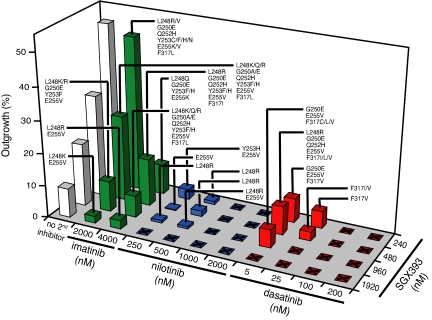
Coadministration of SGX393 with a second Abl kinase inhibitor reduces the frequency of resistant subclones and the spectrum of Bcr-Abl kinase domain mutations. ENU-treated Ba/F3 cells expressing native Bcr-Abl were cultured with graded concentrations of SGX393 alone (white) and in dual combination with imatinib (green), nilotinib (blue), or dasatinib (red). Bars represent the percentage of wells from which drug-resistant subclones were recovered. A total of 288 wells were analyzed in all combination experiments except those involving 240 nM SGX393, for which 96 wells were examined. Labels indicate specific Bcr-Abl mutations identified for recovered subclones. Unlabeled squares with an X indicate inhibitor combinations for which no resistant subclones were recovered. See SI Tables 4–6 for further details pertaining to the Abl inhibitor combination experiments.

References

    1. Druker BJ, et al. Effects of a selective inhibitor of the Abl tyrosine kinase on the growth of Bcr-Abl positive cells. Nat Med. 1996;2:561–566. - PubMed
    1. Druker BJ, et al. Five-year follow-up of patients receiving imatinib for chronic myeloid leukemia. N Engl J Med. 2006;355:2408–2417. - PubMed
    1. Sawyers CL, et al. Imatinib induces hematologic and cytogenetic responses in patients with chronic myelogenous leukemia in myeloid blast crisis: Results of a phase II study. Blood. 2002;99:3530–3539. - PubMed
    1. Talpaz M, et al. Imatinib induces durable hematologic and cytogenetic responses in patients with accelerated phase chronic myeloid leukemia: Results of a phase 2 study. Blood. 2002;99:1928–1937. - PubMed
    1. Ottmann OG, et al. A phase 2 study of imatinib in patients with relapsed or refractory Philadelphia chromosome-positive acute lymphoid leukemias. Blood. 2002;100:1965–1971. - PubMed

Publication types

MeSH terms