The effect of immune selection on the structure of the meningococcal opa protein repertoire
- PMID: 18369470
- PMCID: PMC2265424
- DOI: 10.1371/journal.ppat.1000020
The effect of immune selection on the structure of the meningococcal opa protein repertoire
Abstract
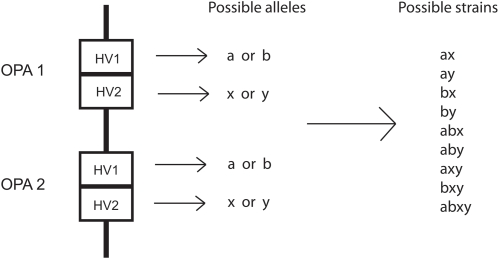
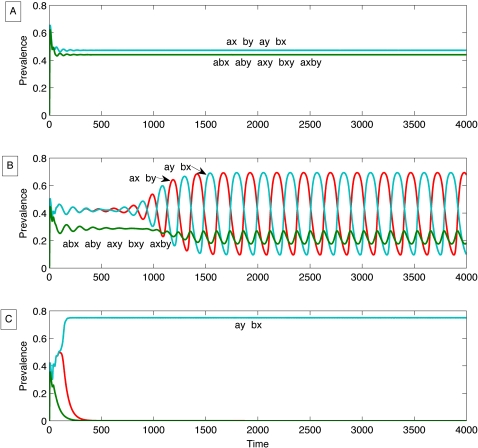
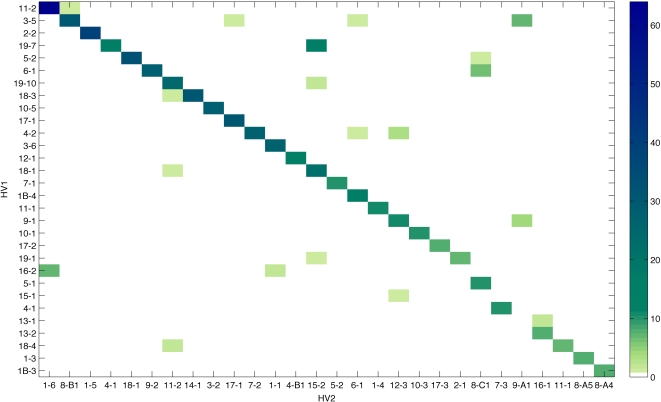
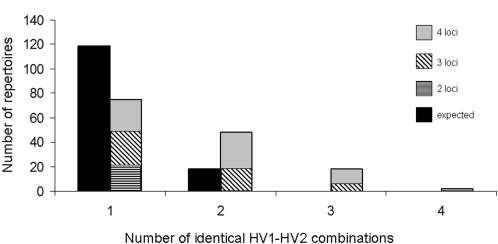
The opa genes of the Gram negative bacterium Neisseria meningitidis encode Opacity-associated outer membrane proteins whose role is to promote adhesion to the human host tissue during colonisation and invasion. Each meningococcus contains 3-4 opa loci, each of which may be occupied by one of a large number of alleles. We analysed the Opa repertoire structure in a large, well-characterised collection of asymptomatically carried meningococci. Our data show an association between Opa repertoire and meningococcal lineages similar to that observed previously for meningococci isolated from cases of invasive disease. Furthermore, these Opa repertoires exhibit discrete, non-overlapping structure at a population level, and yet low within-repertoire diversity. These data are consistent with the predictions of a mathematical model of strong immune selection upon a system where identical alleles may occupy different loci.
Conflict of interest statement
MCJM is named as an inventor and MJC as a contributor on patent applications in the area of serogroup B meningococcal vaccine development. No other authors report conflicts of interest.
Figures
References
-
- Virji M, Makepeace K, Ferguson DJ, Achtman M, Moxon ER. Meningococcal Opa and Opc proteins: their role in colonization and invasion of humanepithelial and endothelial cells. Molecular Microbiology. 1993;10:499–510. - PubMed
-
- Moore J, Bailey SE, Benmechernene Z, Tzitzilonis C, Griffiths NJ, et al. Recognition of saccharides by the OpcA, OpaD, and OpaB outer membrane proteins from Neisseria meningitidis. J Biol Chem. 2005;280:31489–31497. - PubMed
-
- Virji M, Watt SM, Barker S, Makepeace K, Doyonnas R. The N-domain of the human CD66a adhesion molecule is a target for Opa proteins of Neisseria meningitidis and Neisseria gonorrhoeae. Mol Microbiol. 1996;22:929–939. - PubMed
-
- Virji M, Makepeace K, Ferguson DJ, Watt SM. Carcinoembryonic antigens (CD66) on epithelial cells and neutrophils are receptors for Opa proteins of pathogenic neisseriae. Mol Microbiol. 1996;22:941–950. - PubMed
-
- Morelli G, Malorny B, Muller K, Seiler A, Wang JF, et al. Clonal descent and microevolution of Neisseria meningitidis during 30 years of epidemic spread. Mol Microbiol. 1997;25:1047–1064. - PubMed
Publication types
MeSH terms
Substances
Grants and funding
LinkOut - more resources
Full Text Sources