


Reward-related activity in the human motor cortex
- PMID: 18371077
- PMCID: PMC5456265
- DOI: 10.1111/j.1460-9568.2008.06147.x
Reward-related activity in the human motor cortex
Abstract
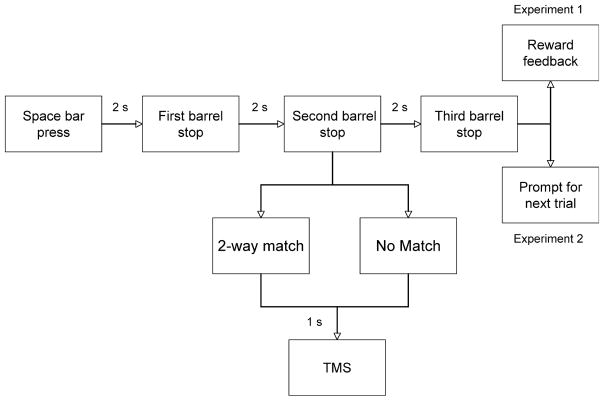
The human primary motor cortex (M1) participates in motor learning and response selection, functions that rely on feedback on the success of behavior (i.e. reward). To investigate the possibility that behavioral contingencies alter M1 activity in humans, we tested intracortical inhibition with single and paired (subthreshold/suprathreshold) transcranial magnetic stimulation during a slot machine simulation that delivered variable money rewards for three-way matches and required no movement. A two-way match before the third barrel had stopped (increased reward expectation) was associated with more paired-pulse inhibition than no match. Receiving a large reward on the preceding trial augmented this effect. A control task that manipulated attention to the same stimuli produced no changes in excitability. The origin of this reward-related activity is not clear, although dopaminergic ventral tegmental area neurons project to M1, where they are thought to inhibit output neurons and could be the source of the finding. Transcranial magnetic stimulation of M1 may be useful as a quantitative measure of reward-related activity.
Figures


References
-
- Abler B, Walter H, Erk S, Kammerer H, Spitzer M. Prediction error as a linear function of reward probability is coded in human nucleus accumbens. Neuroimage. 2006;31:790–795. - PubMed
-
- Alexander GE, Crutcher MD. Neural representations of the target (goal) of visually guided arm movements in three motor areas of the monkey. J Neurophysiol. 1990;64:164–178. - PubMed
-
- Amassian VE, Stewart M, Quirk GJ, Rosenthal JL. Physiological basis of motor effects of a transient stimulus to cerebral cortex. Neurosurgery. 1987;20:74–93. - PubMed
-
- Aron AR, Shohamy D, Clark J, Myers C, Gluck MA, Poldrack RA. Human midbrain sensitivity to cognitive feedback and uncertainty during classification learning. J Neurophysiol. 2004;92:1144–1152. - PubMed
-
- Awenowicz PW, Porter LL. Local application of dopamine inhibits pyramidal tract neuron activity in the rodent motor cortex. J Neurophysiol. 2002;88:3439–3451. - PubMed
Publication types
MeSH terms
Grants and funding
LinkOut - more resources
Full Text Sources
