. 2008 Jun;190(11):4017-26.
doi: 10.1128/JB.00117-08. Epub 2008 Mar 28.

Genetic analysis of the methanol- and methylamine-specific methyltransferase 2 genes of Methanosarcina acetivorans C2A

Affiliations

Genetic analysis of the methanol- and methylamine-specific methyltransferase 2 genes of Methanosarcina acetivorans C2A

Arpita Bose et al. J Bacteriol. 2008 Jun.

Abstract

The entry of methanol into the methylotrophic pathway of methanogenesis is mediated by the concerted effort of two methyltransferases, namely, methyltransferase 1 (MT1) and methyltransferase 2 (MT2). The mtaA1, mtaA2, and mtbA genes of Methanosarcina acetivorans C2A encode putative methanol- or methylamine-specific MT2 enzymes. To address the in vivo roles of these genes in growth and methanogenesis from known substrates, we constructed and characterized mutants with deletions of each of these genes. The mtaA1 gene is required for growth on methanol, whereas mtaA2 was dispensable. However, the mtaA2 mutant had a reduced rate of methane production from methanol. Surprisingly, deletion of mtaA1 in combination with deletions of the genes encoding three methanol-specific MT1 isozymes led to lack of growth on acetate, suggesting that MT1 and MT2 enzymes might play an important role during growth on this substrate. The mtbA gene was required for dimethylamine and monomethylamine (MMA) utilization and was important, but not required, for trimethylamine utilization. Analysis of reporter gene fusions revealed that both mtaA1 and mtbA were expressed on all methanogenic substrates tested. However, mtaA1 expression was induced on methanol, while mtbA expression was down-regulated on MMA and acetate. mtaA2 was expressed at very low levels on all substrates. The mtaA1 transcript had a large 5' untranslated region (UTR) (275 bp), while the 5' UTR of the mtbA transcript was only 28 bp long.


Figures
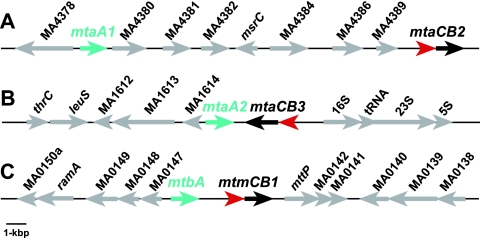
FIG. 1.
FIG. 1.
Physical maps of the mtaA genes in M. acetivorans. A 20-kbp DNA region surrounding mtaA1 (A), mtaA2 (B), and the mtbA gene mtaA2 (C) is shown. mtaA1, mtaA2, and mtbA are shown as aquamarine arrows; mtaC2 and mtaC3 are shown as red arrows; and mtaB2 and mtaB3 are shown as blue arrows. Other open reading frames are shown as gray arrows.
FIG. 2.
FIG. 2.
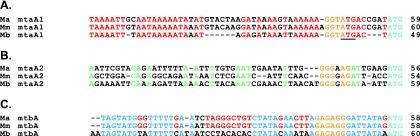
Sequence alignment of the upstream regions of Methanosarcina mtaA1, mtaA1, and mtbA genes. A sequence of approximately 60 bp of DNA upstream of the predicted start site of the M. acetivorans (Ma), M. barkeri (Mb), and M. mazei (Mm) mtaA1 gene (A), mtaA2 gene (B), and mtbA gene (C) was compared using CLUSTALW (42). The predicted start codon for each gene is shown in cyan. The putative RBS is shown in yellow. (A) Conserved bases are shown in red. The annotated start site is underlined. (B) Conserved bases are shown in green. (C) Bases conserved in all three Methanosarcina spp. are shown in blue while those conserved in M. acetivorans and M. mazei are shown in red.
FIG. 3.
FIG. 3.
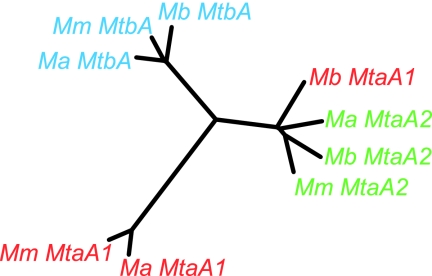
Phylogeny of Methanosarcina MtaA and MtbA proteins. Unrooted neighbor-joining tree generated by the DrawTree program (http://workbench.sdsc.edu) (13, 22, 42) for the MtaA1 (red), MtaA2 (green), and MtbA (blue) proteins from M. acetivorans (Ma), M. mazei (Mm), and M. barkeri (Mb) are shown. Note that in all cases the individual isozymes in the three Methanosarcina spp. are more similar to each other than they are to other isozymes found in the same organism. The M. barkeri MtaA1 protein is an exception as it is more similar to the MtaA2 isozymes from the three Methanosarcina spp.
FIG. 4.
FIG. 4.
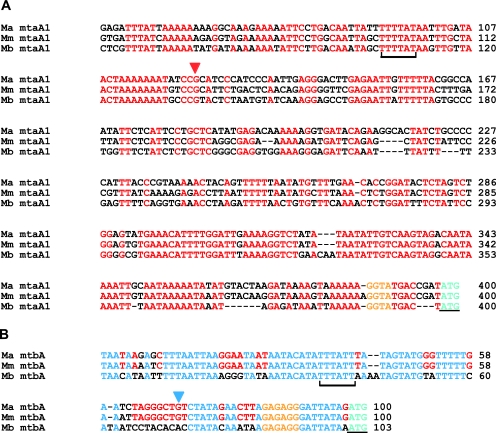
The TSS of mtaA1 and mtbA in M. acetivorans determined by 5′ RLM-RACE. The 5′ mRNA leader region upstream of the putative start codon (cyan and underlined bases) for the three genes along with the experimentally determined TSS(arrow) and the putative TATA box (black bracket) and RBS (orange text) are shown. Panel A shows this region for the mtaA1 promoter; the red letters represent bases conserved in all three Methanosarcina spp., namely M. acetivorans (Ma), M. mazei (Mm), and M. barkeri (Mb). Panel B shows the 5′ mRNA leader region for the mtbA promoter; the blue letters represent bases conserved in all three Methanosarcina spp. while the red letters represent bases conserved between M. acetivorans and M. mazei.

References

    1. Ausubel, F. M., R. Brent, R. E. Kingston, D. D. Moore, J. G. Seidman, J. A. Smith, and K. Struhl. 1992. Current protocols in molecular biology. John Wiley and Sons, New York, NY.
    1. Boccazzi, P., J. K. Zhang, and W. W. Metcalf. 2000. Generation of dominant selectable markers for resistance to pseudomonic acid by cloning and mutagenesis of the ileS gene from the archaeon Methanosarcina barkeri Fusaro. J. Bacteriol. 1822611-2618. - PMC - PubMed
    1. Bose, A., and W. W. Metcalf. 2008. Distinct regulators control the expression of methanol methyltransferase isozymes in Methanosarcina acetivorans C2A. Mol. Microbiol. 67649-661. - PubMed
    1. Bose, A., M. A. Pritchett, M. Rother, and W. W. Metcalf. 2006. Differential regulation of the three methanol methyltransferase isozymes in Methanosarcina acetivorans C2A. J. Bacteriol. 1887274-7283. - PMC - PubMed
    1. Brosius, J. 1989. Superpolylinkers in cloning and expression vectors. DNA 8759-777. - PubMed

Publication types

LinkOut - more resources