. 2008 Jun;190(11):4027-37.
doi: 10.1128/JB.01981-07. Epub 2008 Mar 28.

Complete genome sequence of uropathogenic Proteus mirabilis, a master of both adherence and motility

Affiliations

Complete genome sequence of uropathogenic Proteus mirabilis, a master of both adherence and motility

Melanie M Pearson et al. J Bacteriol. 2008 Jun.

Abstract

The gram-negative enteric bacterium Proteus mirabilis is a frequent cause of urinary tract infections in individuals with long-term indwelling catheters or with complicated urinary tracts (e.g., due to spinal cord injury or anatomic abnormality). P. mirabilis bacteriuria may lead to acute pyelonephritis, fever, and bacteremia. Most notoriously, this pathogen uses urease to catalyze the formation of kidney and bladder stones or to encrust or obstruct indwelling urinary catheters. Here we report the complete genome sequence of P. mirabilis HI4320, a representative strain cultured in our laboratory from the urine of a nursing home patient with a long-term (> or =30 days) indwelling urinary catheter. The genome is 4.063 Mb long and has a G+C content of 38.88%. There is a single plasmid consisting of 36,289 nucleotides. Annotation of the genome identified 3,685 coding sequences and seven rRNA loci. Analysis of the sequence confirmed the presence of previously identified virulence determinants, as well as a contiguous 54-kb flagellar regulon and 17 types of fimbriae. Genes encoding a potential type III secretion system were identified on a low-G+C-content genomic island containing 24 intact genes that appear to encode all components necessary to assemble a type III secretion system needle complex. In addition, the P. mirabilis HI4320 genome possesses four tandem copies of the zapE metalloprotease gene, genes encoding six putative autotransporters, an extension of the atf fimbrial operon to six genes, including an mrpJ homolog, and genes encoding at least five iron uptake mechanisms, two potential type IV secretion systems, and 16 two-component regulators.


Figures
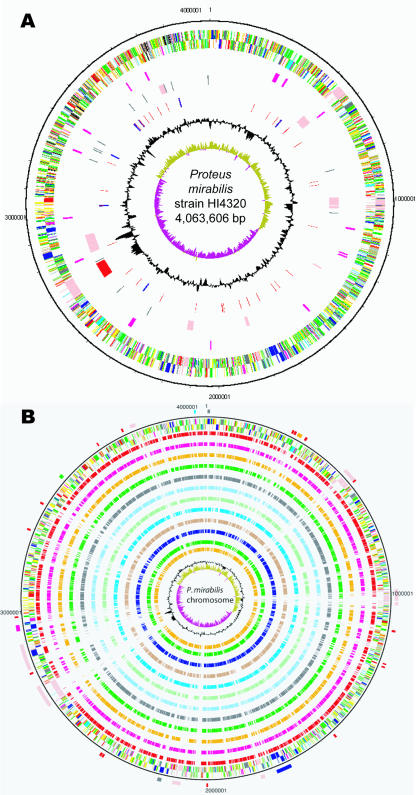
FIG. 1.
FIG. 1.
Circular representations of the genome of P. mirabilis. (A) The circles indicate (from the outside in) the positions of the following genes: circles 1 and 2, all genes (transcribed clockwise and counterclockwise); circle 3, fimbrial operons; circle 4, mobile elements (pink, prophages; red, integrative and conjugative elements; black, insertion elements); circle 5, RNA genes (blue, rRNA genes; red, tRNA genes); circle 6, G+C content (plotted using a 10-kb window); circle 7, GC deviation ([G − C]/[G + C] plotted using a 10-kb window; khaki, values more than 1; purple, values less than 1). (B) Comparison of P. mirabilis with other enteric genomes. The outer scale shows the positions (in bp). The circles indicate (from the outside in) the positions of the following genes. Circles 1 and 2 show all genes transcribed clockwise and counterclockwise, respectively (for an explanation of the colors, see below). Circles 3 to 14 show the positions of P. mirabilis genes that have orthologs (as determined by reciprocal FASTA) in E. coli UTI89, E. coli CFT073, E. coli 536, E. coli APEC O1, E. coli O157:H7 Sakai, E. coli E24377A, E. coli K-12, P. luminescens, K. pneumoniae, S. enterica serovar Typhimurium, Y. enterocolitica, and Y. pseudotuberculosis, respectively. Circle 15 shows a plot of the G+C content (plotted using a 10-kb window), and circle 16 shows a plot of GC deviation ([G − C]/[G + C] plotted using a 10-kb window; khaki, values more than 1; purple, values less than 1). The positions of the following important regions (mentioned in the text) are indicated on the outermost circle: putative toxins (black), fimbrial operons (red), Zap proteases (orange), flagella (dark blue), type III secretion system (purple), O antigen biosynthesis (green), urease (light blue), and mobile elements (pink). Colors in both panels for genes in circles 1 and 2 indicate the following: dark blue, cell processes, adaptation, or pathogenicity; black, energy metabolism; red, information transfer; dark green, surface associated; cyan, degradation of large molecules; magenta, degradation of small molecules; yellow, central or intermediary metabolism; pale green, unknown; pale blue, regulators; orange, conserved hypothetical proteins; brown, pseudogenes; pink, mobile elements; gray, miscellaneous.
FIG. 2.
FIG. 2.
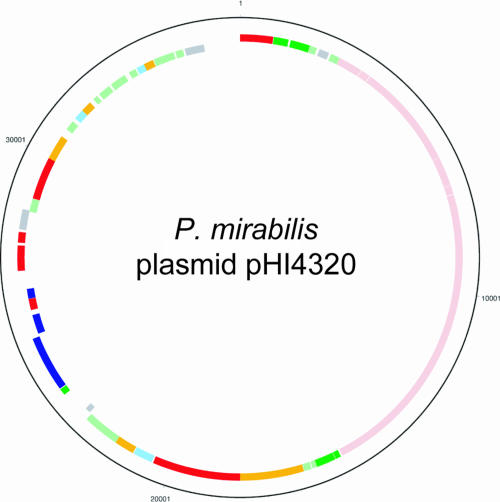
Circular representation of the P. mirabilis HI4320 plasmid. Circles 1 and 2 (from the outside in) show all 55 CDSs transcribed clockwise and counterclockwise, respectively. For an explanation of the colors, see the legend to Fig. 1. Of particular interest, CDSs indicated by pink encode a type IV conjugal transfer pilus, and CDSs indicated by blue encode a proticin and immunity system.
FIG. 3.
FIG. 3.
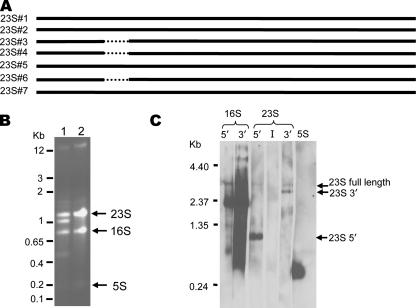
(A) Alignment of the seven 23S rRNA gene copies in HI4320. The dotted lines indicate where an insertion is present in four of seven copies of the 23S rRNA gene. Insertions are present in rRNA gene sequences 1, 2, 5, and 7. (B) RNA was isolated from P. mirabilis HI4320 and uropathogenic E. coli strain CFT073 and resolved on a 1.5% agarose gel. Lane 1, HI4320 RNA; lane 2, CFT073 RNA. The positions of double-stranded DNA molecular weight markers are indicated on the left. (C) Probes were designed to recognize the beginning and end of the 16S rRNA gene; the beginning, insertion sequence, and end of the 23S rRNA gene; and the 5S rRNA gene. These probes were used in a Northern blot analysis of HI4320 RNA. The intervening sequence of the 23S rRNA gene is believed to be excised and degraded (51), leaving behind the 5′ and 3′ fragments, which appear as the second and fourth bands in the agarose gel in panel B.
FIG. 4.
FIG. 4.
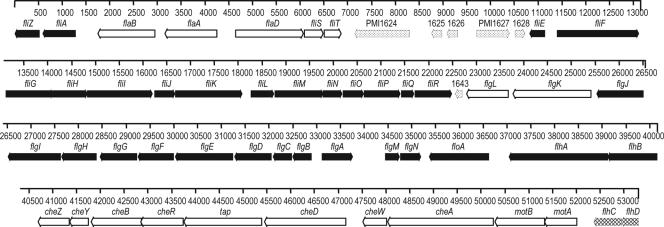
All genes that encode flagellar components are located in a 54-kb contiguous region of the HI4320 genome. There are 50 genes that are known to be involved in flagellar structure, regulation, or chemotaxis in this locus. In addition, there are five hypothetical or unknown genes between fliT and fliE (indicated by stippled arrows). It is unusual among the Enterobacteriaceae to find all the flagellar genes in one locus of the chromosome. Class 1 genes are indicated by cross-hatched arrows, class 2 genes are indicated by filled arrows, and class 3 genes are indicated by open arrows.
FIG. 5.
FIG. 5.
The well-studied mrp fimbrial operon, mrpABCDEFGHJ, is required for full virulence in the CBA/J mouse model of ascending UTI (6). The mrpI gene encodes a recombinase that controls the invertible promoter element for the mrp operon (38). Sequence analysis of the completed HI4320 genome revealed a duplication of the mrp operon immediately upstream of mrpI. This mrp operon, currently designated mrp′ (open arrows), is missing the mrpB gene and the mrpI recombinase but otherwise is highly similar to mrp (filled arrows). The percentages of similarity of the predicted MR/P′ protein sequences to the MR/P protein sequences are indicated above the mrp′ genes.
FIG. 6.
FIG. 6.
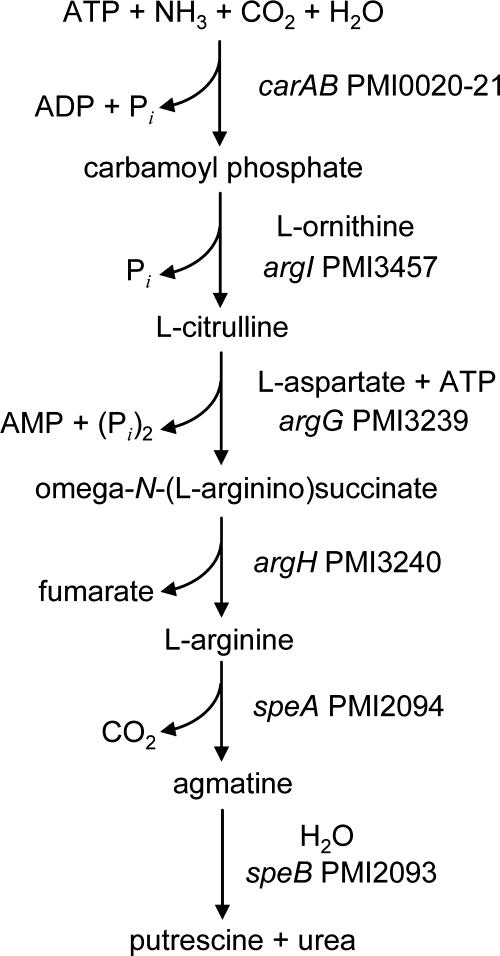
Predicted generation of putrescine and urea from ammonia. P. mirabilis HI4320 possesses seven genes potentially encoding a pathway that converts ammonia, ATP, carbon dioxide, and water into putrescine and urea in six steps.

References

    1. Adegbola, R. A., D. C. Old, and B. W. Senior. 1983. The adhesins and fimbriae of Proteus mirabilis strains associated with high and low affinity for the urinary tract. J. Med. Microbiol. 16427-431. - PubMed
    1. Alamuri, P., and H. L. T. Mobley. A novel autotransporter of uropathogenic Proteus mirabilis is both a cytotoxin and an agglutinin. Mol. Microbiol., in press. - PubMed
    1. Allison, C., H. C. Lai, and C. Hughes. 1992. Co-ordinate expression of virulence genes during swarm-cell differentiation and population migration of Proteus mirabilis. Mol. Microbiol. 61583-1591. - PubMed
    1. Aoki, S. K., R. Pamma, A. D. Hernday, J. E. Bickham, B. A. Braaten, and D. A. Low. 2005. Contact-dependent inhibition of growth in Escherichia coli. Science 3091245-1248. - PubMed
    1. Bahrani, F. K., S. Cook, R. A. Hull, G. Massad, and H. L. Mobley. 1993. Proteus mirabilis fimbriae: N-terminal amino acid sequence of a major fimbrial subunit and nucleotide sequences of the genes from two strains. Infect. Immun. 61884-891. - PMC - PubMed

Publication types

MeSH terms

Associated data