


Bionomics of Anopheles latens in Kapit, Sarawak, Malaysian Borneo in relation to the transmission of zoonotic simian malaria parasite Plasmodium knowlesi
- PMID: 18377652
- PMCID: PMC2292735
- DOI: 10.1186/1475-2875-7-52
Bionomics of Anopheles latens in Kapit, Sarawak, Malaysian Borneo in relation to the transmission of zoonotic simian malaria parasite Plasmodium knowlesi
Abstract
Background: A large focus of human infections with Plasmodium knowlesi, a simian parasite naturally found in long-tailed and pig-tailed macaques was discovered in the Kapit Division of Sarawak, Malaysian Borneo. A study was initiated to identify the vectors of malaria, to elucidate where transmission is taking place and to understand the bionomics of the vectors in Kapit.
Methods: Three different ecological sites in the forest, farm and longhouse in the Kapit district were selected for the study. Mosquitoes were collected by human landing collection at all sites and at the forest also by monkey-baited-traps situated on three different levels. All mosquitoes were identified and salivary glands and midguts of anopheline mosquitoes were dissected to determine the presence of malaria parasites.
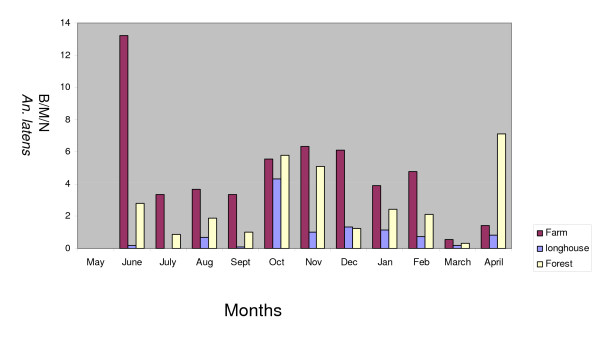
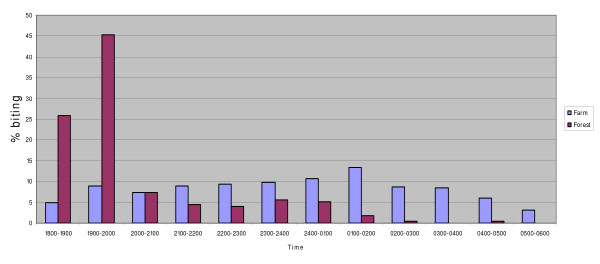
Results and discussions: Over an 11-month period, a total of 2,504 Anopheles mosquitoes comprising 12 species were caught; 1,035 at the farm, 774 at the forest and 425 at the longhouse. Anopheles latens (62.3%) and Anopheles watsonii (30.6%) were the predominant species caught in the forested ecotypes, while in the farm Anopheles donaldi (49.9%) and An. latens (35.6%) predominated. In the long house, An. latens (29.6%) and An. donaldi (22.8%) were the major Anopheline species. However, An. latens was the only mosquito positive for sporozoites and it was found to be attracted to both human and monkey hosts. In monkey-baited net traps, it preferred to bite monkeys at the canopy level than at ground level. An. latens was found biting early as 18.00 hours.
Conclusion: Anopheles latens is the main vector for P. knowlesi malaria parasites in the Kapit District of Sarawak, Malaysian Borneo. The study underscores the relationship between ecology, abundance and bionomics of anopheline fauna. The simio-anthropophagic and acrodendrophilic behaviour of An. latens makes it an efficient vector for the transmission of P. knowlesi parasites to both human and monkey hosts.
Figures
References
-
- Daniels CW. Animal parasites in man and some of the lower animals in Malaya. Stud Inst Med Res FMS. 1908;3:1–13.
-
- Sandosham AA. Recent researches on malaria at the Institute for Medical Research, Kuala Lumpur. Med J Malaya. 1967;22:145–160. - PubMed
Publication types
MeSH terms
Substances
LinkOut - more resources
Full Text Sources
Medical
