


Controlled Clinical Trial
doi: 10.1016/j.fertnstert.2008.01.108.
Epub 2008 Apr 18.
Nitric oxide metabolite production in the human preimplantation embryo and successful blastocyst formation
Affiliations
- PMID: 18377900
- PMCID: PMC3359095
- DOI: 10.1016/j.fertnstert.2008.01.108
Item in Clipboard
Controlled Clinical Trial
Nitric oxide metabolite production in the human preimplantation embryo and successful blastocyst formation
Fertil Steril.
2009 Apr.
Abstract
Eleven patients underwent controlled ovarian hyperstimulation yielding 72 embryos for evaluation. Mean nitric oxide metabolite levels in the insemination media were 2.6 times higher in embryos that progressed to blastocysts by culture day 5 than in those that did not. A comparison of the receiver operating characteristic curves between morphological predictors and nitric oxide metabolite levels revealed a trend toward a stronger association of insemination media nitric oxide metabolite with blastocyst formation.
Figures
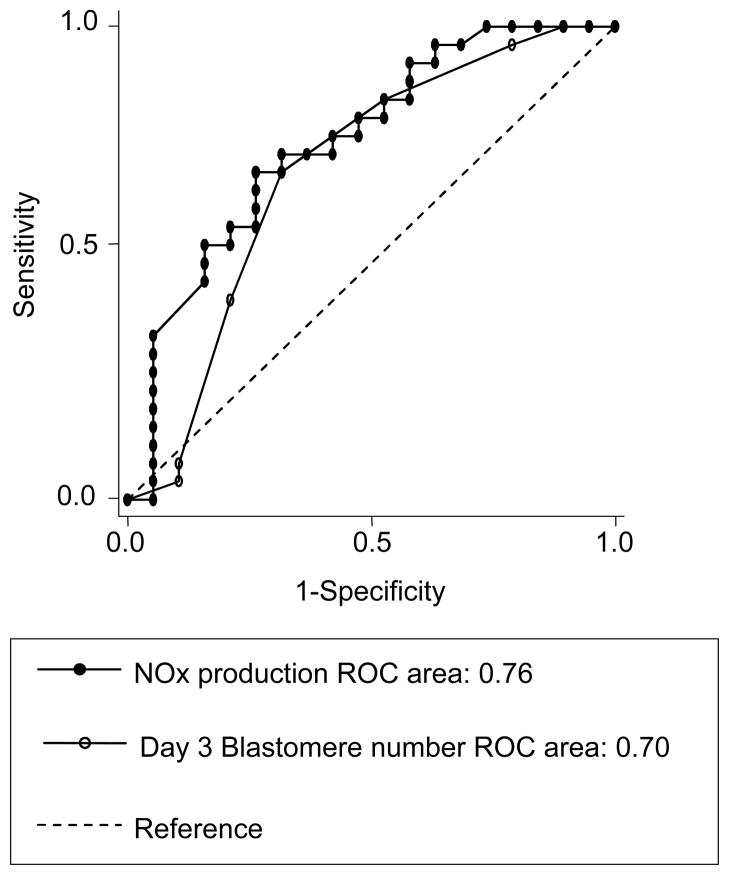
ROC analysis: IM NOx, CD 3 blastomere number and progression to the blastocyst stage by CD 5.
References
-
- Gardner DK, Lane M. Culture and selection of viable blastocysts: a feasible proposition for human IVF? Hum Reprod Update. 1997;3:367–82. - PubMed
-
- Papanikolaou EG, Camus M, Kolibianakis EM, Van Landuyt L, Van Steirteghem A, Devroey P. In vitro fertilization with single blastocyst-stage versus single cleavage-stage embryos. N Engl J Med. 2006;354:1139–46. - PubMed
-
- Scholtes MC, Zeilmaker GH. Blastocyst transfer in day-5 embryo transfer depends primarily on the number of oocytes retrieved and not on age. Fertil Steril. 1998;69:78–83. - PubMed
-
- Milki AA, Hinckley MD, Gebhardt J, Dasig D, Westphal LM, Behr B. Accuracy of day 3 criteria for selecting the best embryos. Fertil Steril. 2002;77:1191–5. - PubMed
-
- Rijnders PM, Jansen CA. The predictive value of day 3 embryo morphology regarding blastocyst formation, pregnancy and implantation rate after day 5 transfer following in-vitro fertilization or intracytoplasmic sperm injection. Hum Reprod. 1998;13:2869–73. - PubMed
Publication types
MeSH terms
Substances
Grants and funding
LinkOut - more resources
Full Text Sources
Other Literature Sources
