The relationship between in-home water service and the risk of respiratory tract, skin, and gastrointestinal tract infections among rural Alaska natives
- PMID: 18382002
- PMCID: PMC2636427
- DOI: 10.2105/AJPH.2007.115618
The relationship between in-home water service and the risk of respiratory tract, skin, and gastrointestinal tract infections among rural Alaska natives
Abstract
Objectives: We investigated the relationship between the presence of in-home piped water and wastewater services and hospitalization rates for respiratory tract, skin, and gastrointestinal tract infections in rural Alaska.
Methods: We determined in-home water service and hospitalizations for selected infectious diseases among Alaska Natives by region during 2000 to 2004. Within 1 region, infant respiratory hospitalizations and skin infections for all ages were compared by village-level water services.
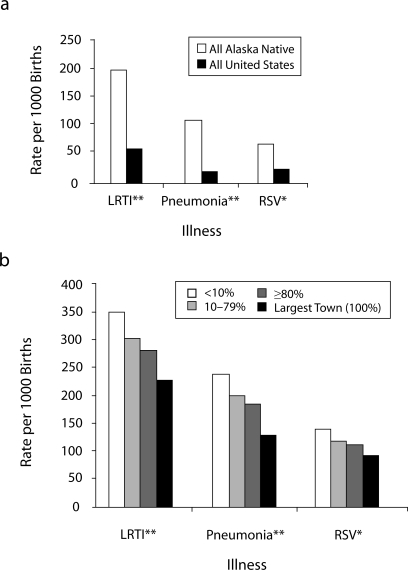
Results: Regions with a lower proportion of home water service had significantly higher hospitalization rates for pneumonia and influenza (rate ratio [RR] = 2.5), skin or soft tissue infection (RR = 1.9), and respiratory syncytial virus (RR = 3.4 among those younger than 5 years) than did higher-service regions. Within 1 region, infants from villages with less than 10% of homes served had higher hospitalization rates for pneumonia (RR = 1.3) and respiratory syncytial virus (RR = 1.2) than did infants from villages with more than 80% served. Outpatient Staphylococcus aureus infections (RR = 5.1, all ages) and skin infection hospitalizations (RR = 2.7, all ages) were higher in low-service than in high-service villages.
Conclusions: Higher respiratory and skin infection rates were associated with a lack of in-home water service. This disparity should be addressed through sanitation infrastructure improvements.
Figures
References
-
- US Census Bureau. Census of Housing, 1950. Available at: http://www.census.gov/hhes/www/housing/census/historic/plumbing.html. Accessed January 27, 2008.
-
- US Census Bureau. Census of Housing, 1970. Available at: http://www.census.gov/hhes/www/housing/census/historic/plumbing.html. Accessed January 27, 2008.
-
- US Census Bureau. US Summary, 2000. Available at: http://www.census.gov/prod/2002pubs/c2kprof00-us.pdf. Accessed January 27, 2008.
-
- Sanitation 2000: Water and Wastewater in Rural Alaska . Anchorage: Alaska Dept of Environmental Conservation, Village Safe Water Program; 2000
MeSH terms
LinkOut - more resources
Full Text Sources
Medical