. 2008 May;118(5):1858-66.
doi: 10.1172/JCI34257.

Deubiquitinating enzyme CYLD negatively regulates RANK signaling and osteoclastogenesis in mice

Affiliations

Deubiquitinating enzyme CYLD negatively regulates RANK signaling and osteoclastogenesis in mice

Wei Jin et al. J Clin Invest. 2008 May.

Abstract

Osteoclastogenesis is a tightly regulated biological process, and deregulation can lead to severe bone disorders such as osteoporosis. The regulation of osteoclastic signaling is incompletely understood, but ubiquitination of TNF receptor-associated factor 6 (TRAF6) has recently been shown to be important in mediating this process. We therefore investigated the role of the recently identified deubiquitinating enzyme CYLD in osteoclastogenesis and found that mice with a genetic deficiency of CYLD had aberrant osteoclast differentiation and developed severe osteoporosis. Cultured osteoclast precursors derived from CYLD-deficient mice were hyperresponsive to RANKL-induced differentiation and produced more and larger osteoclasts than did controls upon stimulation. We assessed the expression pattern of CYLD and found that it was drastically upregulated during RANKL-induced differentiation of preosteoclasts. Furthermore, CYLD negatively regulated RANK signaling by inhibiting TRAF6 ubiquitination and activation of downstream signaling events. Interestingly, we found that CYLD interacted physically with the signaling adaptor p62 and thereby was recruited to TRAF6. These findings establish CYLD as a crucial negative regulator of osteoclastogenesis and suggest its involvement in the p62/TRAF6 signaling axis.


Figures
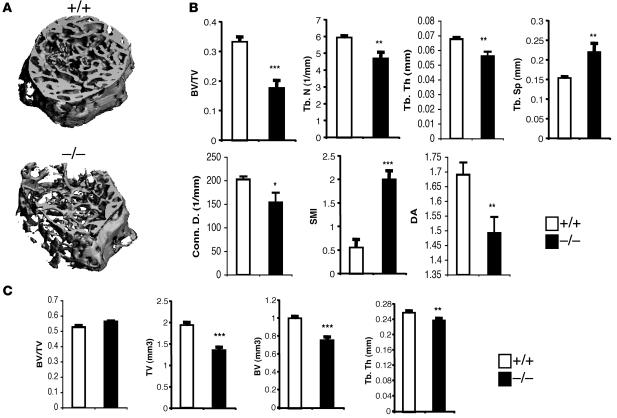
Figure 1
Figure 1. Bone loss in Cyld–/– mice.
Age-matched Cyld+/+ and Cyld–/– male mice (14 weeks of age, 7 per group) were subjected to microCT analysis. (A) Representative images of 3D microCT reconstruction of trabecular bone 263 μm above the distal femoral growth plate showing the severe bone loss in Cyld–/– mice. (B) Parameters of trabecular bone mass, including bone volume fraction (BV/TV), trabecular number (Tb. N), trabecular thickness (Tb. Th), trabecular separation (Tb. Sp), connectivity density (Conn. D), structure model index (SMI), and degree of anisotropy (DA). (C) Parameters of cortical bone mass, including bone volume fraction, total volume (TV), bone volume (BV), and cortical bone thickness (Tb. Th). *P < 0.05, **P < 0.02, ***P < 0.002. Error bars represent SEM.
Figure 2
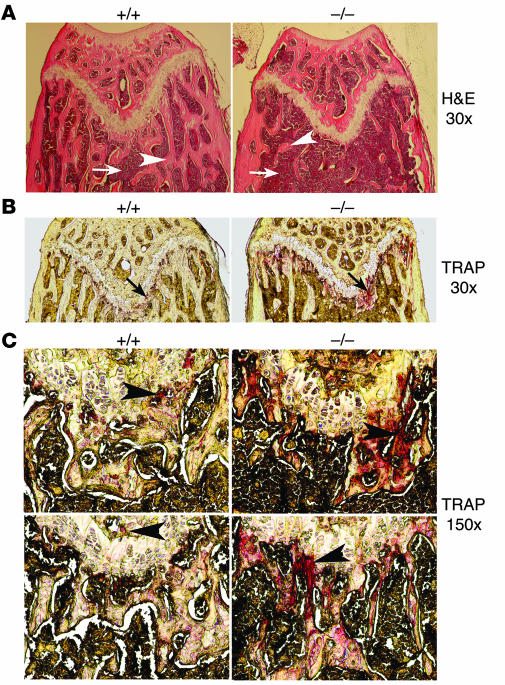
Figure 2. Cyld–/– mice have enlarged OCs.
(A) H&E staining of femoral sections of age-matched Cyld+/+ and Cyld–/– mice (14 weeks old), showing reduced trabecular bone (white arrowheads) in Cyld–/– femur. White arrows indicate bone marrow. (B) Increased TRAP activity in Cyld–/– bone compared with Cyld+/+ (black arrows). Original magnification, ×30. (C) Higher-magnification (×150) images showing the enlarged TRAP-positive OCs in 2 different Cyld+/+ and Cyld–/– mice.
Figure 3
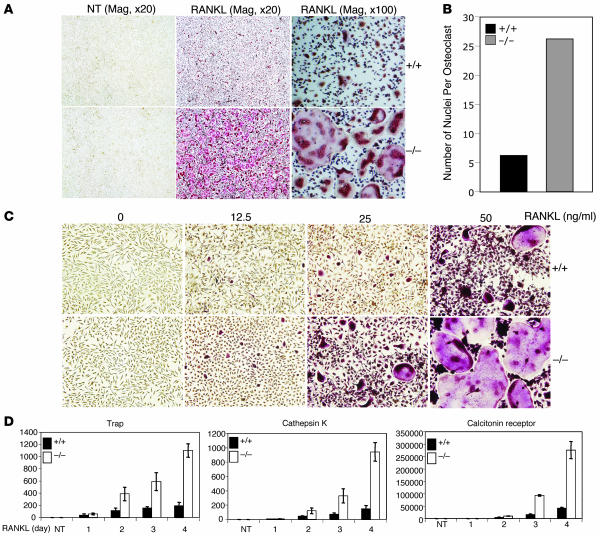
Figure 3. Enhanced OC differentiation from Cyld–/– bone marrow cells.
(A) Bone marrow cells derived from age-matched Cyld+/+ and Cyld–/– mice were cultured in M-CSF media either in the absence (NT) or presence of 100 ng/ml of GST-RANKL for 4 days and then subjected to TRAP staining. The images of RANKL-stimulated cells are presented as lower (×20) and higher (×100) magnifications. (B) Average number of nuclei per OC calculated based on counting in 15 Cyld+/+ and 15 Cyld–/– OCs. (C) Bone marrow cells derived from CYLD+/+ and CYLD–/– mice were cultured in M-CSF media supplemented with the indicated amounts of GST-RANKL. After 7 days, OCs were detected by TRAP staining. Note that this experiment used a longer differentiation time (7 days) than that shown in Figure 3A in order to detect OCs in the wild-type cell culture at low doses of GST-RANKL. (D) Real-time RT-PCR was performed using RNA isolated from BMDMs or BMDMs cultured in the presence of both M-CSF and 100 ng/ml GST-RANKL for the indicated times. The relative mRNA level of individual genes was expressed as fold induction compared with NT Cyld+/+ cells. Data represent mean values of 3 independent experiments, with error bars indicating SD.
Figure 4
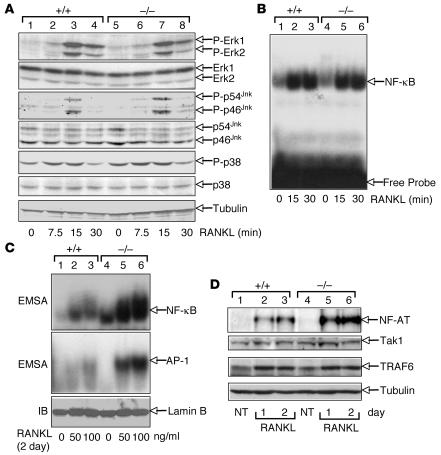
Figure 4. RANK signaling is normal in BMDMs but aberrant in preosteoclasts in the absence of CYLD.
(A) BMDMs were cultured in M-CSF–containing medium and stimulated with GST-RANKL (100 ng/ml) for the indicated times and subjected to IB assays using phospho-specific (P-) or regular antibodies against the indicated MAPKs or tubulin. (B) BMDMs were stimulated with GST-RANKL for the indicated times as in A, and the nuclear NF-κB DNA binding activity was detected by EMSA. (C) BMDMs were cultured for 2 days in M-CSF medium lacking (represented by 0) or containing the indicated amounts of GST-RANKL. Nuclear extracts were subjected to EMSA to detect the activation of NF-κB or AP-1. An IB of lamin B was included as a loading control. (D) BMDMs were cultured in M-CSF medium for 2 days in the absence of RANKL (NT) or for the indicated days in the presence of RANKL. Total cell lysates were subjected to IB to detect the indicated proteins.
Figure 5
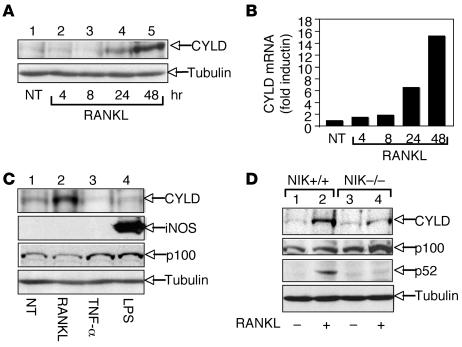
Figure 5. Induction of CYLD expression by RANKL but not by LPS or TNF-α.
(A) Wild-type BMDMs were cultured in M-CSF–containing medium in the absence of RANKL (NT) or for the indicated times in the presence of GST-RANKL (100 ng/ml). Total cell lysates were subjected to IB to detect CYLD and tubulin. (B) Real-time RT-PCR was performed using RNA isolated from cells as described in A to determine the relative expression of Cyld mRNA. (C) Wild-type BMDMs were cultured in M-CSF medium for 1 day in either the absence (NT) or presence of the indicated inducers. Total cell lysates were subjected to IB to detect the indicated proteins. (D) BMDMs prepared from Nik-knockout (NIK–/–) and control (NIK+/+) mice were cultured for 1 day in the absence (–) or presence (+) of GST-RANKL (100 ng/ml) followed by IB to detect the expression of CYLD (top panel) or processing of p100 (middle 2 panels). A tubulin IB was used as a loading control.
Figure 6
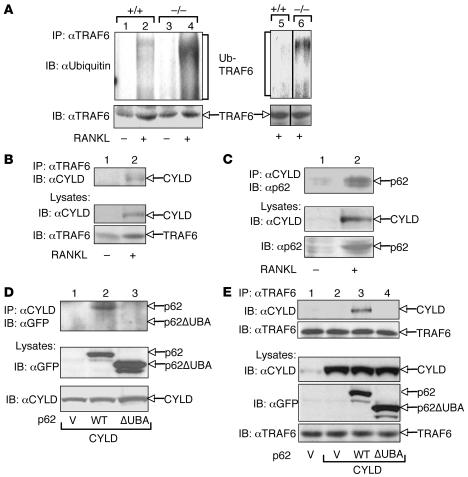
Figure 6. CYLD targets TRAF6, which is promoted by p62.
(A) Wild-type and Cyld–/– BMDMs were cultured for 2 days in M-CSF medium in either the absence (–) or presence (+) of GST-RANKL. TRAF6 was isolated by IP followed by IB to detect ubiquitin-conjugated TRAF6 (upper panel) or unmodified TRAF6 (lower panel). In lanes 5 and 6, the RANKL-treated cells were chased in RANKL-free media overnight before the TRAF6 ubiquitination assay. (B) Wild-type BMDMs were cultured for 2 days in M-CSF medium in the absence or presence of GST-RANKL. TRAF6 was isolated by IP followed by detection of the associated CYLD by IB (top panel). The lysates were subjected to IB to monitor the expression of CYLD and TRAF6 (middle and bottom panels). (C) Wild-type BMDMs were cultured for 2 days in M-CSF medium in the absence or presence of GST-RANKL. CYLD was isolated by IP followed by detection of the associated p62 by IB (top panel). The cell lysates were subjected to IB to monitor the expression of CYLD and p62 (middle and bottom panels). (D) 293 cells were transfected with CYLD along with vector control (V), wild-type p62, or p62ΔUBA. CYLD was isolated by IP, and its associated p62 was detected by IB (top panel). Protein expression in cell lysates was monitored by direct IB (middle and bottom panels). (E) 293T cells were transfected with either an empty vector or expression vectors encoding wild-type p62 or p62ΔUBA. Lanes 2–4 were also transfected with CYLD. Endogenous TRAF6 was isolated by IP followed by IB to detect the associated CYLD or the precipitated TRAF6 (top 2 panels). The cell lysates were subjected to IB to detect the expression of CYLD, EGFP-tagged p62 proteins, and TRAF6 (bottom 3 panels).
Figure 7
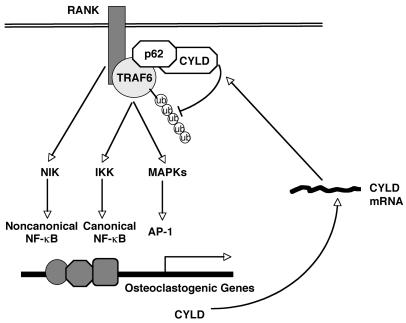
Figure 7. A model of CYLD function in RANK signaling.
Engagement of RANK by RANKL induces TRAF6 ubiquitination (Ub) and activation of downstream signaling molecules, leading to induction of genes involved in osteoclastogenesis. The RANK signaling also results in upregulation of CYLD as well as p62. CYLD targets TRAF6 via the assistance of p62, thereby negatively regulating TRAF6 ubiquitination and RANK signaling.

References

    1. Hadjidakis D.J., Androulakis I. Bone remodeling. Ann. N. Y. Acad. Sci. 2006;1092:385–396. doi: 10.1196/annals.1365.035. - DOI - PubMed
    1. Boyle W.J., Simonet W.S., Lacey D.L. Osteoclast differentiation and activation. Nature. 2003;423:337–342. doi: 10.1038/nature01658. - DOI - PubMed
    1. Teitelbaum S.L., Ross F.P. Genetic regulation of osteoclast development and function. Nat. Rev. Genet. 2003;4:638–649. doi: 10.1038/nrg1122. - DOI - PubMed
    1. Asagiri M., Takayanagi H. The molecular understanding of osteoclast differentiation. Bone. 2007;40:251–264. doi: 10.1016/j.bone.2006.09.023. - DOI - PubMed
    1. Takayanagi H. Osteoimmunology: shared mechanisms and crosstalk between the immune and bone systems. Nat. Rev. Immunol. 2007;7:292–304. doi: 10.1038/nri2062. - DOI - PubMed

Publication types

MeSH terms