. 2008 Jun;82(11):5408-16.
doi: 10.1128/JVI.00070-08. Epub 2008 Apr 2.

Characterization of a rhesus monkey calicivirus representing a new genus of Caliciviridae

Affiliations

Characterization of a rhesus monkey calicivirus representing a new genus of Caliciviridae

Tibor Farkas et al. J Virol. 2008 Jun.

Abstract

In this study, we report the characterization of a novel calicivirus (CV), the Tulane virus (TV), which was isolated from stool samples of captive juvenile rhesus macaques (Macaca mulatta) of the Tulane National Primate Research Center. The complete genome of TV contains 6,714 nucleotides plus a poly(A) tail and is organized into three open reading frames (ORFs) that encode the nonstructural (NS) polyprotein (ORF1); the capsid protein (ORF2), with an estimated molecular mass of 57.9 kDa; and a possible minor structural protein (ORF3), with an isoelectric point (pI) of 10.0 and a calculated molecular mass of 22.8 kDa. The NS polyprotein revealed all typical CV amino acid motifs, including GXXGXGKT (NTPase), EYXEX (Vpg), GDCG (protease), and GLPSG and YGDD (polymerase). Phylogenetic trees constructed for the NS polyprotein, NTPase, protease, polymerase, and capsid protein sequences consistently placed the TV on a branch rooted with Norovirus, but with distances equal to those between other genera. The TV can be cultured in a monkey kidney cell line (LLC-MK2) with the appearance of typical cytopathic effect. TV exhibits a typical CV morphology, with a diameter of 36 nm, and has a buoyant density of 1.37 g/ml. According to these physicochemical and genetic characteristics, TV represents a new CV genus for which we propose the name "Recovirus" (rhesus enteric CV). Although the pathogenicity of TV in rhesus macaques remains to be elucidated, the likelihood of TV causing intestinal infection and the availability of a tissue culture system make this virus a valuable surrogate for human CVs.


Figures
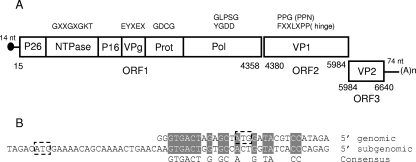
FIG. 1.
FIG. 1.
(A) Genome organization of TV. Conserved amino acid motifs are indicated. (B) Alignment of the 5′ ends of genomic and subgenomic TV RNAs. Initiation codons of the NS polyprotein and VP1 are boxed.
FIG. 2.
FIG. 2.
Predicted NS polyprotein cleavage sites of TV based on sequence alignments with published cleavage maps of other CVs. Since the alignments revealed the highest identity between TV and NVs, only published NV cleavage maps representing GI, GII, and GV are shown. Calculated protein molecular masses (in kilodaltons) and the positions of the amino acids at the cleavage sites are shown.
FIG. 3.
FIG. 3.
Unrooted phylogenetic trees based on amino acid sequence alignments of CV NTPase (A), polymerase (B), and VP1 (C). Trees were constructed by the neighbor-joining clustering method of MEGA 3.1, with Poisson distance calculations. The scale bars represent the phylogenetic distances expressed as units of amino acid substitutions per site. The confidence values of the internal nodes were obtained by performing 1,025 bootstrap analyses. Trees constructed for the NS polyprotein and protease exhibited similar topologies (data not shown).
FIG. 4.
FIG. 4.
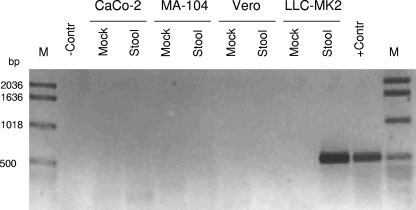
Detection of TV-specific RNA at the 6th passage of a TV-positive stool sample in CaCo-2, MA-104, Vero, and LLC-MK2 cells. M, molecular size marker (1-kb DNA ladder; Invitrogen, Carlsbad, CA). Mock-infected cells were passed parallel with stool-inoculated cells for each cell line. RNA was extracted from 100 μl of cell-free tissue culture medium obtained from each mock or infected (stool) cell culture. RNA extracted from 100 μl of TV-positive stool that was used to inoculate the cells originally served as a positive control (+Contr). −Contr, negative control. Primers P885 and P886 (Table 1) were used to amplify a 523-bp TV-specific product.
FIG. 5.
FIG. 5.
Physicochemical properties of TV. (A) RT-PCR amplification of TV-specific RNA extracted from CsCl density gradient fractions revealed a peak with a mean density calculated as follows: x̄ = 1.37 g/ml. −Contr, negative control. (B) Virus particles with typical CV morphology and a mean diameter (calculated as x̄ = 35.8 nm) were visualized in the peak fractions. (C) A single protein band of about 60 kDa could be visualized by SDS-polyacrylamide gel electrophoresis of peak fractions.

References

    1. Belliot, G., S. V. Sosnovtsev, T. Mitra, C. Hammer, M. Garfield, and K. Y. Green. 2003. In vitro proteolytic processing of the MD145 norovirus ORF1 nonstructural polyprotein yields stable precursors and products similar to those detected in calicivirus-infected cells. J. Virol. 7710957-10974. - PMC - PubMed
    1. Chang, K. O., S. S. Sosnovtsev, G. Belliot, Q. Wang, L. J. Saif, and K. Y. Green. 2005. Reverse genetics system for porcine enteric calicivirus, a prototype sapovirus in the Caliciviridae. J. Virol. 791409-1416. - PMC - PubMed
    1. Chaudhry, Y., A. Nayak, M. E. Bordeleau, J. Tanaka, J. Pelletier, G. J. Belsham, L. O. Roberts, and I. G. Goodfellow. 2006. Caliciviruses differ in their functional requirements for eIF4F components. J. Biol. Chem. 28125315-25325. - PubMed
    1. Cheetham, S., M. Souza, R. McGregor, T. Meulia, Q. Wang, and L. J. Saif. 2007. Binding patterns of human norovirus-like particles to buccal and intestinal tissues of gnotobiotic pigs in relation to A/H histo-blood group antigen expression. J. Virol. 813535-3544. - PMC - PubMed
    1. Cheetham, S., M. Souza, T. Meulia, S. Grimes, M. G. Han, and L. J. Saif. 2006. Pathogenesis of a genogroup II human norovirus in gnotobiotic pigs. J. Virol. 8010372-10381. - PMC - PubMed

Publication types