. 2008 Apr 8;105(14):5549-54.
doi: 10.1073/pnas.0711744105. Epub 2008 Apr 2.

Purported nanobacteria in human blood as calcium carbonate nanoparticles

Affiliations

Purported nanobacteria in human blood as calcium carbonate nanoparticles

Jan Martel et al. Proc Natl Acad Sci U S A. .

Erratum in

  • Proc Natl Acad Sci U S A. 2008 Nov 4;105(44):17206

Abstract

Recent evidence suggests a role for nanobacteria in a growing number of human diseases, including renal stone formation, cardiovascular diseases, and cancer. This large body of research studies promotes the view that nanobacteria are not only alive but that they are associated with disease pathogenesis. However, it is still unclear whether they represent novel life forms, overlooked nanometer-size bacteria, or some other primitive self-replicating microorganisms. Here, we report that CaCO(3) precipitates prepared in vitro are remarkably similar to purported nanobacteria in terms of their uniformly sized, membrane-delineated vesicular shapes, with cellular division-like formations and aggregations in the form of colonies. The gradual appearance of nanobacteria-like particles in incubated human serum as well as the changes seen with their size and shape can be influenced and explained by introducing varying levels of CO(2) and NaHCO(3) as well as other conditions known to influence the precipitation of CaCO(3). Western blotting reveals that the monoclonal antibodies, claimed to be specific for nanobacteria, react in fact with serum albumin. Furthermore, nanobacteria-like particles obtained from human blood are able to withstand high doses of gamma-irradiation up to 30 kGy, and no bacterial DNA is found by performing broad-range PCR amplifications. Collectively, our results provide a more plausible abiotic explanation for the unusual properties of purported nanobacteria.


Conflict of interest statement

The authors declare no conflict of interest.

Figures

Fig. 1.
Fig. 1.
Morphology and surface composition of nanobacteria-like particles. (A) SEM of NLP obtained by incubating healthy human serum diluted to 10% in DMEM showing colonies of coccoid bacteria-like formations. (B) Close-up SEM of NLP showing their diameter size between 500 and 1,000 nm. (C) SEM of a mixture of small NLP and larger shelter-like forms. The arrow shows the continuation between small and large forms. The square represents the section magnified in D. (D) Close-up SEM of large shelter-like formations showing their porous structure. The arrow indicates a small cell division-like formation. (E) Negative-stain TEM of NLP with an electron-dense core after incubation in DMEM for 1 month. (F) SEM of control HAP. (G) EDX spectrum of NLP obtained from human serum incubation. (H) EDX of control HAP. (I) EDX of NLP obtained by incubating the liquid fraction of the clotted blood (see Materials and Methods) reveals the absence of calcium and phosphate peaks. [Scale bars: 1 μm (A and B); 10 μm (C, D, and F), and 100 nm (E).]
Fig. 2.
Fig. 2.
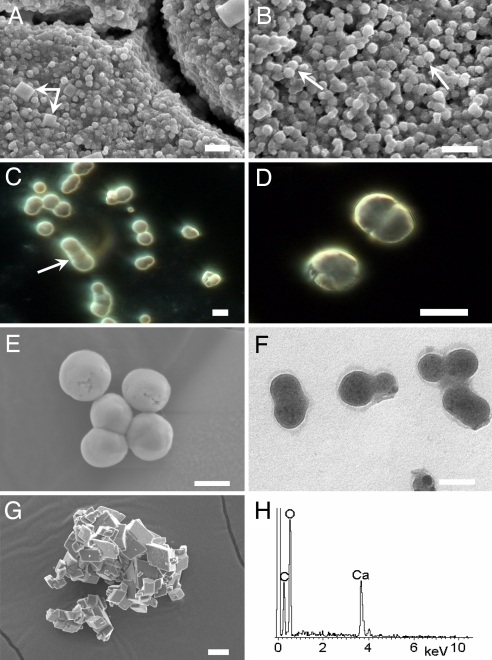
Calcium carbonate nanoparticles prepared in vitro are similar to NLP. (A) SEM of CaCO3 nanoparticles prepared from the diffusion of (NH4)2CO3 crystal vapors into a solution of 1 M CaCl2. Coccoidal bacteria-like structures with a narrow size range are observed along with euhedral calcite crystals (arrows). (B) SEM of CaCO3 nanoparticles prepared by diluting 1 M (NH4)2CO3 and 1 M CaCl2 1:100 in DMEM. Arrows indicate cell division-like forms. (C) Dark-field microscopy of larger CaCO3 crystals prepared by mixing 1 M (NH4)2CO3 and 1 M CaCl2 1:1 showing cellular appearance and division-like formations. The arrow shows a segmented cell division-like form. (D) Dark-field microscopy of a CaCO3 binary fission-like form along with a vesicle-like form reminiscent of a single cell. (E) SEM of large CaCO3 particles showing rounded-edge vesicles and a cell division-like formation. (F) Negative-stain TEM of CaCO3 nanoparticles prepared in DMEM. (G) SEM of control CaCO3. (H) EDX of CaCO3 nanoparticles prepared by mixing 1 M (NH4)2CO3 and 1 M CaCl2 1:1. [Scale bars: 1 μm (A and B), 5 μm (C–E), 100 nm (F), and 10 μm (G).]
Fig. 3.
Fig. 3.
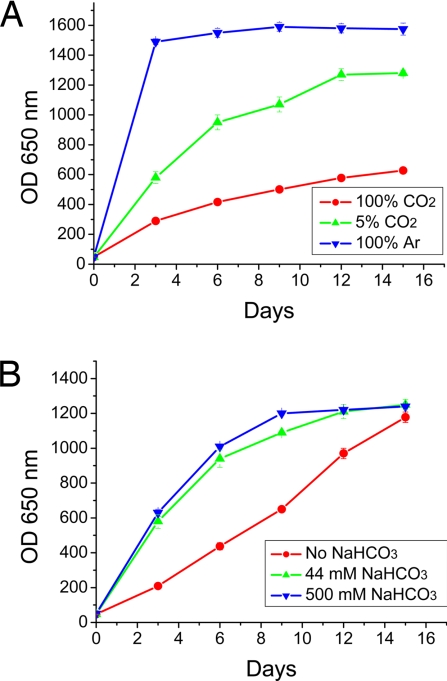
Influence of carbon dioxide and sodium bicarbonate on the culture of NLP. (A) Standard cell culture incubation of healthy human serum diluted 10% in DMEM, incubated with 5% CO2, 100% CO2, or 100% argon. Sample preparations and optical density reading at 650 nm (OD 650 nm) are as described in Materials and Methods. (B) Influence of different levels of NaHCO3 (Inset) on the number of NLP found in human serum cultures.
Fig. 4.
Fig. 4.
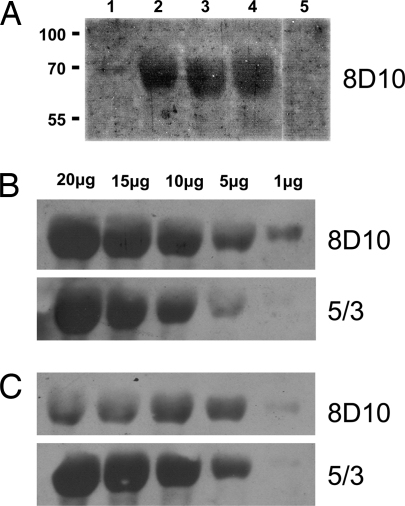
Reaction of nanobacterial monoclonal antibodies 8D10 and 5/3 with NLP cultures and pure albumin fractions. (A) Western blotting done with 8D10 on pelleted, 1-month-old NLP (lane 1), supernatant of 1-month-old NLP culture (lane 2), healthy whole human blood incubated for 1 month (lane 3), and fresh, healthy whole human blood (lane 4). Note a prominent band of 68 kDa for all four fractions as opposed to the protein extract from 293T cells used as control (lane 5). Only fraction from lane 1 but not fractions from lanes 2–5 contained NLP when observed by SEM. (B) Western blotting performed with antibodies 8D10 and 5/3 on different amounts of pure HSA that shows the same unique band of 68 kDa. (C) Immunoblotting done on different amounts of BSA that give the corresponding 68-kDa band.

References

    1. Wang L, et al. An animal model of black pigment gallstones caused by nanobacteria. Dig Dis Sci. 2006;51:1126–1132. - PubMed
    1. Kajander EO, Ciftcioglu N. Nanobacteria: An alternative mechanism for pathogenic intra- and extracellular calcification and stone formation. Proc Natl Acad Sci USA. 1998;95:8274–8279. - PMC - PubMed
    1. Hjelle JT, et al. Endotoxin and nanobacteria in polycystic kidney disease. Kidney Int. 2000;57:2360–2374. - PubMed
    1. Tsurumoto T, Matsumoto T, Yonekura A, Shindo H. Nanobacteria-like particles in human arthritic synovial fluids. J Proteome Res. 2006;5:1276–1278. - PubMed
    1. Sommer AP, Milankovits M, Mester AR. Nanobacteria, HIV and magic bullets: Update of perspectives 2005. Chemotherapy. 2006;52:95–97. - PubMed

Publication types