


The thermal impulse response of Escherichia coli
- PMID: 18385380
- PMCID: PMC2291076
- DOI: 10.1073/pnas.0709903105
The thermal impulse response of Escherichia coli
Abstract
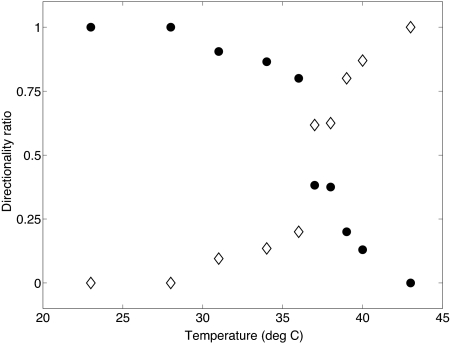
Swimming Escherichia coli responds to changes in temperature by modifying its motor behavior. Previous studies using populations of cells have shown that E. coli accumulate in spatial thermal gradients, but these experiments did not cleanly separate thermal responses from chemotactic responses. Here we have isolated the thermal response by studying the behavior of single, tethered cells. The motor output of cells grown at 33 degrees C was measured at constant temperature, from 10 degrees to 40 degrees C, and in response to small, impulsive increases in temperature, from 23 degrees to 43 degrees C. The thermal impulse response at temperatures < 31 degrees C is similar to the chemotactic impulse response: Both follow a similar time course, share the same directionality, and show biphasic characteristics. At temperatures > 31 degrees C, some cells show an inverted response, switching from warm- to cold-seeking behavior. The fraction of inverted responses increases nonlinearly with temperature, switching steeply at the preferred temperature of 37 degrees C.
Conflict of interest statement
The authors declare no conflict of interest.
Figures


References
-
- Salman H, Zilman A, Loverdo C, Jeffroy M, Libchaber A. Solitary modes of bacterial culture in a temperature gradient. Phys Rev Lett. 2006;97:118101. - PubMed
-
- Berg HC. E. coli in Motion. New York: Springer; 2004.
-
- Nara T, Kawagishi I, Nishiyama S, Homma M, Imae Y. Modulation of the thermosensing profile of the Escherichia coli aspartate receptor tar by covalent modification of its methyl-accepting sites. J Biol Chem. 1996;271:17932–17936. - PubMed
-
- Salman H, Libchaber A. A concentration-dependent switch in the bacterial response to temperature. Nat Cell Biol. 2007;9:1098–1100. - PubMed
Publication types
MeSH terms
Grants and funding
LinkOut - more resources
Full Text Sources
