Variations in the risk for cerebrovascular events after kidney transplant compared with experience on the waiting list and after graft failure
- PMID: 18385393
- PMCID: PMC2440268
- DOI: 10.2215/CJN.03080707
Variations in the risk for cerebrovascular events after kidney transplant compared with experience on the waiting list and after graft failure
Abstract
Background and objectives: This study examined the risks, predictors, and mortality implications of cerebrovascular disease events after kidney transplantation in a national cohort.
Design, setting, participants, & measurements: This analysis used United States Renal Data System registry data to study retrospectively Medicare-insured kidney transplant candidates (n = 51,504), recipients (n = 29,614), and recipients with allograft failure (n = 2954) in 1995 through 2002. New-onset cerebrovascular disease events including ischemic stroke, hemorrhagic stroke, and transient ischemic attacks were ascertained from billing records, and participants were followed until Medicare-end or December 31, 2002. Multivariable survival analysis was used to compare cerebrovascular disease event incidence and risk profiles among the study samples.
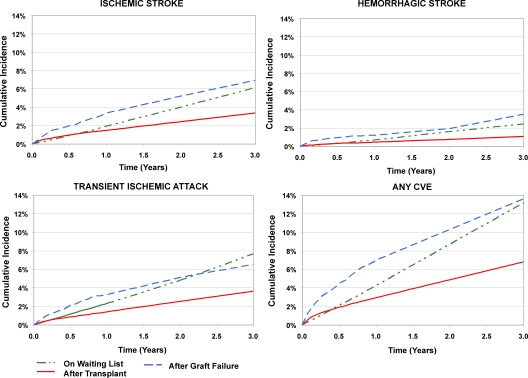
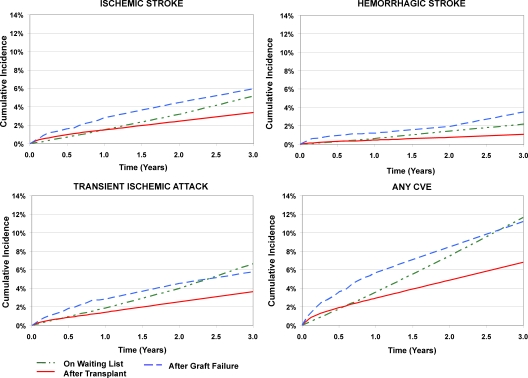
Results: The cumulative, 3-yr incidence of de novo cerebrovascular disease events after transplantation was 6.8% and was lower than adjusted 3-yr estimates of 11.8% on the waiting list and 11.2% after graft loss. In time-dependent regression, transplantation predicted a 34% reduction in subsequent, overall cerebrovascular disease events risk compared with remaining on the waiting list, whereas risk for cerebrovascular disease events increased >150% after graft failure. Similar relationships with transplantation and graft loss were observed for each type of cerebrovascular disease event. Smoking was a potentially preventable correlate of posttransplantation cerebrovascular disease events. Women were not protected. All forms of cerebrovascular disease event diagnoses after transplantation predicted increased mortality.
Conclusions: Along with known benefits for cardiac complications, transplantation with sustained graft function seems to reduce risk for vascular disease events involving the cerebral circulation.
Figures
References
-
- US Renal Data System: USRDS 2006 Annual Data Report, Bethesda, National Institutes of Health, National Institute of Diabetes and Digestive and Kidney Diseases, 2006
-
- Meier-Kriesche HU, Schold JD, Srinivas TR, Reed A, Kaplan B: Kidney transplantation halts cardiovascular disease progression in patients with end-stage renal disease. Am J Transplant 4: 1662–1668, 2004 - PubMed
-
- Lentine KL, Brennan DC, Schnitzler MA: Incidence and predictors of myocardial infarction after kidney transplantation. J Am Soc Nephrol 16: 496–506, 2005 - PubMed
-
- Kasiske BL, Maclean JR, Snyder JJ: Acute myocardial infarction and kidney transplantation. J Am Soc Nephrol 17: 900–907, 2006 - PubMed
-
- Lentine KL, Schnitzler MA, Abbott KC, Li L, Burroughs TE, Irish W, Brennan DC: De novo congestive heart failure after kidney transplantation: A common condition with poor prognostic implications. Am J Kidney Dis 46: 720–733, 2005 - PubMed
Publication types
MeSH terms
Grants and funding
LinkOut - more resources
Full Text Sources
Medical