. 2008 Apr 2;15(4):222-8.
doi: 10.1101/lm.726008. Print 2008 Apr.

Sustained increase in hippocampal sharp-wave ripple activity during slow-wave sleep after learning

Affiliations

Sustained increase in hippocampal sharp-wave ripple activity during slow-wave sleep after learning

Oxana Eschenko et al. Learn Mem. .

Abstract

High-frequency oscillations, known as sharp-wave/ripple (SPW-R) complexes occurring in hippocampus during slow-wave sleep (SWS), have been proposed to promote synaptic plasticity necessary for memory consolidation. We recorded sleep for 3 h after rats were trained on an odor-reward association task. Learning resulted in an increased number SPW-Rs during the first hour of post-learning SWS. The magnitude of ripple events and their duration were also elevated for up to 2 h after the newly formed memory. Rats that did not learn the discrimination during the training session did not show any change in SPW-Rs. Successful retrieval from remote memory was likewise accompanied by an increase in SPW-R density and magnitude, relative to the previously recorded baseline, but the effects were much shorter lasting and did not include increases in ripple duration and amplitude. A short-lasting increase of ripple activity was also observed when rats were rewarded for performing a motor component of the task only. There were no increases in ripple activity after habituation to the experimental environment. These experiments show that the characteristics of hippocampal high-frequency oscillations during SWS are affected by prior behavioral experience. Associative learning induces robust and sustained (up to 2 h) changes in several SPW-R characteristics, while after retrieval from remote memory or performance of a well-trained procedural aspect of the task, only transient changes in ripple density were induced.


Figures
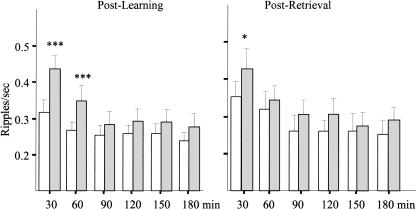
Figure 2.
Figure 2.
The dynamic of hippocampal ripple occurrence during SWS. Open bars indicate baseline recording; gray bars, post-learning (left panel) or post-retrieval (right panel) recording. ***P < 0.001 and *P < 0.05 for within-group comparisons. The post-learning data include all animals, learners and nonlearners. Note the striking elevation of ripple density during the first hour of post-learning SWS and less persistent change during post-retrieval SWS.
Figure 3.
Figure 3.
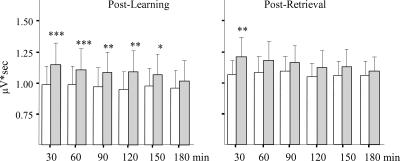
The hippocampal ripple magnitude (μV*sec) across 3 h after SWS onset. Open bars indicate baseline recording; gray bars, post-learning, including both learners and nonlearners (left panel) or post-retrieval (right panel) recording. ***P < 0.001, **P < 0.01, and *P < 0.05 for within-group comparisons. Note the long lasting elevation of ripple magnitude during post-learning SWS and less pronounced change after the retrieval.
Figure 4.
Figure 4.
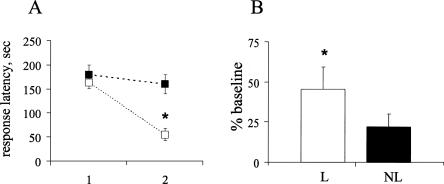
(A) Behavioral expression of odor-reward association learning. Average response latency for the first two trials (1) and the last two trials(2) of the learning session for learners (open squares) and nonlearners (black squares) are shown. Behavioral performance significantly improved within one training session in learners (six out of nine rats). (B) Percentage of ripple density increase over the first hour of post-learning SWS in learners (open bar) and nonlearners (black bar). A significant increase was observed in learners only (one-sample t-test, P < 0.05).
Figure 5.
Figure 5.
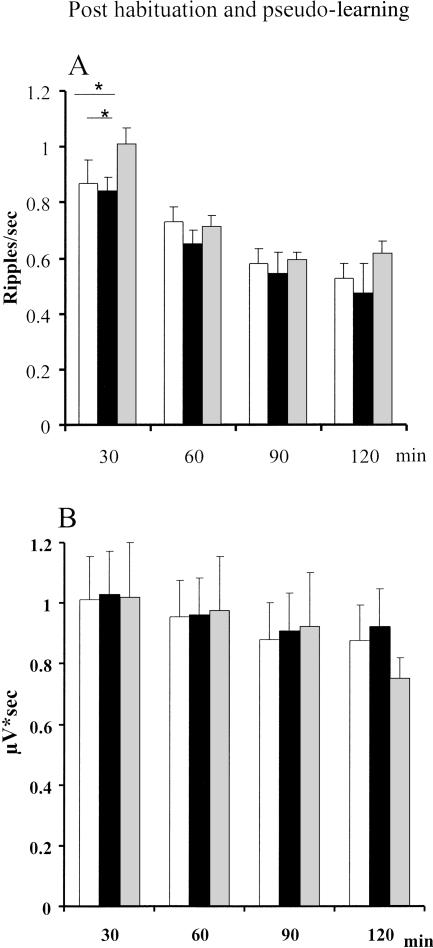
The dynamic of hippocampal ripple occurrence (A) and ripple magnitude (B) during SWS after habituation and after pseudo training. Open bars indicate baseline recording; black bars, post habituation; and gray, pseudo training. *P < 0.05 for within-group comparisons. Note the absence of ripple modification after habituation and the significant elevation of ripple density limited to the first 30 min of SWS after pseudo training.
Figure 1.
Figure 1.
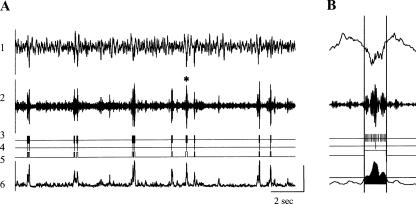
Detection and quantification of CA1 SPW-associated ripples. (A) Trace 1 indicates local field potentials recorded at the CA1 pyramidal cell layer (1–500 Hz); trace 2, trace 1 filtered to 150–250 Hz; trace 3, ripple troughs; trace 4, ripple peaks; trace 5, ripple on and off sets; and trace 6, root mean square of trace 2. (B) Illustration of the ripple detection algorithm and estimation of the ripple intrinsic properties. The ripple indicated with an asterisk on panel A is enlarged. Vertical lines indicate the ripple duration (100 msec); horizontal line on trace 6 indicates the ripple on/off set threshold; and the filled region indicates the area used to estimate the ripple magnitude. The amplitude scale is 1 mV for trace 1; 0.1 mV for trace 2; 0.05 mV for trace 6.

References

    1. Battaglia F.P., Sutherland G.R., McNaughton B.L. Hippocampal sharp wave bursts coincide with neocortical “up-state” transitions. Learn. Mem. 2004;11:697–704. - PMC - PubMed
    1. Behrens C.J., van den Boom L.P., de Hoz L., Friedman A., Heinemann U. Induction of sharp wave-ripple complexes in vitro and reorganization of hippocampal networks. Nat. Neurosci. 2005;8:1560–1567. - PubMed
    1. Ben-Ari Y., Gho M. Long-lasting modification of the synaptic properties of rat CA3 hippocampal neurones induced by kainic acid. J. Physiol. 1988;404:365–384. - PMC - PubMed
    1. Bjorvatn B., Fagerland S., Ursin R. EEG power densities (0.5-20 Hz) in different sleep-wake stages in rats. Physiol. Behav. 1998;63:413–417. - PubMed
    1. Born J., Rasch B., Gais S. Sleep to remember. Neuroscientist. 2006;12:410–424. - PubMed

Publication types

LinkOut - more resources