


Matrix metalloproteinases and diabetic foot ulcers: the ratio of MMP-1 to TIMP-1 is a predictor of wound healing
- PMID: 18387077
- PMCID: PMC2326726
- DOI: 10.1111/j.1464-5491.2008.02414.x
Matrix metalloproteinases and diabetic foot ulcers: the ratio of MMP-1 to TIMP-1 is a predictor of wound healing
Abstract
Aims: Matrix metalloproteinases (MMPs) play a major role in wound healing: they can degrade all components of the extracellular matrix. In diabetic foot ulcers there is an excess of MMPs and a decrease of the tissue inhibitors of MMPs (TIMPs). This imbalance is probably one cause of impaired healing. However, little is known about changes in MMPs during wound healing.
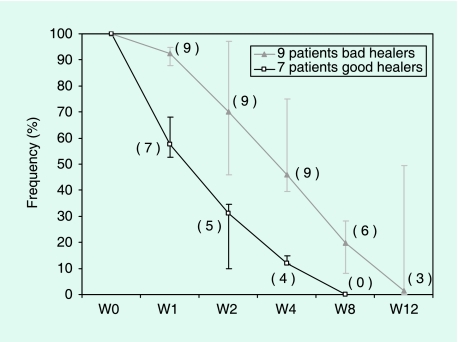
Methods: Sixteen patients with neuropathic diabetic foot ulcers participated. Wound fluid was collected regularly during the 12-week follow-up period, for measurement of MMP-1, MMP-2, MMP-8, MMP-9 and TIMP-1. Results were analysed by the degree of wound healing: good healers (defined by a reduction of at least 82% in initial wound surface at 4 weeks) and poor healers (reduction of less than 82% in wound surface at 4 weeks).
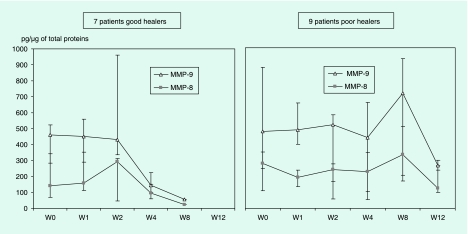
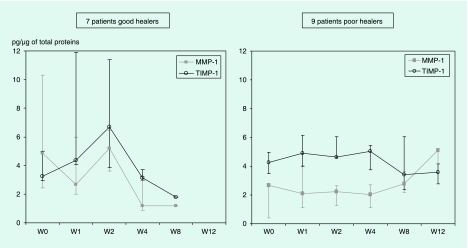
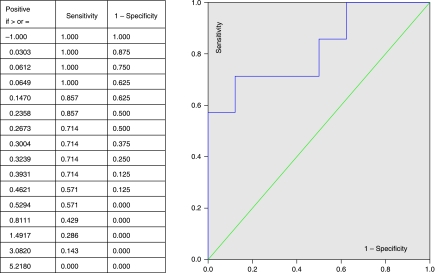
Results: In good healers, levels of MMP-8 and -9 secreted by inflammatory cells decreased earlier. The initial levels of MMP-1 were similar in good and poor healers (P = 0.1) but rose significantly at week 2 in good healers (P = 0.039). There was a significant correlation between a high ratio of MMP-1/TIMP-1 and good healing (r = 0.65, P = 0.008). Receiver Operator Curve (ROC) analysis showed that an MMP-1/TIMP-1 ratio of 0.39 best predicted wound healing (sensitivity = 71%, specificity = 87.5%).
Conclusions: A high level of MMP-1 seems essential to wound healing, while an excess of MMP-8 and -9 is deleterious, and could be a target for new topical treatments. The MMP-1/TIMP-1 ratio is a predictor of wound healing in diabetic foot ulcers.
Figures
References
-
- Armstrong DG, Jude EB. The role of matrix metalloproteinases in wound healing. J Am Podiatr Med Assoc. 2002;92:12–18. - PubMed
-
- Ravanti L, Kahari VM. Matrix metalloproteinases in wound repair (Review) Int J Mol Med. 2000;6:391–407. - PubMed
-
- Lobmann R, Schultz G, Lehnert H. Proteases and the diabetic foot syndrome: mechanisms and therapeutic implications. Diabetes Care. 2005;28:461–471. - PubMed
-
- Patterson BC, Sang QA. Angiostatin-converting enzyme activities of human matrilysin (MMP-7) and gelatinase B/type IV collagenase (MMP-9) J Biol Chem. 1997;272:28823–28825. - PubMed
-
- Soo C, Shaw WW, Zhang X, Longaker MT, Howard EW, Ting K. Differential expression of matrix metalloproteinases and their tissue-derived inhibitors in cutaneous wound repair. Plast Reconstr Surg. 2000;105:638–647. - PubMed
Publication types
MeSH terms
Substances
LinkOut - more resources
Full Text Sources
Other Literature Sources
Medical
Research Materials
Miscellaneous
