


Day length and estradiol affect same-sex affiliative behavior in the female meadow vole
- PMID: 18387611
- PMCID: PMC2501115
- DOI: 10.1016/j.yhbeh.2008.02.007
Day length and estradiol affect same-sex affiliative behavior in the female meadow vole
Abstract
Non-sexual social bonding between adult mammals is poorly understood, despite its importance in many species. Female meadow voles are territorial and nest alone in long summer day lengths when circulating estradiol concentrations are high, but cohabit in groups in short winter photoperiods when estradiol secretion is low. The influence of day length and estradiol on same-sex huddling behavior was assessed in adult female pairs housed together in long day lengths (LDs) or short day lengths (SDs) from weaning. The behavior of intact, ovariectomized, and estradiol-treated ovariectomized females from each photoperiod was assessed during 3 h partner-preference tests. Intact SD voles, unlike intact LD voles, spent the majority of the test in proximity to their cage-mates. Estradiol treatment of SD voles significantly reduced time spent huddling with the partner. Neither ovariectomy nor estradiol treatment significantly affected the amount of time LD females spent in contact with their partners. Low estradiol availability is therefore a necessary but not sufficient condition for maintenance of high levels of huddling. These results establish that ovarian hormones interact with photoperiod to affect same-sex social behavior.
Figures
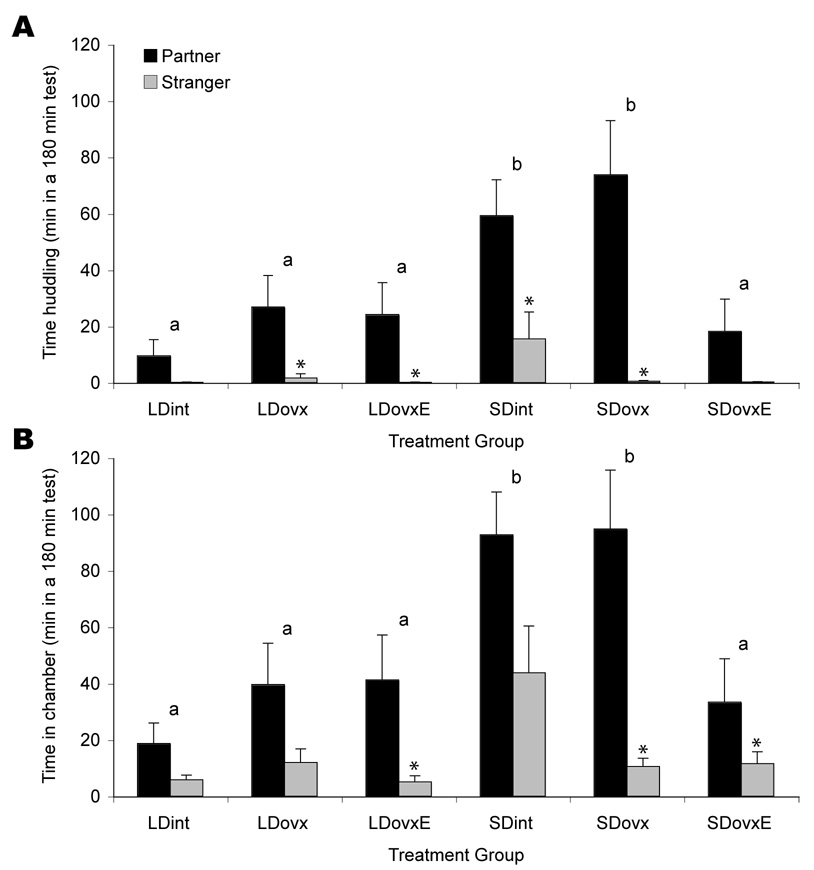
 ) during a 3 h test. (B) Mean (± SEM) time focal females spent in the same chamber as the partner or the stranger during a 3 h test. Asterisks denote significant differences within groups (between partners and strangers). Letters denote differences between treatment groups — groups labeled “a” are not different from LD intact voles, whereas groups labeled “b” are significantly different from LD intact animals (P <0.005, Dunnet’s test).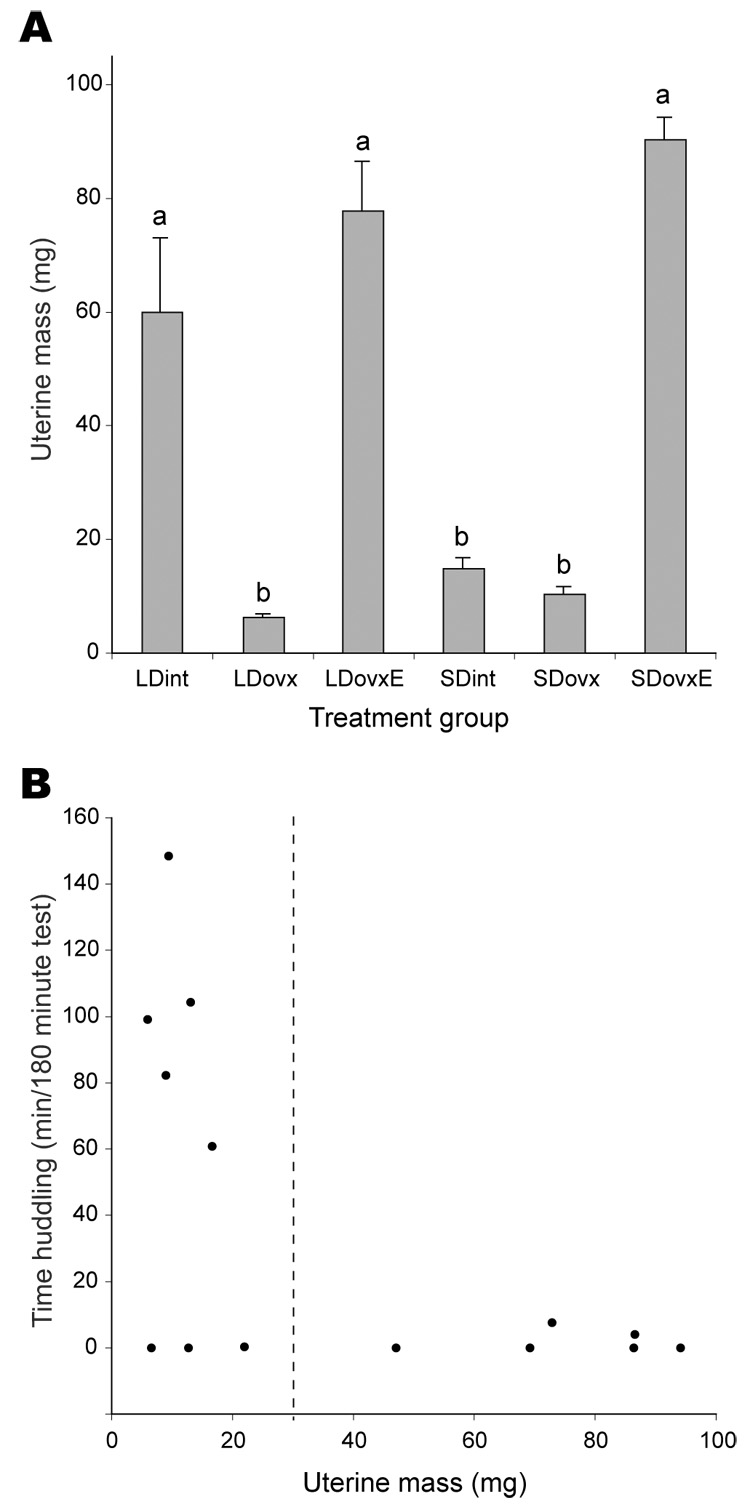
References
-
- Andrews RV, Phillips D, Makihara D. Metabolic and thermoregulatory consequences of social behaviors between Microtus townsendii. Comp Biochem Physiol A. 1987;87:345–348. - PubMed
-
- Andrews RV, Belknap RW. Season affects tolerance of cohabitation by deer mice. Physiol Behav. 1993;53:617–620. - PubMed
-
- Batchelder P, Kinney RO, Demlow L, Lynch CB. Effects of temperature and social interactions on huddling behavior in Mus musculus. Physiol Behav. 1983;31:97–102. - PubMed
-
- Beery AK, Lacey EA, Francis DD. Oxytocin and vasopressin receptor distributions in a solitary and a social species of tuco-tuco (Ctenomys haigi and Ctenomys sociabilis) J Comp Neurol. 2008;507:1847–1859. - PubMed
-
- Boonstra R, Xia X, Pavone L. Mating system of the meadow vole, Microtus pennsylvanicus. Behav Ecol. 1993;4:83–89.
Publication types
MeSH terms
Substances
Grants and funding
LinkOut - more resources
Full Text Sources
Research Materials
