


Adrenergic regulation of cardiac contractility does not involve phosphorylation of the cardiac ryanodine receptor at serine 2808
- PMID: 18388322
- PMCID: PMC2652487
- DOI: 10.1161/CIRCRESAHA.108.174722
Adrenergic regulation of cardiac contractility does not involve phosphorylation of the cardiac ryanodine receptor at serine 2808
Abstract
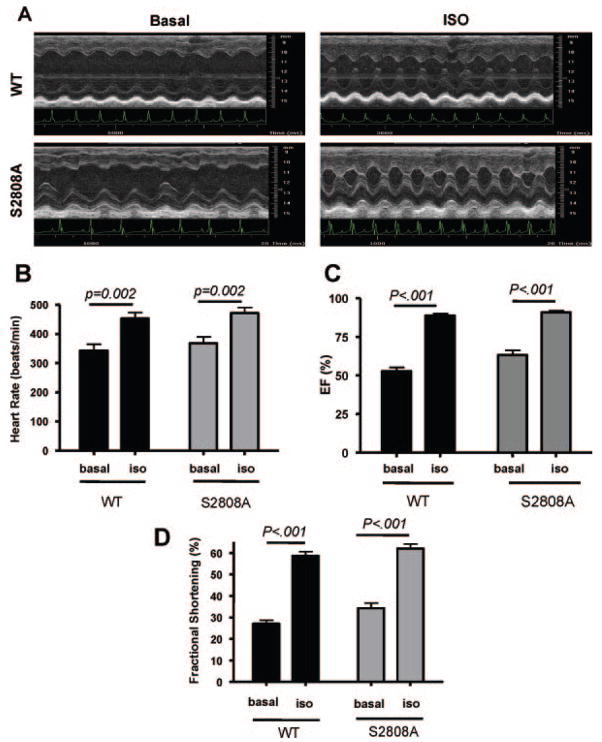
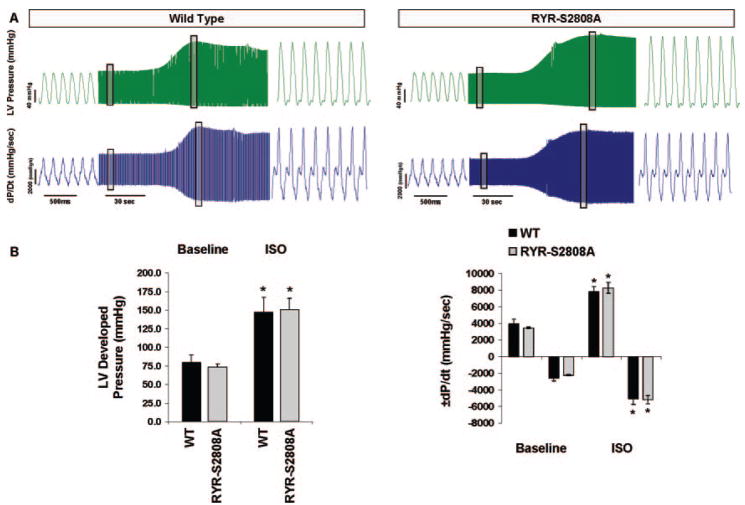
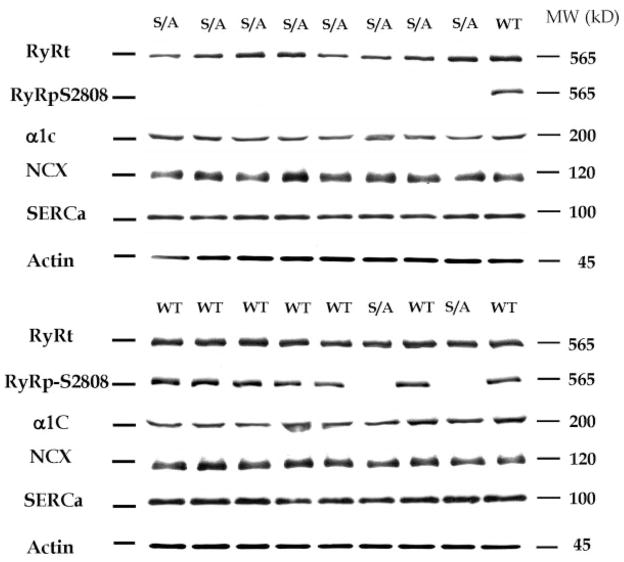
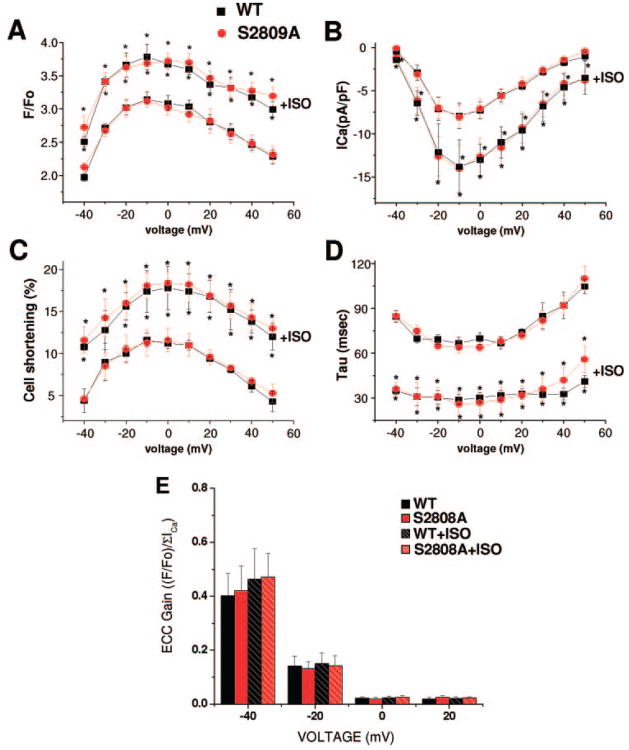
The sympathetic nervous system is a critical regulator of cardiac function (heart rate and contractility) in health and disease. Sympathetic nervous system agonists bind to adrenergic receptors that are known to activate protein kinase A, which phosphorylates target proteins and enhances cardiac performance. Recently, it has been proposed that protein kinase A-mediated phosphorylation of the cardiac ryanodine receptor (the Ca(2+) release channel of the sarcoplasmic reticulum at a single residue, Ser2808) is a critical component of sympathetic nervous system regulation of cardiac function. This is a highly controversial hypothesis that has not been confirmed by several independent laboratories. The present study used a genetically modified mouse in which Ser2808 was replaced by alanine (S2808A) to prevent phosphorylation at this site. The effects of isoproterenol (a sympathetic agonist) on ventricular performance were compared in wild-type and S2808A hearts, both in vivo and in isolated hearts. Isoproterenol effects on L-type Ca(2+) current (I(CaL)), sarcoplasmic reticulum Ca(2+) release, and excitation-contraction coupling gain were also measured. Our results showed that isoproterenol caused significant increases in cardiac function, both in vivo and in isolated hearts, and there were no differences in these contractile effects in wild-type and S2808A hearts. Isoproterenol increased I(CaL), the amplitude of the Ca(2+) transient and excitation-contraction coupling gain, but, again, there were no significant differences between wild-type and S2808A myocytes. These results show that protein kinase A phosphorylation of ryanodine receptor Ser2808 does not have a major role in sympathetic nervous system regulation of normal cardiac function.
Figures
Comment in
-
What are the consequences of phosphorylation and hyperphosphorylation of ryanodine receptors in normal and failing heart?Circ Res. 2008 May 9;102(9):995-7. doi: 10.1161/CIRCRESAHA.108.176172. Circ Res. 2008. PMID: 18467636 No abstract available.
-
Ca2+-calmodulin-dependent protein kinase phosphorylation of ryanodine receptor may contribute to the beta-adrenergic regulation of myocardial contractility independently of increases in heart rate.Circ Res. 2008 Jul 3;103(1):e10-1; author reply e12. doi: 10.1161/CIRCRESAHA.108.178673. Circ Res. 2008. PMID: 18596257 No abstract available.
References
-
- Bers DM. Cardiac excitation-contraction coupling. Nature. 2002;415:198–205. - PubMed
-
- Castellano M, Bohm M. The cardiac beta-adrenoceptor-mediated signaling pathway and its alterations in hypertensive heart disease. Hypertension. 1997;29:715–722. - PubMed
-
- Young MA, Hintze TH, Vatner SF. Correlation between cardiac performance and plasma catecholamine levels in conscious dogs. Am J Physiol. 1985;248:H82–H88. - PubMed
-
- Bers DM. Excitation-Contraction Coupling and Cardiac Contractile Force. 2. Dordrecht, The Netherlands: Kluwer Academic Publishers; 2001.
-
- Tsien RW, Bean BP, Hess P, Lansman JB, Nilius B, Nowycky MC. Mechanisms of calcium channel modulation by beta-adrenergic agents and dihydropyridine calcium agonists. J Mol Cell Cardiol. 1986;18:691–710. - PubMed
Publication types
MeSH terms
Substances
Grants and funding
- HL55438/HL/NHLBI NIH HHS/United States
- R01 HL088243/HL/NHLBI NIH HHS/United States
- HL089312/HL/NHLBI NIH HHS/United States
- HL61495/HL/NHLBI NIH HHS/United States
- R01 HL055438/HL/NHLBI NIH HHS/United States
- HL76826/HL/NHLBI NIH HHS/United States
- HL33921/HL/NHLBI NIH HHS/United States
- R01 HL089312/HL/NHLBI NIH HHS/United States
- P01 HL091799/HL/NHLBI NIH HHS/United States
- R01 HL076826/HL/NHLBI NIH HHS/United States
- R01 HL061495/HL/NHLBI NIH HHS/United States
- R37 HL033921/HL/NHLBI NIH HHS/United States
- R01 HL033921/HL/NHLBI NIH HHS/United States
LinkOut - more resources
Full Text Sources
Miscellaneous
