. 2008 Apr;27(4):425-41.
doi: 10.1109/TMI.2007.906087.

An optimized blockwise nonlocal means denoising filter for 3-D magnetic resonance images

Affiliations

An optimized blockwise nonlocal means denoising filter for 3-D magnetic resonance images

P Coupe et al. IEEE Trans Med Imaging. 2008 Apr.

Abstract

A critical issue in image restoration is the problem of noise removal while keeping the integrity of relevant image information. Denoising is a crucial step to increase image quality and to improve the performance of all the tasks needed for quantitative imaging analysis. The method proposed in this paper is based on a 3-D optimized blockwise version of the nonlocal (NL)-means filter (Buades, et al., 2005). The NL-means filter uses the redundancy of information in the image under study to remove the noise. The performance of the NL-means filter has been already demonstrated for 2-D images, but reducing the computational burden is a critical aspect to extend the method to 3-D images. To overcome this problem, we propose improvements to reduce the computational complexity. These different improvements allow to drastically divide the computational time while preserving the performances of the NL-means filter. A fully automated and optimized version of the NL-means filter is then presented. Our contributions to the NL-means filter are: 1) an automatic tuning of the smoothing parameter; 2) a selection of the most relevant voxels; 3) a blockwise implementation; and 4) a parallelized computation. Quantitative validation was carried out on synthetic datasets generated with BrainWeb (Collins, et al., 1998). The results show that our optimized NL-means filter outperforms the classical implementation of the NL-means filter, as well as two other classical denoising methods [anisotropic diffusion (Perona and Malik, 1990)] and total variation minimization process (Rudin, et al., 1992) in terms of accuracy (measured by the peak signal-to-noise ratio) with low computation time. Finally, qualitative results on real data are presented .


Figures
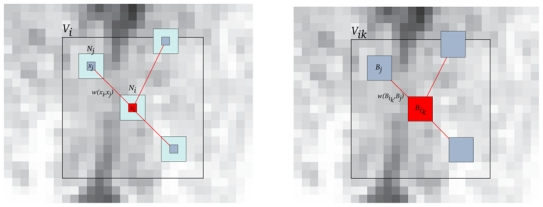
Fig. 1
Fig. 1
Left: Classical voxelwise NL-means filter: 2D illustration of the NL-means principle. The restored value of voxel xi (in red) is the weighted average of all intensities of voxels xj in the search volume Vi, based on the similarity of their intensity neighborhoods u(Ni) and u(Nj). In this example, we set d = 1 and M = 8. Right: Blockwise NL-means filter: 2D illustration of the blockwise NL-means principle. The restored value of the block Bik is the weighted average of all the blocks Bj in the search volume Vik. In this example, we set α = 1 and M = 8.
Fig. 2
Fig. 2
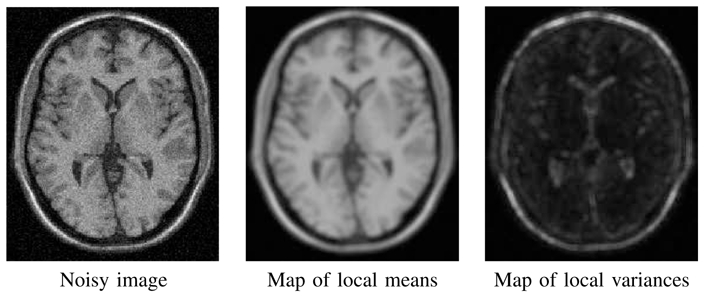
Left: noisy image with 9 % of Gaussian noise (see Section IV). Center: map of the mean of u(Ni) denoted u(Ni)¯. Right map of the variance of u(Ni) denoted Var(u(Ni)). In these examples, we set Ni = 5 × 5 × 5 voxels.
Fig. 3
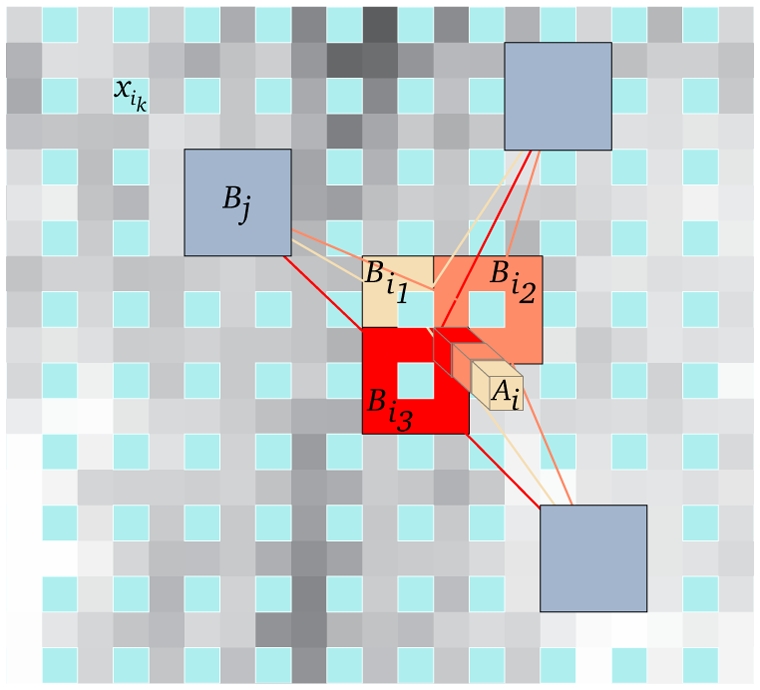
Fig. 3. Blockwise NL-means Filter
For each block Bikcentered on voxel xik, a NL-means like restoration is performed from blocks Bj. In this way, for a voxel xi included in several blocks, several estimations are obtained. The restored value of voxel xi is the average of the different estimations stored in vector Ai. In this example α = 1, n = 2 and |Ai| = 3.
Fig. 4
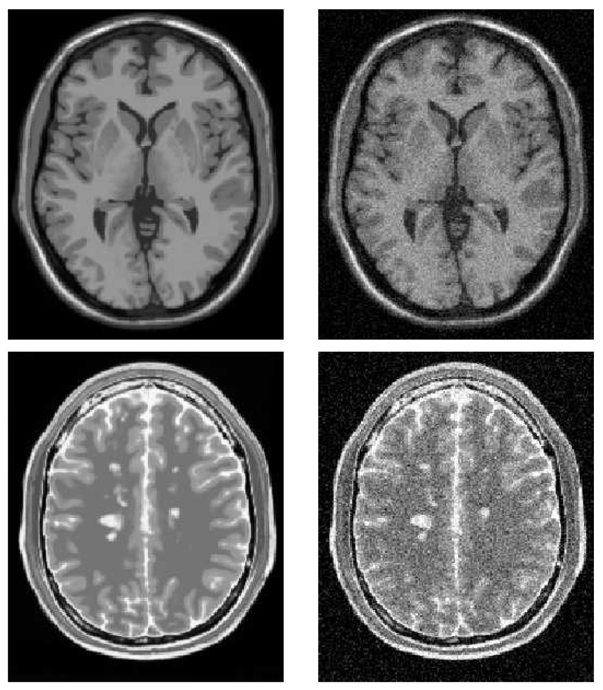
Fig. 4. Synthetic data used for validation with Gaussian Nnoise
Example of the Brainweb Database. Top: T1-w images without any noise (left), and corrupted with a white Gaussian noise at 9% (right). Bottom: T2-w images with MS lesions without noise (left), and corrupted with a white Gaussian noise at 9% (right).
Fig. 5
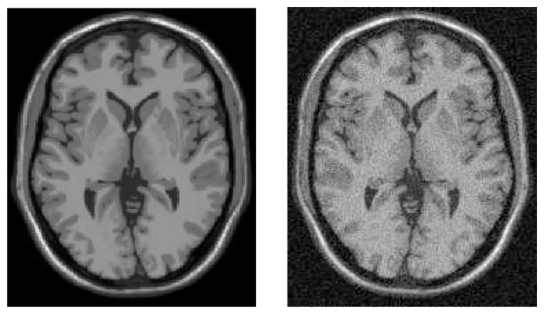
Fig. 5. Synthetic data used for validation with Rician noise
Example of the Brainweb Database. T1-w images without any noise (left), and corrupted with a Rician noise at 9% (right).
Fig. 6
Fig. 6. Calibration of the smoothing parameter
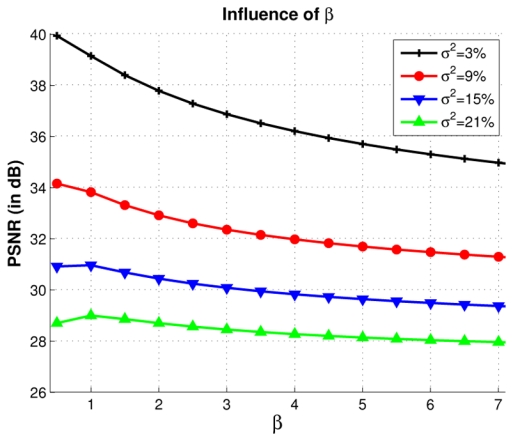
h: Influence of the smoothing parameter 2βσ̂2|Ni| on the PSNR, according to β and for several levels of noise. For low levels of noise the best value of β is close to 0.5. For high levels of noise this value is 1. The default value of β is set to 1, thus the estimation of h is h2 = 2σ̂2. These results are obtained with σ̂2 = 3.42% at 3%, σ̂2 = 7.93% at 9%, σ̂2 = 12.72% at 15% and σ̂2 = 17.44% at 21%.
Fig. 7
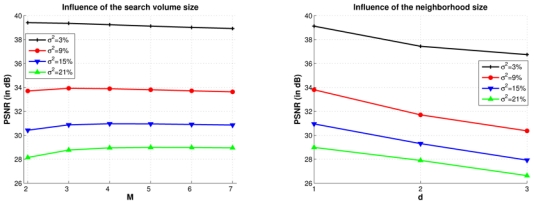
Fig. 7. Influence of the size |Vi| = (2M + 1)3 and |Ni| = (2d + 1)3 for denoising
Influence of the size of the search volume and the size of the neighborhood on the PSNR, for several levels of noise. Left: Variation of the size M of the search volume Vi for d = 1. Right: Variation of the size d of the neighborhood Ni for M = 5. These results show that the limit M = 5 prevents useless computation. Moreover, increasing d degrades and drastically slows down the algorithm.
Fig. 8
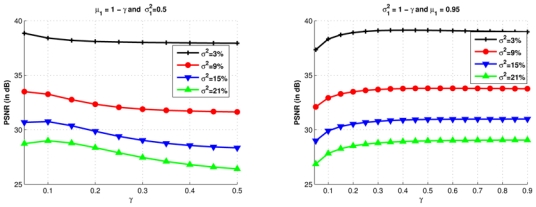
Fig. 8. Influence of the limits of the voxels selection
Influence of the limits μ1 and σ12 on the PSNR, for several level of noise. Left: σ12=0.5, while μ1 varies with γ. A restrictive selection based on the mean (low values of γ) increases the PSNR. The optimal limits are obtained for μ1 = 0.95. Right: μ1 = 0.95 and σ12 varies accordingly to γ. A too restrictive selection (low values of γ) degrades the PSNR. In addition, a too permissive selection (high values of γ) does not increase the PSNR while concurrently increasing uselessly the computational burden. A good compromise is found by fixing σ12=0.5.
Fig. 9
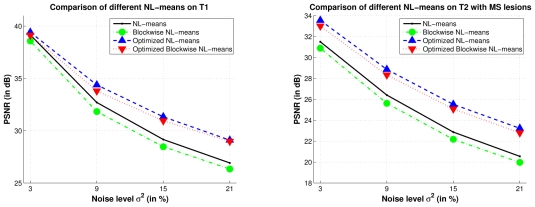
Fig. 9. Impact of the blockwise implementation and voxels selection
Comparison of the different implementations of the NL-means filter, with α = 1. Left: on T1-w images. For the Optimized Blockwise NL-means filter, as for the Optimized NL-means filter, the selection of voxels/blocks in the search volume improves the quality of denoising and decreases the computational burden (see Tab. II). The reduction of computational time brought by the blockwise approach needs to be balanced with a slight decrease in quality of denoising. Right: on T2-w images with MS lesions. The same conclusions can be drawn for this kind of images. These results suggest that the parameters tuning determined experimentally on T1-w images are not T1-specific.
Fig. 10
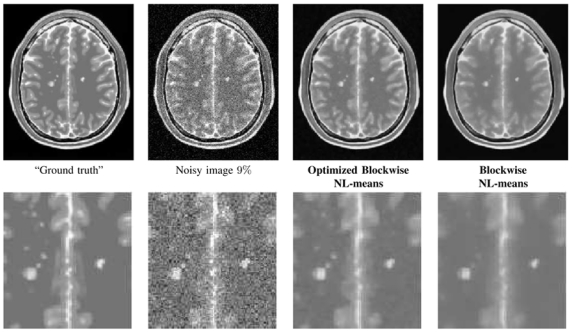
Fig. 10. Comparison of the optimized and non-optimized blockwise NL-means on T2-w images
NL-means restoration of T2-w Brainweb data with MS lesions. From left to right: “Ground truth”, noised image at 9% of Gaussian noise, restored images by the Optimized Blockwise NL-means filter and by the Blockwise NL-means filter. The Optimized Blockwise NL-means filter preserves efficiently the contours of the MS lesions.
Fig. 11
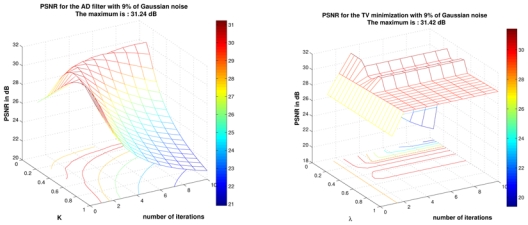
Fig. 11
Result for AD filter and TV minimization on phantom images with Gaussian noise at 9%. For AD filter K varies from 0.05 to 1 with step of 0.05 and the number of iterations varies from 1 to 10. For TV minimization λ varies from 0.01 to 1 with step of 0.01 and the number of iterations varies from 1 to 10
Fig. 12
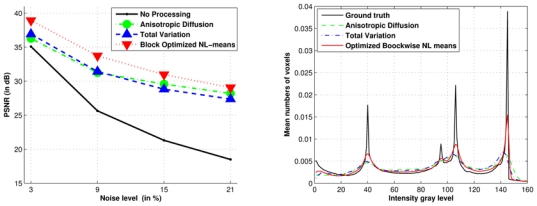
Fig. 12. Comparison between Anisotropic Diffusion, Total Variation and Optimized Blockwise NL-means denoising
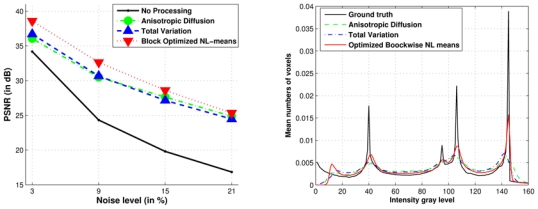
the PSNR values and histograms for different denoising methods on BrainWeb at 9% of Gaussian noise. Left: the PSNR experiment shows that the Optimized Blockwise NL-means filter outperforms the well-established Total Variation minimization process and the Anisotropic Diffusion approach. Right: Contrary to others methods, the NL-means based restoration clearly distinguishes the three main peaks representing the white matter, the gray matter and the cerebrospinal fluid. The sharpness of the peaks shows how the Optimized Blockwise NL-means filter increases the contrast between denoised biological structures.
Fig. 13
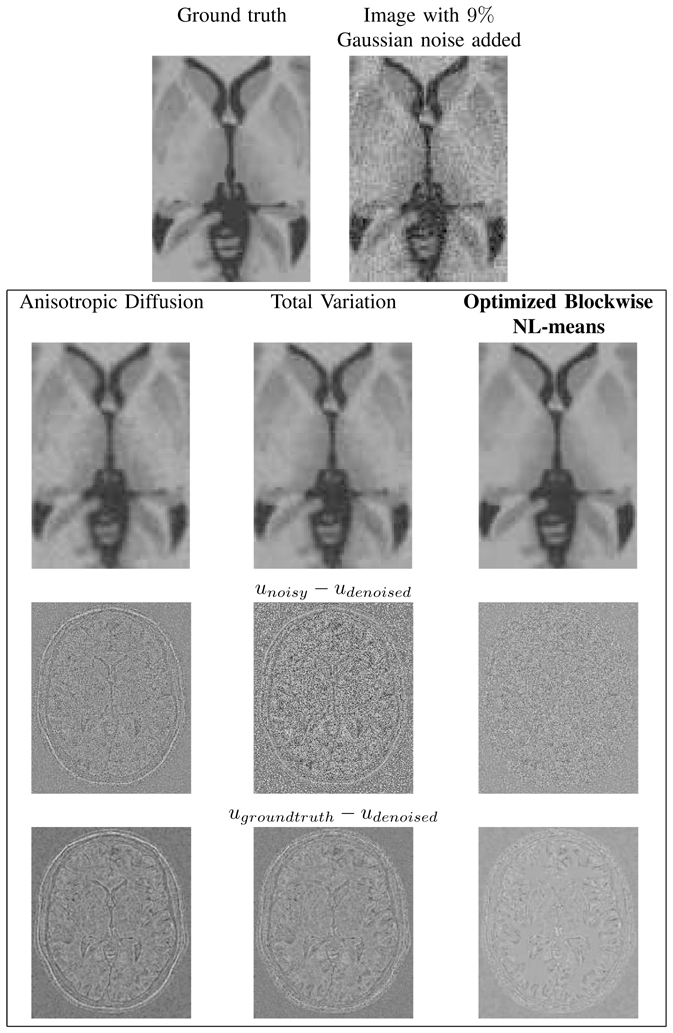
Fig. 13. Comparison with Anisotropic Diffusion, Total Variation and NL-means denoising on synthetic T1-w images
Top: zooms on T1-w BrainWeb images. Left: the “ground truth”. Right: the noisy images with 9% of Gaussian noise. Middle: the results of restoration obtained with the different methods and the images of the removed noise (i.e. the difference (centered on 128) between the noisy image and the denoised image. Bottom: the difference (centered on 128) between the denoised image and the ground truth. Left: Anisotropic Diffusion denoising. Left: Anisotropic Diffusion denoising. Middle: Total Variation minimization process. Right: Optimized Blockwise NL-means filter. The NL-means based restoration better preserves the anatomical structure in the image while efficiently removing the noise as it can be seen in the image of removed noise.
Fig. 14
Fig. 14. Comparison with Anisotropic Diffusion, Total Variation and NL-means denoising on synthetic T1-w images
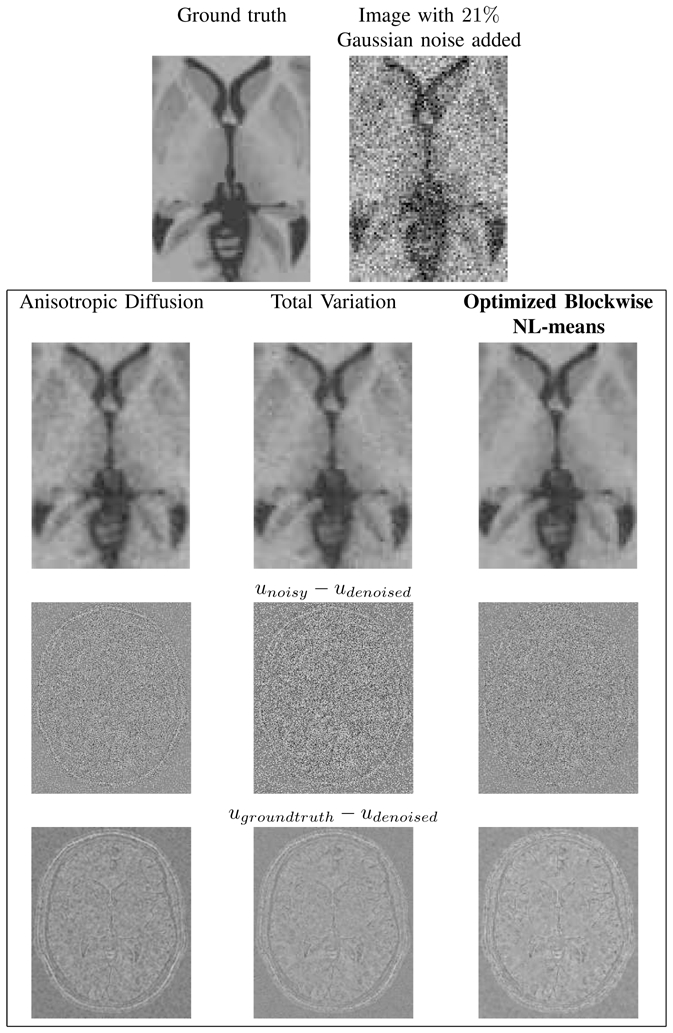
Top: zooms on T1-w BrainWeb images. Left: the “ground truth”. Right: the noisy images with 21% of Gaussian noise. Middle: the results of restoration obtained with the different methods and the images of the removed noise (i.e. the difference (centered on 128) between the noisy image and the denoised image. Bottom: the difference (centered on 128) between the denoised image and the ground truth. Left: Anisotropic Diffusion denoising. Middle: Total Variation minimization process. Right: Optimized Blockwise NL-means filter.
Fig. 15
Fig. 15. Comparison with Anisotropic Diffusion, Total Variation and Optimized Blockwise NL-means denoising
PSNR values and histograms for different denoising methods on BrainWeb at 9% of Rician noise. Left: the PSNR study shows that the Optimized Blockwise NL-means filter outperforms the well-established Total Variation minimization process and the Anisotropic Diffusion approach. Right: When the histograms are compared low values of intensity (< 20) are incorrectly restored for all the filters; the Gaussian approximation is not appropriate in that case. Nevertheless, it seems the underlying assumption is well suited to high values (> 60). Contrary to others methods, the NL-means based restoration clearly emphasizes the three main peaks representing the white matter, the gray matter and the cerebrospinal fluid. The sharpness of the peaks shows how the Optimized Blockwise NL-means filter increases the contrast between denoised biological structures.
Fig. 16
Fig. 16. Comparison with Anisotropic Diffusion, Total Variation and NL-means denoising on synthetic T1-w images
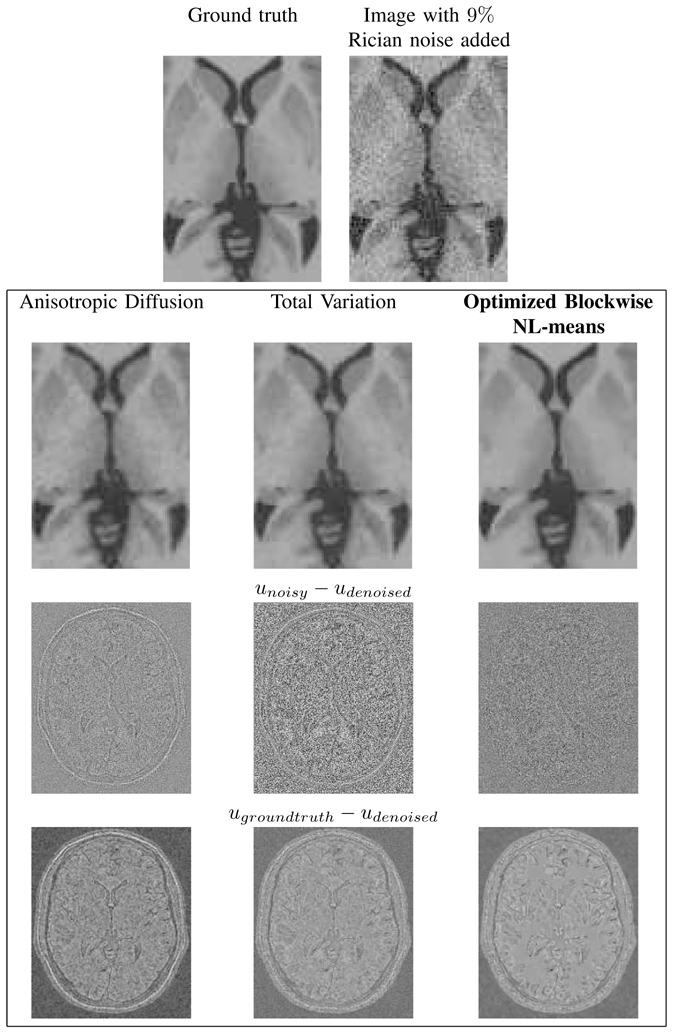
Top: zooms on T1-w BrainWeb images. Left: the “ground truth”. Right: the noisy images with 9% of Rician noise. Middle: the results of restoration obtained with the different methods and the images of the removed noise (i.e. the difference (centered on 128) between the noisy image and the denoised image. Bottom: the “Method Noise” which is the difference (centered on 128) between the denoised image and the ground truth. Left: Anisotropic Diffusion denoising. Middle: Total Variation minimization process. Right: Optimized Blockwise NL-means filter. The NL-means based restoration better preserves the anatomical structure in the image while efficiently removing the noise, it can be seen in the image of removed noise.
Fig. 17
Fig. 17
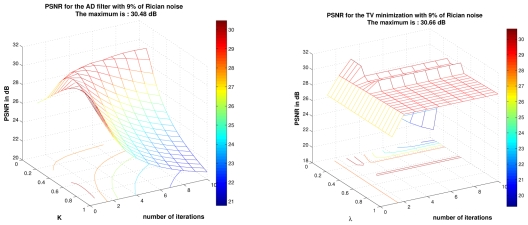
Result for AD filter and TV minimization on phantom images with 9% of Rician noise. For AD filter K varies from 0.05 to 1 with step of 0.05 and the number of iterations varies from 1 to 10. For TV minimization λ varies from 0.01 to 1 with step of 0.01 and the number of iterations varies from 1 to 10.
Fig. 18
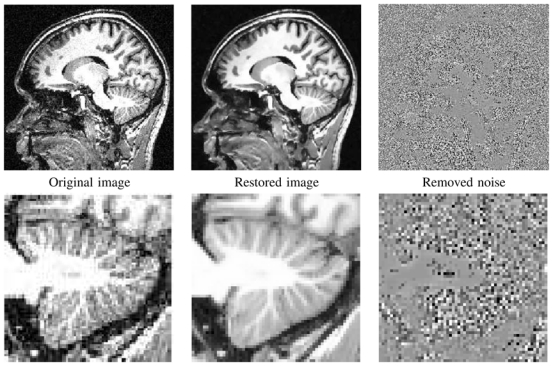
Fig. 18. NL-means filter on a real T1-w MRI
Fully-automatic restoration obtained with the Optimized Blockwise NL-means filter on a 3 Tesla T1-w MRI data of 2563 voxels in less than 3 minutes on a Intel(R) Pentium(R) D CPU 3.40GHz with 2Go of RAM. From left to right: Original image, denoised image, and difference image with gray values centered on 128. The whole image is shown on top, and a detail is displayed on bottom.
Fig. 19
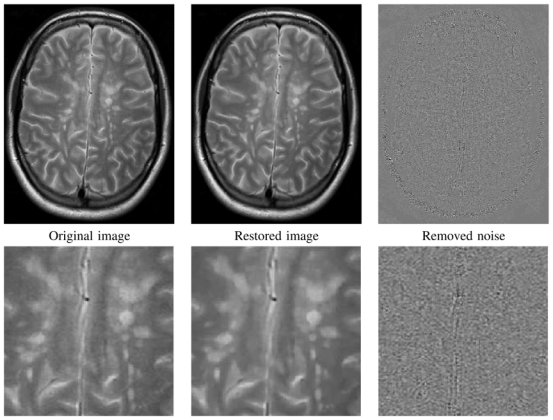
Fig. 19. NL-means filter on a real T2-w MRI with MS
Fully-automatic restoration obtained with the Optimized Blockwise NL-means filter on a 1.5T T2-w MRI data with MS lesions of 512 × 512 × 28 voxels in less than 2 minute on a Intel(R) Pentium(R) D CPU 3.40GHz with 2Go of RAM. From left to right: Original image, denoised image, and difference image with gray values centered on 128. The whole image is shown on top, and a detail is exposed on bottom.

References

    1. Buades A, Coll B, Morel JM. A review of image denoising algorithms, with a new one. Multiscale Modeling & Simulation. 2005;4(2):490–530.
    1. Collins D, Zijdenbos A, Kollokian V, Sled J, Kabani N, Holmes C, Evans A. Design and construction of a realistic digital brain phantom. IEEE Trans Med Imaging. 1998;17(3):463–468. - PubMed
    1. Perona P, Malik J. Scale-space and edge detection using anisotropic diffusion. IEEE Trans Pattern Anal Mach Intell. 1990;12(7):629–639.
    1. Rudin L, Osher S, Fatemi E. Nonlinear total variation based noise removal algorithms. Physica D. 1992;60:259–268.
    1. Mazziotta J, Toga A, Evans A, Fox P, Lancaster J, Zilles K, Woods R, Paus T, Simpson G, Pike B, Holmes C, Collins L, Thompson P, MacDonald D, Iacoboni M, Schormann T, Amunts K, Palomero-Gallagher N, Geyer S, Parsons L, Narr K, Kabani N, Le Goualher G, Boomsma D, Cannon T, Kawashima R, Mazoyer B. A probabilistic atlas and reference system for the human brain: International consortium for brain mapping (icbm) Philos Trans R Soc Lond B Biol Sci. 2001 Aug;356(1412):1293–1322. - PMC - PubMed

MeSH terms