


Factors controlling the distribution of archaeal tetraethers in terrestrial hot springs
- PMID: 18390673
- PMCID: PMC2423032
- DOI: 10.1128/AEM.02450-07
Factors controlling the distribution of archaeal tetraethers in terrestrial hot springs
Abstract
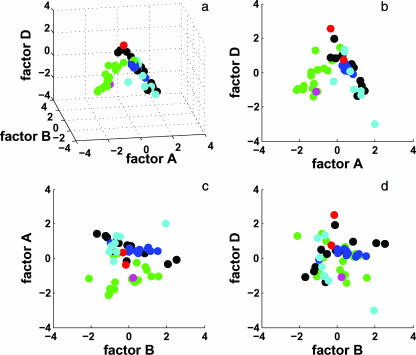
Glycerol dialkyl glycerol tetraethers (GDGTs) found in hot springs reflect the abundance and community structure of Archaea in these extreme environments. The relationships between GDGTs, archaeal communities, and physical or geochemical variables are underexamined to date and when reported often result in conflicting interpretations. Here, we examined profiles of GDGTs from pure cultures of Crenarchaeota and from terrestrial geothermal springs representing a wide distribution of locations, including Yellowstone National Park (United States), the Great Basin of Nevada and California (United States), Kamchatka (Russia), Tengchong thermal field (China), and Thailand. These samples had temperatures of 36.5 to 87 degrees C and pH values of 3.0 to 9.2. GDGT abundances also were determined for three soil samples adjacent to some of the hot springs. Principal component analysis identified four factors that accounted for most of the variance among nine individual GDGTs, temperature, and pH. Significant correlations were observed between pH and the GDGTs crenarchaeol and GDGT-4 (four cyclopentane rings, m/z 1,294); pH correlated positively with crenarchaeol and inversely with GDGT-4. Weaker correlations were observed between temperature and the four factors. Three of the four GDGTs used in the marine TEX(86) paleotemperature index (GDGT-1 to -3, but not crenarchaeol isomer) were associated with a single factor. No correlation was observed for GDGT-0 (acyclic caldarchaeol): it is effectively its own variable. The biosynthetic mechanisms and exact archaeal community structures leading to these relationships remain unknown. However, the data in general show promise for the continued development of GDGT lipid-based physiochemical proxies for archaeal evolution and for paleo-ecology or paleoclimate studies.
Figures
References
-
- Biddle, J. F., J. S. Lipp, M. A. Lever, K. G. Lloyd, K. B. Sorensen, R. Anderson, H. K. Fredricks, M. Elvert, T. J. Kelly, D. P. Schrag, M. L. Sogin, J. E. Brenchley, A. Teske, C. H. House, and K. U. Hinrichs. 2006. Heterotrophic Archaea dominate sedimentary subsurface ecosystems off Peru. Proc. Natl. Acad. Sci. USA 103:3846-3851. - PMC - PubMed
-
- Bligh, E. G., and W. J. Dyer. 1959. A rapid method for total lipid extraction and purification. Can. J. Biochem. Physiol. 37:911-917. - PubMed
-
- Bonch-Osmolovskaya, E. A., A. I. Slesarev, M. L. Miroshnichenko, T. P. Svetlichnaya, and V. A. Alekseev. 1988. Characteristics of Desulfurococcus amylolyticus n. sp.—a new extremely thermophilic archaebacterium isolated from thermal springs of Kamchatka and Kunashir Island. Mikrobiologiya 57:94-101. (In Russian.)
-
- Bonch-Osmolovskaya, E. A., M. L. Miroshnichenko, N. A. Kostrikina, N. A. Chernyh, and G. A. Zavarzin. 1990. Thermoproteus uzoniensis sp. nov., a new extremely thermophilic archaebacterium from Kamchatka continental hot springs. Arch. Microbiol. 154:556-559.
Publication types
MeSH terms
Substances
LinkOut - more resources
Full Text Sources
