


FOXOs, cancer and regulation of apoptosis
- PMID: 18391973
- PMCID: PMC2819403
- DOI: 10.1038/onc.2008.24
FOXOs, cancer and regulation of apoptosis
Abstract
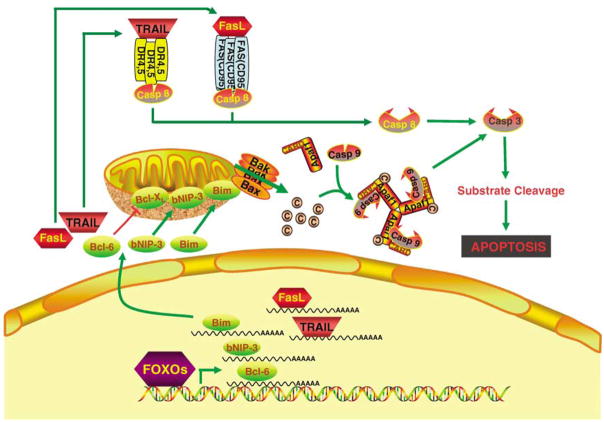
Forkhead box O (FOXO) transcription factors are involved in multiple signaling pathways and play critical roles in a number of physiological and pathological processes including cancer. The importance of FOXO factors ascribes them under multiple levels of regulation including phosphorylation, acetylation/deacetylation, ubiquitination and protein-protein interactions. As FOXO factors play a pivotal role in cell fate decision, mounting evidence suggests that FOXO factors function as tumor suppressors in a variety of cancers. FOXOs are actively involved in promoting apoptosis in a mitochondria-independent and -dependent manner by inducing the expression of death receptor ligands, including Fas ligand and tumor necrosis factor-related apoptosis-inducing ligand, and Bcl-2 family members, such as Bim, bNIP3 and Bcl-X(L), respectively. An understanding of FOXO proteins and their biology will provide new opportunities for developing more effective therapeutic approaches to treat cancer.
Figures
References
-
- Accili D, Arden KC. FoxOs at the crossroads of cellular metabolism, differentiation, and transformation. Cell. 2004;117:421–426. - PubMed
-
- Alessi DR, Caudwell FB, Andjelkovic M, Hemmings BA, Cohen P. Molecular basis for the substrate specificity of protein kinase B; comparison with MAPKAP kinase-1 and p70 S6 kinase. FEBS Lett. 1996;399:333–338. - PubMed
-
- Anderson MJ, Viars CS, Czekay S, Cavenee WK, Arden KC. Cloning and characterization of three human forkhead genes that comprise an FKHR-like gene subfamily. Genomics. 1998;47:187–199. - PubMed
-
- Barr FG. Gene fusions involving PAX and FOX family members in alveolar rhabdomyosarcoma. Oncogene. 2001;20:5736–5746. - PubMed
Publication types
MeSH terms
Substances
Grants and funding
LinkOut - more resources
Full Text Sources
Other Literature Sources
Research Materials
Miscellaneous
