. 2008 Apr;218(3-4):193-202.
doi: 10.1007/s00427-007-0170-3. Epub 2008 Apr 8.

Tribolium Wnts: evidence for a larger repertoire in insects with overlapping expression patterns that suggest multiple redundant functions in embryogenesis

Affiliations

Tribolium Wnts: evidence for a larger repertoire in insects with overlapping expression patterns that suggest multiple redundant functions in embryogenesis

Renata Bolognesi et al. Dev Genes Evol. 2008 Apr.

Abstract

Wingless (wg)/Wnt family genes encode secreted glycoproteins that function as signalling molecules in the development of vertebrates as well as invertebrates. In a survey of Wnt family genes in the newly sequenced Tribolium genome, we found a total of nine Wnt genes. In addition to wg or Wnt1, Tribolium contains orthologs of the vertebrate Wnt5-7 and Wnt9-11 genes. As in Drosophila, Wnt1, Wnt6 and Wnt10 are clustered in the genome. Comparative genomics indicates that Wnt9 is also a conserved member of this cluster in several insects for which genome sequence is available. One of the Tribolium Wnt genes appears to be a member of the WntA family, members of which have been identified in Anopheles and other invertebrates but not in Drosophila or vertebrates. Careful phylogenetic examination suggests an Apis Wnt gene, previously identified as a Wnt4 homolog, is also a member of the WntA family. The ninth Tribolium Wnt gene is related to the diverged Drosophila WntD gene, both of which phylogenetically group with Wnt8 genes. Some of the Tribolium Wnt genes display multiple overlapping expression patterns, suggesting that they may be functionally redundant in segmentation, brain, appendage and hindgut development. In contrast, the unique expression patterns of Wnt5, Wnt7 and Wnt11 in developing appendages likely indicate novel functions.


Figures
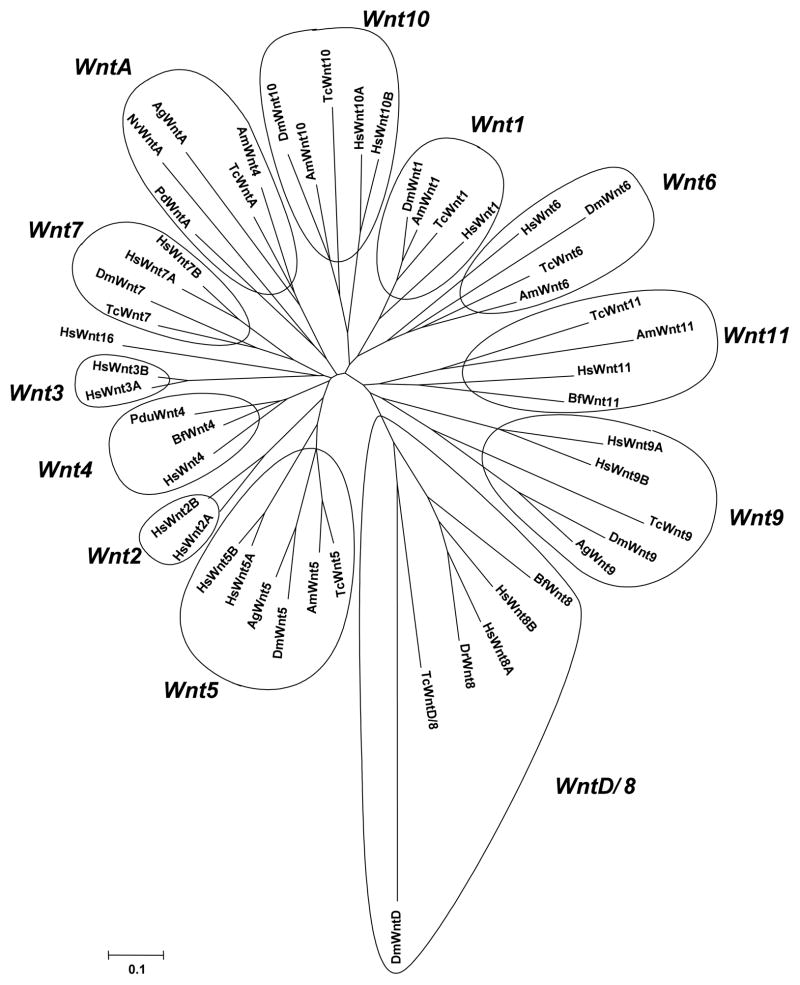
Fig. 1
Fig. 1
a Neighbour-joining phylogenetic tree of Wnt gene family. Analysis in MEGA 3.0 was performed using a bootstrap value of 1000. Tribolium Wnt8/D is clustered with Drosophila WntD and other Wnt8 family members. WntA from Tribolium, Apis and Anopheles also clustered together. Species abbreviations: Tc, Tribolium castaneum; Am, Apis melifera (insect); Dm, Drosophila melanogaster Ag, Anopheles gambiae (insect); Dr, Danio rerio (vertebrate); Hs, Homo sapiens; Bf, Branchiostoma floridae (amphioxus); Nv, Nematostella vectensis (sea anemone); Pd Platynereis dumerilii (annelid). b Wnt gene families in insects. The hymenopteran Apis stands basal to Tribolium, Anopheles and Drosophila (Savard et al. 2006). WntD is placed according to its phylogenetic position close to Wnt8.
Fig. 1
Fig. 1
a Neighbour-joining phylogenetic tree of Wnt gene family. Analysis in MEGA 3.0 was performed using a bootstrap value of 1000. Tribolium Wnt8/D is clustered with Drosophila WntD and other Wnt8 family members. WntA from Tribolium, Apis and Anopheles also clustered together. Species abbreviations: Tc, Tribolium castaneum; Am, Apis melifera (insect); Dm, Drosophila melanogaster Ag, Anopheles gambiae (insect); Dr, Danio rerio (vertebrate); Hs, Homo sapiens; Bf, Branchiostoma floridae (amphioxus); Nv, Nematostella vectensis (sea anemone); Pd Platynereis dumerilii (annelid). b Wnt gene families in insects. The hymenopteran Apis stands basal to Tribolium, Anopheles and Drosophila (Savard et al. 2006). WntD is placed according to its phylogenetic position close to Wnt8.
Fig. 2
Fig. 2
Insect Wnt gene clusters. The relative size, order and orientation of Wnt genes, including Wnt9, Wnt1/wg, Wnt6 and Wnt10 are compared. Non-Wnt genes found in the Tribolium and Drosophila clusters are also shown The Drosophila non-Wnt gene is not annotated, but is not orthologous to the Tribolium CDP-diglyceride synthetase. Orthologs are color-coded.
Fig. 3
Fig. 3
Only three Tribolium Wnt genes show expression in blastoderm embryos (whole mount in situ hybridization). Anterior pole points to the left. a wingless / Wnt 1. b Wnt 8/D. c Wnt A.
Fig. 4
Fig. 4. Expression of Tribolium Wnt genes in germband embryos (whole mount in situ hybridization). Ventral views, anterior to the left
a–c wingless (wg)/Wnt1. a In the germ rudiment, wg is expressed in the head lobes and posteriorly in a subterminal position that marks the developing hindgut and leaves the posterior pole free of expression (arrow). b In the extending germband embryo, stripes of wg are visible in the antennal, gnathal and thoracic segments anterior to the growth zone. c wg expression extends ventrally into the appendages of the fully extended germband embryo. In the head wg expression appears in the labrum and the developing brain lobes. wg is also expressed in patches along the lateral edge of each segment and in the developing hindgut. d–f Wnt5. d Wnt5 is expressed faintly in the head lobes (arrow) and in segmental stripes in an embryo beginning germband elongation. More intense expression is visible at the posterior end of the growth zone. e Stripes of Wnt5 in the gnathal and thoracic segments cross the ventral midline. Wnt5 expression is more intense at the posterior end and in broad wedge shaped domains in the head lobes. f In the fully extended germband embryo, Wnt5 is no longer expressed at the posterior end of the growth zone, but extends ventrally into the developing limbs and is also visible at their tips. g–i Wnt6. g In an embryo beginning germband elongation, Wnt6 is expressed faintly in the lateral head lobes (arrow), in segmental stripes and in a subterminal domain in the growth zone (arrowhead). h After elongation, a single segmental stripe remains, marking the eleventh abdominal segment, while expression is observed along the ventral edge of the limbs, along the dorsolateral edge of the embryo and in spots to the left and right of the midline. Expression near the posterior end of the germband marks the anlagen of the Malpighian tubules (arrowhead). i In the retracted germband, fore- and hindgut anlagen express Wnt6, as do precursors of the tracheal openings. Several spots of Wnt6 expression are also evident in the brain. Non-specific expression in the pleuropodia is marked by an asterisk. j–l Wnt7. j Faint segmental stripes of Wnt7 are apparent in the elongating embryo. k In a slightly older embryo, gnathal expression of Wnt7 is restricted to specific cells in the developing CNS, while in the thorax, expression encompasses the leg anlagen. l In the thorax and abdomen of the germband extended embryo, segmental stripes of Wnt7, which extend laterally into the dorsal mesoderm of the appendages, do not cross the midline. m Wnt8/D. During elongation, Wnt8/D remains expressed at the posterior end of the growth zone in two small patches, one at each side of the ventral mesoderm, that are connected by a narrow row of cells at a subterminal position. n–p Wnt9 n In late stage embryos Wnt9 expression is visible in cells of the fore- and hindgut that appear to be positioned at the border of the ectodermal and endodermal derivatives of the gut. o Closeup view of the embryo in n focusing on the foregut (arrow). p Closeup view of Wnt9 expression at the anterior end of the hindgut, where it connects to the midgut (arrow). Nonspecific staining of the pleuropodia in abdominal segment 1 is marked by an asterisk. q–s Wnt10. q Wnt10 expression is first visible in a single stripe in the mandibular segment. r In elongated embryos segmental stripes have resolved into dots of expression that extend ventrally into the developing limbs. Three prominent cells in each hemisphere of the developing brain also begin to express Wnt10. s During retraction, segmental expression of Wnt10 remains in the ventral limbs and in a few cells on either side of the ventral midline while expression in the brain has expanded. t–v Wnt11. t Wnt11 expression is visible in cells of the serosa, remnants of which are evident along the edge of the embryo and covering part of the posterior end. u In the germ-band extended embryo, Wnt11expression is visible in the distal tips of the developing legs. The distal regions of the maxillary and labial appendages express Wnt11 strongly but it is seen only weakly in the antennal lobes and there is no expression in the mandibles (arrowhead). Wnt11 is also expressed at the border of the dorsal ectoderm (arrow). v As the legs mature during germband retraction, expression of Wnt11 there resolves proximally into rings and distally into a ventral patch. Only a few antennal and labral cells express Wnt11, while expression is strong in the anal plate. w–y WntA. w In a germband embryo beginning elongation, WntA is expressed faintly in lateral domains of the head lobes, segmentally and in the growth zone. x Segmental expression appears as stripes only in the most posterior abdominal segments where it resolves into spots on either side of the ventral midline (arrows). As elongation nears completion, expression in the growth zone fades, while head specific expression develops. y During germband retraction, WntA expression appears in the developing hindgut and in the labrum. Expression also appears in the limbs in a ring at midlength and in patches along the lateral edge of the embryo.

References

    1. Angelini DR, Kaufman TC. Functional analyses in the milkweed bug Oncopeltus fasciatus (Hemiptera) support a role for Wnt signaling in body segmentation but not appendage development. Dev Biol. 2005;283:409–423. - PubMed
    1. Baker NE. Localization of transcripts from the wingless gene in whole Drosophila embryos. Development. 1988;103:289–298. - PubMed
    1. Brown SJ, Parrish JK, Beeman RW, Denell RE. Molecular characterization and embryonic expression of the even-skipped ortholog of Tribolium castaneum. Mech Dev. 1997;61:165–173. - PubMed
    1. Choe CP, Miller SC, Brown SJ. A pair-rule gene circuit defines segments sequentially in the short-germ insect Tribolium castaneum. Proc Natl Acad Sci USA. 2006;103:6560–6564. - PMC - PubMed
    1. Cohen ED, Mariol M, Wallace RMH, Weyers J, Kamberov YG, Pradel J, Wilder EL. DWnt4 regulates cell movement and focal adhesion kinase during Drosophila ovarian morphogenesis. Developmental Cell. 2002;2:437–448. - PubMed

Publication types

LinkOut - more resources
