


What are the differences between long-term, short-term, and working memory?
- PMID: 18394484
- PMCID: PMC2657600
- DOI: 10.1016/S0079-6123(07)00020-9
What are the differences between long-term, short-term, and working memory?
Abstract
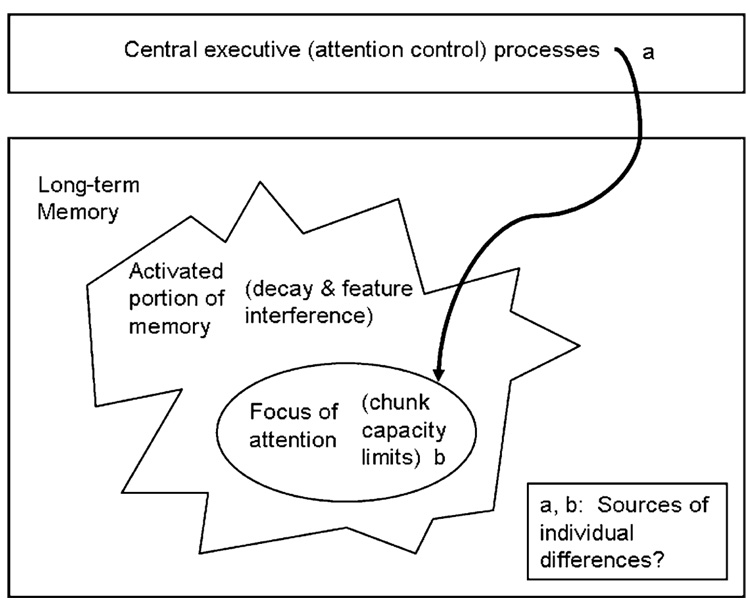
In the recent literature there has been considerable confusion about the three types of memory: long-term, short-term, and working memory. This chapter strives to reduce that confusion and makes up-to-date assessments of these types of memory. Long- and short-term memory could differ in two fundamental ways, with only short-term memory demonstrating (1) temporal decay and (2) chunk capacity limits. Both properties of short-term memory are still controversial but the current literature is rather encouraging regarding the existence of both decay and capacity limits. Working memory has been conceived and defined in three different, slightly discrepant ways: as short-term memory applied to cognitive tasks, as a multi-component system that holds and manipulates information in short-term memory, and as the use of attention to manage short-term memory. Regardless of the definition, there are some measures of memory in the short term that seem routine and do not correlate well with cognitive aptitudes and other measures (those usually identified with the term "working memory") that seem more attention demanding and do correlate well with these aptitudes. The evidence is evaluated and placed within a theoretical framework depicted in Fig. 1.
Figures
References
-
- Atkinson RC, Shiffrin RM. Human memory: a proposed system and its control processes. In: Spence KW, Spence JT, editors. The Psychology of Learning and Motivation: Advances in Research and Theory. Vol. 2. New York: Academic Press; 1968. pp. 89–195.
-
- Baddeley A. The episodic buffer: a new component of working memory? Trends Cogn. Sci. 2000;4:417–423. - PubMed
-
- Baddeley AD. Oxford Psychology Series No. 11. Oxford: Clarendon Press; 1986. Working Memory.
-
- Baddeley AD, Hitch G. Working memory. In: Bower GH, editor. The Psychology of Learning and Motivation. Vol. 8. New York: Academic Press; 1974. pp. 47–89.
-
- Baddeley AD, Scott D. Short-term forgetting in the absence of proactive inhibition. Q. J. Exp. Psychol. 1971;23:275–283.
Publication types
MeSH terms
Grants and funding
LinkOut - more resources
Full Text Sources
Medical
