. 2008 Jun;52(7):1365-72.
doi: 10.1016/j.neuint.2008.02.006. Epub 2008 Mar 4.

Electrophysiological properties and gap junction coupling of striatal astrocytes

Affiliations

Electrophysiological properties and gap junction coupling of striatal astrocytes

Louise Adermark et al. Neurochem Int. 2008 Jun.

Abstract

The striatum is the biggest nucleus of the basal ganglia and receives input from almost all cortical regions, substantia nigra and the thalamus. Striatal neuronal circuitry is well characterized, but less is known about glial physiology. To this end, we evaluated astrocyte electrophysiological properties using whole-cell patch-clamp recording in dorsal striatal brain slices from P15 to P21 rat. The majority of cells (95%) were passive astrocytes that do not express any detectable voltage-gated channels. Passive astrocytes were subcategorized into three groups based on time-dependent current properties. The observed proportion of the different astrocyte subtypes did not change within the age range evaluated here, but was modulated during reduction of specific conductances and gap junction coupling. Striatal astrocytes were extensively interconnected and closure of gap junctions with octanol (1mM), carbenoxolone (100 microM) or increased intracellular calcium (2mM), significantly altered intrinsic properties. When simultaneously blocking potassium channels and gap junction coupling almost no passive conductance was detected, implying that the major currents in striatal astrocytes derive from potassium and gap junction conductance. Uncoupling of the syncytium reduced currents activated in response to a hyperpolarizing pulse, suggesting that changes in gap junction coupling alters astrocyte electrophysiological responses. Our findings indicate that the prevalent gap junction coupling is vital for astrocyte function in the striatum, and that whole-cell recordings will be distorted by currents activated in neighboring cells.


Figures
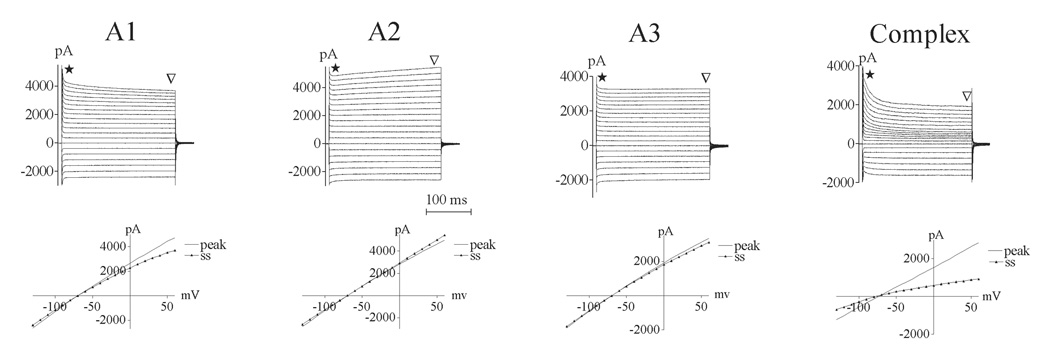
Figure 1
Figure 1
Astrocyte subtypes were categorized based on physiological criteria’s. All passive cells displayed large voltage independent currents. (a) Cells with an A1 current pattern (56%) also had a slowly decaying current component, while A2 astrocytes (19%) displayed a slowly activating component (b). (c) A3 astrocytes (20%) only showed time- and voltage independent conductance. (d) Complex astrocytes expressed a combination of time- and voltage-activated conductances. To activate the currents, cells were held at −70 mV and 10 mV hyperpolarizing and depolarizing voltage steps of 250 ms duration were applied in both hyperpolarizing and depolarizing direction (+ 60 to − 130 (+ 100 to − 90 for the complex cell)). Current/voltage relationship was measured for both peak and steady-state (ss) components of current.
Figure 2
Figure 2
Developmental properties of p15 to p21 astrocytes. a) The proportion of electrophysiologically-defined astrocyte subtypes did not vary across the age range evaluated here. b) Resting membrane potential in cells from P21 slices were more positive in comparison to cells at earlier developmental time points (P15 p <0.001; P16 p < 0.05; P19 p < 0.05), but input resistance and apparent capacitance did not differ significantly within this age span. Each group represents data from 22 to 40 patch clamped astrocytes from at least 3 different animals. The total number of cells analyzed was 217. Data are presented as mean values with 95% CI and statistical comparisons between groups of cells were performed by one-way ANOVA with Tukey's Multiple Comparison Test, or Fisher’s exact test.
Figure 3
Figure 3
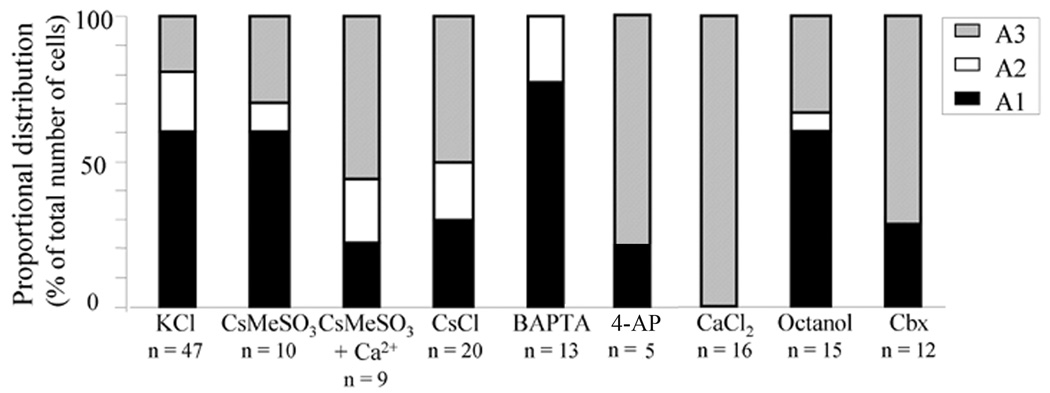
The relative proportion of different striatal subtypes is modulated by the composition of the internal solution and gap junction coupling. The number of A1 expressing astrocytes was significantly reduced in astrocytes patch clamped with an internal solution containing CsCl or increased [Ca2+]i. Blocking gap junction coupling by Cbx (100 µM) or intracellular loading with CaCl2 (2 mM), increased the number of cells with an A3 membrane current pattern, while no A3-subtypes were detected when intracellular calcium was chelated with BAPTA. Graph showing proportional representation of the different subtypes of passive astrocytes. Each group is based on recordings from at least 3 different animals.
Figure 4
Figure 4
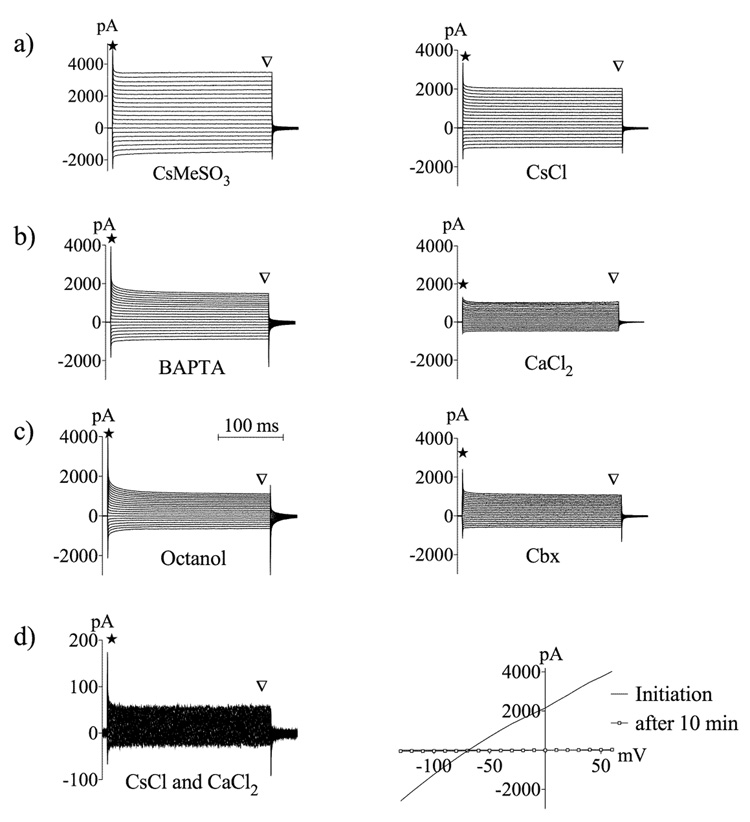
Representative traces showing membrane current pattern during reduction of specific conductances. a) Potassium channels were blocked by intracellular Cs+-loading. b) Intracellular calcium was chelated by 10 mM BAPTA or increased by intracellular loading with 2 mM CaCl2. In the presence of elevated intracellular calcium, transients at the start and end of current pulses are diminished, indicative of decreased apparent capacitance (star), and current amplitude during voltage steps is also decreased, indicative of decreased conductance. c) Recordings during extracellular treatment with 1 mM octanol or extracellular application of 100 µM Cbx. Note the diminished transients and current, indicating decreases in apparent capacitance and conductance, respectively. d) Recordings in the combined presence of Cs+ and elevated intracellular Ca2+. Passive conductances are greatly diminished under this condition. Note the expanded current scale. Right hand figure shows I/V relationship at steady state (arrowhead) immediately after establishing the whole cell recording and 15 min later when the CsCl and high [Ca2+]i-containing internal solution has diffused into the cell. Currents were activated in response to increasing hyper- and depolarizing potentials ranging from −130 to 60 mV, in 10 mV increments.
Figure 5
Figure 5
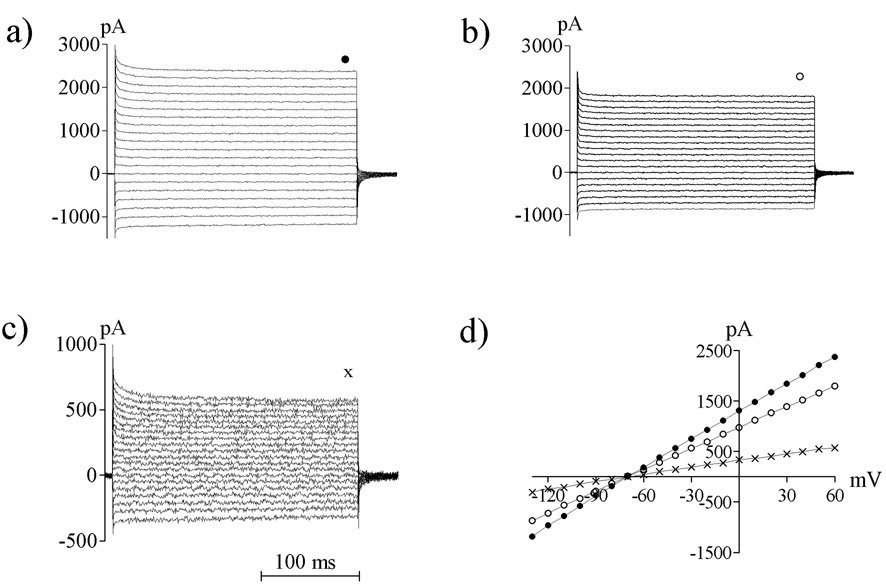
Striatal astrocytes displayed 4-AP-sensitive outward K+ currents. The 4-AP sensitive current (c), was obtained by subtracting the current observed during 4-AP exposure (4 mM) (b) from the baseline conductance (a). d) Graph show I/V relationships for baseline current (●), 4-AP insensitive current (○), and 4-AP sensitive current (X) from one representative experiment. A stable I/V relationship was required before slices were treated with 4-AP.
Figure 6
Figure 6
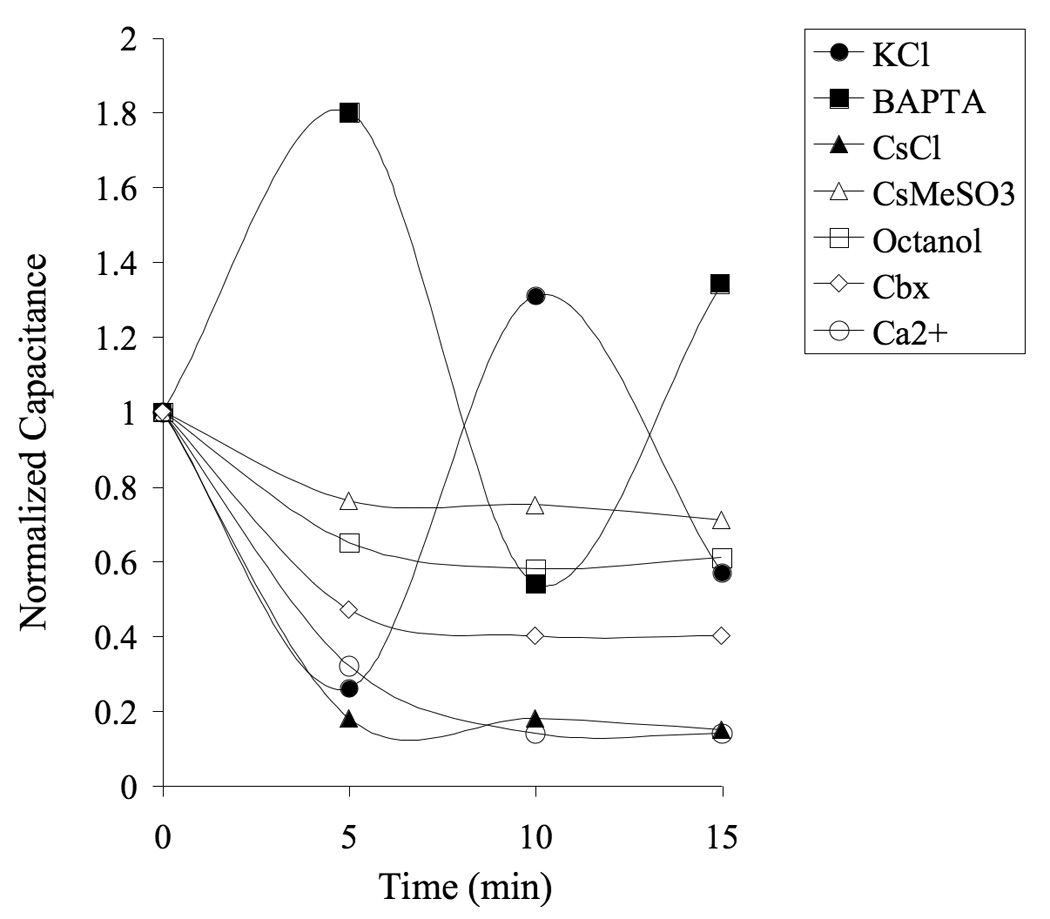
Capacitance fluctuates over time in patch clamped astrocytes. Measured capacitance stabilized within 5 min after established whole cell configuration in 90% of the cells loaded with Cs+-based internal solution, but varied extensively (> 30 pF) in 62% of the astrocytes loaded with a KCl-based internal solution. None of the cells treated with gap junction blockers exhibited an unstable capacitance. Graph shows normalized capacitance in representative astrocytes.
Figure 7
Figure 7
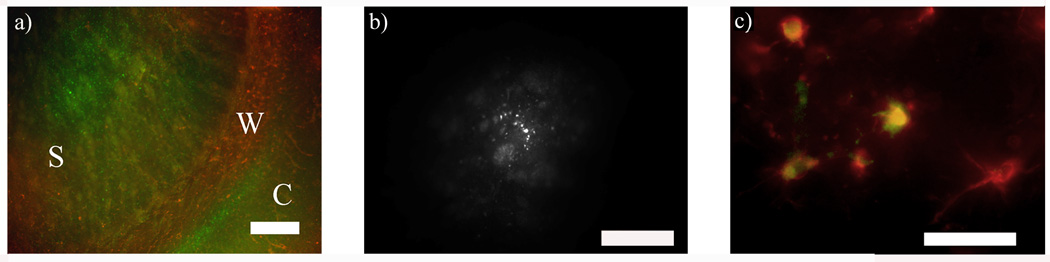
Dye coupling and immunohistochemistry. a) Intracellular staining of Lucifer Yellow revealed an extensive astrocytic network in the striatum that also included cells in the cortex. To be able to show the whole network the amplification is low and therefore Lucifer Yellow stained astrocytes appear as very small green puncta. S = striatum, W = white matter, C = cortex. (GFAP, red, Lucifer Yellow, green). b) The number of cells loaded with Lucifer Yellow was significantly reduced in slices perfused with octanol (1 mM). Note the different scale in comparison to a. c) Cells loaded with Lucifer Yellow were immunopositive for GFAP, showing that patch clamped cells are astrocytes. GFAP, red; Lucifer Yellow, green. Scale bar is 200 µm in a, 100 µm in b and 20 µm in c.
Figure 8
Figure 8
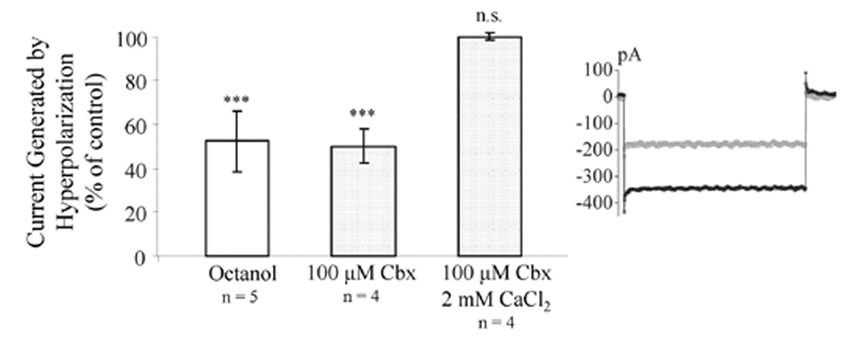
Changes in gap junction coupling alters astrocyte electrophysiological responses. Extracellular application of 1 mM octanol or 100 µM Cbx significantly reduced the current response to a hyperpolarizing pulse (−20 mV) in KCl-loaded astrocytes. Cbx did not reduce activated current in astrocytes were gap junction coupling was blocked by high [Ca2+]i. Patch clamped cells were held at −70 mV and a stable baseline was required before extracellular application of gap junction blockers. Example traces show baseline current (black) and after Cbx treatment (gray). *** p <0.001.

References

    1. Adermark L, Lovinger DM. Ethanol effects on electrophysiological properties of astrocytes in striatal brain slices. Neuropharmacology. 2006;51:1099–1108. - PubMed
    1. Adermark L, Olsson T, Hansson E. Ethanol acutely decreases astroglial gap junction permeability in primary cultures from defined brain regions. Neurochem Int. 2004;45:971–978. - PubMed
    1. Anderova M, Antonova T, Petrik D, Neprasova H, Chvatal A, Sykova E. Voltage-dependent potassium currents in hypertrophied rat astrocytes after a cortical stab wound. Glia. 2004;48:311–326. - PubMed
    1. Balleine BW, Delgado MR, Hikosaka O. The role of the dorsal striatum in reward and decision-making. J Neurosci. 2007;27:8161–8165. - PMC - PubMed
    1. Blomstrand F, Aberg ND, Eriksson PS, Hansson E, Ronnback L. Extent of intercellular calcium wave propagation is related to gap junction permeability and level of connexin-43 expression in astrocytes in primary cultures from four brain regions. Neuroscience. 1999a;92:255–265. - PubMed

Publication types