


Retinol-binding protein 4 and its relation to insulin resistance in obese children before and after weight loss
- PMID: 18397979
- PMCID: PMC2729181
- DOI: 10.1210/jc.2007-2745
Retinol-binding protein 4 and its relation to insulin resistance in obese children before and after weight loss
Abstract
Context: There are limited and controversial data concerning the relationships between retinol-binding protein 4 (RBP4), weight status, and insulin resistance in obese humans and especially in children.
Objective: Our objective was to study the longitudinal relationships among RBP4, insulin resistance and weight status in obese children.
Design, setting, and patients: We conducted a 1-yr longitudinal follow-up study in a primary-care setting with 43 obese children (median age 10.8 yr) and 19 lean children of same the age and gender.
Intervention: Our outpatient 1-yr intervention program was based on exercise, behavior, and nutrition therapy.
Main outcomes measures: Changes of weight status (body mass index sd score), RBP4, molar RBP4/serum retinol (SR) ratio, insulin resistance index homeostasis model assessment (HOMA), and quantitative insulin sensitivity check index (QUICKI).
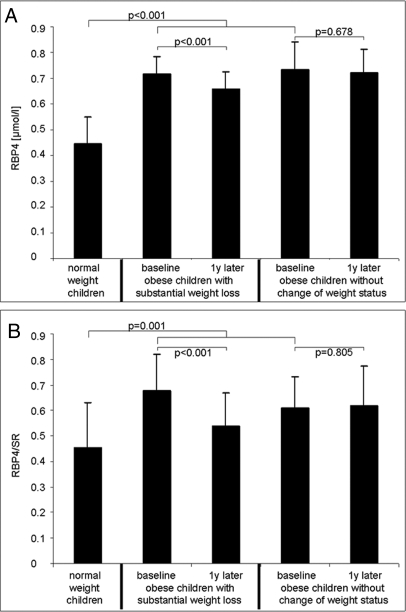
Results: Obese children had significantly (P < 0.01) higher RBP4 concentrations and a higher RBP4/SR ratio compared with lean children. In multiple linear regression analyses adjusted to age, gender, and pubertal stage, RBP4 was significantly correlated to insulin and body mass index. Pubertal children demonstrated significantly decreased QUICKI and significantly increased HOMA index, insulin, and RBP4 concentrations compared with prepubertal children. Changes of RBP4 correlated significantly to changes of insulin (r = 0.29), HOMA index (r = 0.29), QUICKI (r = 0.22), and weight status (r = 0.31). Substantial weight loss in 25 children led to a significant (P < 0.001) decrease of RBP4, RBP4/SR, blood pressure, triglycerides, insulin, and HOMA index and an increase in QUICKI in contrast to the 18 children without substantial weight loss.
Conclusion: RBP4 levels were related to weight status and insulin resistance in both cross-sectional and longitudinal analyses, suggesting a relationship between RBP4, obesity, and insulin resistance in children.
Trial registration: ClinicalTrials.gov NCT00435734.
Figures
References
-
- Grundy SM 2004 Obesity, metabolic syndrome, and cardiovascular disease. J Clin Endocrinol Metab 89:2595–2600 - PubMed
-
- Moller DE, Kaufman KD 2005 Metabolic syndrome: a clinical and molecular perspective. Annu Rev Med 56:45–62 - PubMed
-
- Ferroni P, Basili S, Falco A, Davi G 2004 Inflammation, insulin resistance, and obesity. Curr Atheroscler Rep 6:424–431 - PubMed
-
- Fu Y, Luo N, Klein RL, Garvey WT 2005 Adiponectin promotes adipocyte differentiation, insulin sensitivity, and lipid accumulation. J Lipid Res 46:1369–1379 - PubMed
-
- Yang Q, Graham TE, Mody N, Preitner F, Peroni OD, Zabolotny JM, Kotani K, Quadro L, Kahn BB 2005 Serum retinol binding protein 4 contributes to insulin resistance in obesity and type 2 diabetes. Nature 436:356–362 - PubMed
Publication types
MeSH terms
Substances
Associated data
Grants and funding
LinkOut - more resources
Full Text Sources
Other Literature Sources
Medical
Research Materials
Miscellaneous
