. 2008 Apr 9;28(15):3839-45.
doi: 10.1523/JNEUROSCI.5389-07.2008.

Insolubility of disrupted-in-schizophrenia 1 disrupts oligomer-dependent interactions with nuclear distribution element 1 and is associated with sporadic mental disease

Affiliations

Insolubility of disrupted-in-schizophrenia 1 disrupts oligomer-dependent interactions with nuclear distribution element 1 and is associated with sporadic mental disease

S Rutger Leliveld et al. J Neurosci. .

Abstract

Disrupted-in-schizophrenia 1 (DISC1) and other genes have been identified recently as potential molecular players in chronic psychiatric diseases such as affective disorders and schizophrenia. A molecular mechanism of how these genes may be linked to the majority of sporadic cases of these diseases remains unclear. The chronic nature and irreversibility of clinical symptoms in a subgroup of these diseases prompted us to investigate whether proteins corresponding to candidate genes displayed subtle features of protein aggregation. Here, we show that in postmortem brain samples of a distinct group of patients with phenotypes of affective disorders or schizophrenia, but not healthy controls, significant fractions of DISC1 could be identified as cold Sarkosyl-insoluble protein aggregates. A loss-of-function phenotype could be demonstrated for insoluble DISC1 through abolished binding to a key DISC1 ligand, nuclear distribution element 1 (NDEL1): in human neuroblastoma cells, DISC1 formed expression-dependent, detergent-resistant aggregates that failed to interact with endogenous NDEL1. Recombinant (r) NDEL1 expressed in Escherichia coli selectively bound an octamer of an rDISC1 fragment but not dimers or high molecular weight multimers, suggesting an oligomerization optimum for molecular interactions of DISC1 with NDEL1. For DISC1-related sporadic psychiatric disease, we propose a mechanism whereby impaired cellular control over self-association of DISC1 leads to excessive multimerization and subsequent formation of detergent-resistant aggregates, culminating in loss of ligand binding, here exemplified by NDEL1. We conclude that the absence of oligomer-dependent ligand interactions of DISC1 can be associated with sporadic mental disease of mixed phenotypes.


Figures
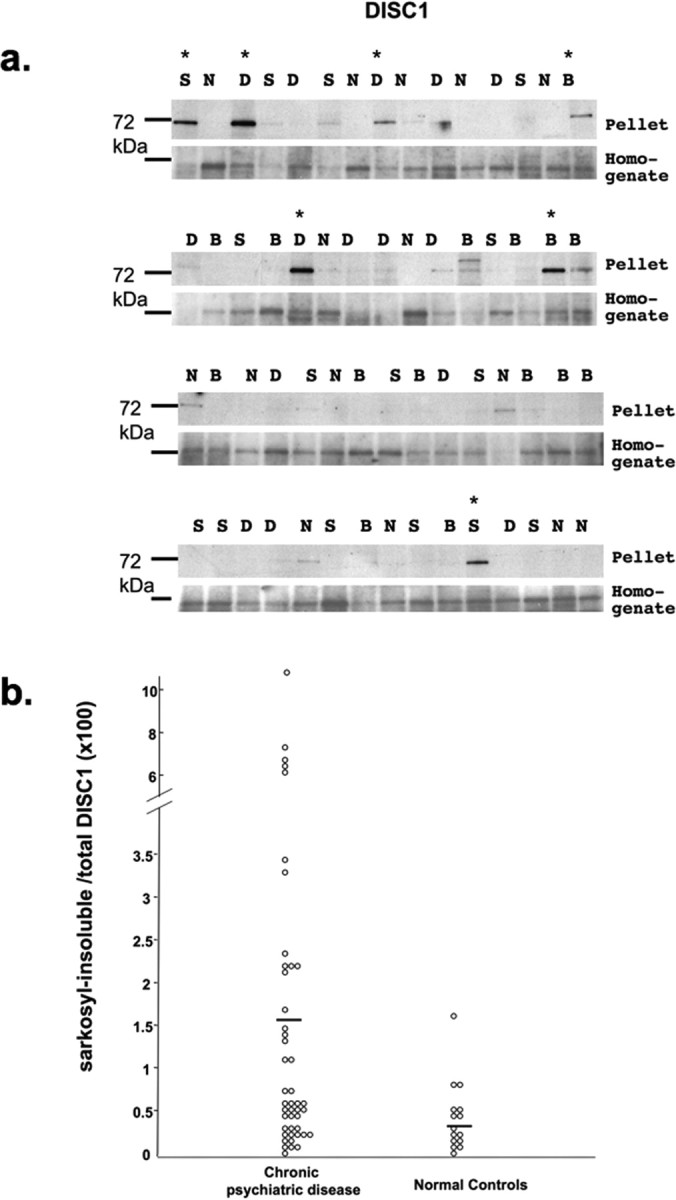
Figure 1.
Figure 1.
a, Western blot for DISC1 of cold Sarkosyl-insoluble pellets (top) and starting brain homogenates (bottom) of 60 individual cases (SMRI Consortium Collection) of schizophrenia (S), bipolar disorder (B), depression (D), and normal controls (N). Each lane corresponds to one case. Asterisks indicate immunoreactivity above threshold (defined as strongest background immunoreactivity in normal controls) in the insoluble pellet fraction. b, Scatter plot of the ratio of Sarkosyl-insoluble pelleted material (P) by the starting material (H) of DISC1 from diseased cases versus normal controls, quantified by densitometry of Western blots from a. Eighty-six percent of positive cases from a were also found to have a high P/H ratio. Calculation of P/H ratio leads to slight adjustments of positive cases relative to a, when the homogenate concentration was relatively abundant. The solid bold lines mark the arithmetic means. A pronounced scatter of P/H values is evident across the three disease groups; current clinical interview-based diagnostic protocols cannot avoid the grouping of pathological entities with different molecular underpinnings under a similar broad diagnostic category. Therefore, mean values for any of these groups, although of interest, should be relativized. Means of diseased (n = 45) versus normal (n = 15) brains was 1.6 versus 0.4, respectively (p = 0.002; ANOVA).
Figure 2.
Figure 2.
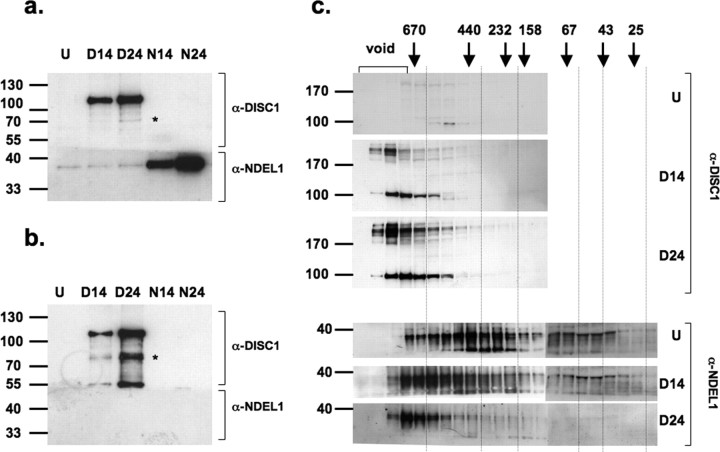
Western blots demonstrating that molecular interactions of DISC1 and NDEL1 in NLF cells depend on solubility of DISC1. After transient transfection of NLF cells with DISC1, cells were lyzed and subjected to a fractionation protocol, including ultracentrifugation in the presence of cold Sarkosyl (see Materials and Methods). a, b, The supernatant after the first low-speed spin in 0.2% cold Sarkosyl (a) and the pellet purified, including ultracentrifugation (b), were analyzed by Western blot. The Western blot was horizontally cut at ∼55 kDa and stained with mouse α-DISC1 monoclonal antibody 3D4 (top) or polyclonal NDEL1 antiserum (bottom); before film exposure, cut blot parts stained with different antibodies were reassembled. U, Untransfected; D14 or N14, transient transfection with DISC1 or NDEL1, respectively, for 14 h; D24 or N24, transient transfection with DISC1 or NDEL1, respectively, for 24 h. Baseline expression of DISC1 was not detectable; DISC1 immunoreactivity increased after prolonged transfection time (a, lanes U-D24, top); there was baseline NDEL1 expression detectable, which increased after prolonged transient transfection of NDEL1 but not DISC1 (a, lanes U-N24). DISC1 pelleted as Sarkosyl-insoluble in an expression-dependent manner (b, top, compare D14 with D24), without pulling down NDEL1 (b, bottom, D14-D24); NDEL1 itself did not pellet under the same conditions used for DISC1 (b, bottom, N14-N24). The asterisk indicates a 72 kDa immunoreactive band that is strongly enriched in the Sarkosyl-insoluble fraction, as is a 55 kDa band. c, Soluble fractions of DISC1 transfected lysates were further processed by size exclusion chromatography and analyzed by Western blot. Although overexpression of DISC1 did not qualitatively change the size distribution of DISC1 multimers, NDEL1 was redistributed dramatically toward high-molecular size complexes in an expression level-dependent manner as evidence for a sensitive regulation of NDEL1 by soluble DISC1 (bottom three panels). The DISC1-positive bands >200 kDa reflect SDS-resistant oligomers, similar to the ∼180 kDa bands we observed for rDISC316 (supplemental Fig. 10c, available at www.jneurosci.org as supplemental material). Vertical gridlines are shown to facilitate comparisons of aligned lanes corresponding to the same eluted fractions.
Figure 3.
Figure 3.
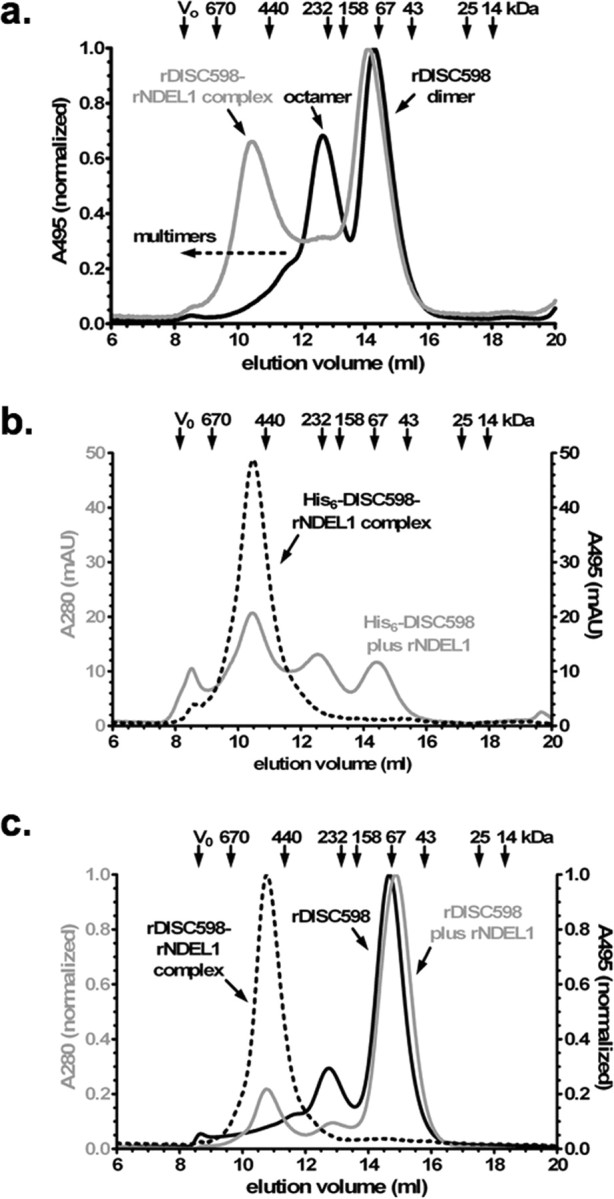
Analysis of interaction between rDISC598 and rNDEL1 by SEC. a, Normalized SEC profile at 495 nm of fluorescein-labeled rDISC598 alone (black) and combined with nonlabeled rNDEL1 (gray; 1:4 as monomer). The resulting complex peak (∼500 kDa) reflects a homogenous species, whereby the disappearance of the rDISC598 octamer peak indicates that NDEL1 preferentially binds the octamer and not the dimer (∼65 kDa) and is unlikely to bind multimers (>300 kDa). b, SEC profile at 280 nm (total protein; gray) and 495 nm of His6-tagged rDISC598 plus fluorescein-tagged NDEL1 (dashed black; 1:4), confirming that NDEL1 has little or no affinity for multimeric rDISC598. The presence of the hexahistidine tag increases favors multimerization without affecting overall structure, as verified by CD spectroscopy. c, Normalized SEC profile at 280 and 495 nm of nonlabeled DISC598 without (solid black) or with (gray; 10:1) fluorescein-labeled rNDEL1. Again, the rDISC598-rNDEL1 complex (495 nm; dashed black) is homogenous, even with an excess of rDISC598. The rDISC598 used here is the isolated and then concentrated dimer fraction, verifying that previously non-NDEL1-binding dimers can form NDEL1-binding octamers.

References

    1. an der Heiden W, Hafner H. The epidemiology of onset and course of schizophrenia. Eur Arch Psych Clin Neurosci. 2000;250:292–303. - PubMed
    1. Berrettini W. Evidence for shared susceptibility in bipolar disorder and schizophrenia. Am J Med Genet. 2003;123:59–64. - PubMed
    1. Blackwood DH, Muir WJ. Clinical phenotypes associated with DISC1, a candidate gene for schizophrenia. Neurotox Res. 2004;6:35–41. - PubMed
    1. Blackwood DH, Fordyce A, Walker MT, St Clair DM, Porteous DJ, Muir WJ. Schizophrenia and affective disorders–cosegregation with a translocation at chromosome 1q42 that directly disrupts brain-expressed genes: clinical and P300 findings in a family. Am J Hum Genet. 2001;69:428–433. - PMC - PubMed
    1. Chua SE, McKenna PJ. A skeptical view of the neuropathology of schizophrenia. In: Harrison PJ, Roberts GW, editors. The neuropathology of schizophrenia. Oxford: Oxford UP; 2000. pp. 291–337.

Publication types

MeSH terms