. 2008 Apr;19(4):318-30.
doi: 10.1089/hum.2007.138.

Delivery of recombinant adeno-associated virus-mediated human tissue kallikrein for therapy of chronic renal failure in rats

Affiliations

Delivery of recombinant adeno-associated virus-mediated human tissue kallikrein for therapy of chronic renal failure in rats

Ling Tu et al. Hum Gene Ther. 2008 Apr.

Abstract

The tissue kallikrein-kinin system is important in regulating cardiovascular and renal function, and dysregulation of the system has been implicated in heart and kidney pathologies. These findings suggest that if balance can be restored to the kallikrein-kinin axis, then associated disease progression may be attenuated. To test this hypothesis, recombinant adeno-associated virus (rAAV)-mediated human tissue kallikrein (HK) expression was induced in a rodent model of chronic renal failure involving 5/6 nephrectomy (nephrectomy plus 70% reduction of remaining kidney). rAAV-HK treatment attenuated the rise in blood pressure, glomerular sclerosis, and tubulointerstitial injury observed in this model. rAAV-HK treatment also attenuated renal function decline as measured by urinary microalbumin, osmolarity, and cGMP levels. Reverse transcriptase-polymerase chain reaction analysis showed that rAAV-HK-treated rats had higher levels of bradykinin receptor-2 (B(2)R) and dopamine receptor-1 mRNAs. In contrast, angiotensin II receptor-1, endothelin receptor-A, and vasopressin receptor-2 mRNAs were markedly downregulated in kidneys from HK-treated rats. Bradykinin induced similar changes in receptor levels and prevented transforming growth factor-beta(1)-induced tubulointerstitial fibrosis. The effects of bradykinin could be reversed with the B(2)R antagonist HOE-140. Together, these findings suggest that restoration of the kallikrein-kinin system reduces kidney injury and protects renal function in 5/6-nephrectomized rats via changes in the expression and activation of G protein-coupled receptors including B(2)R.


Figures
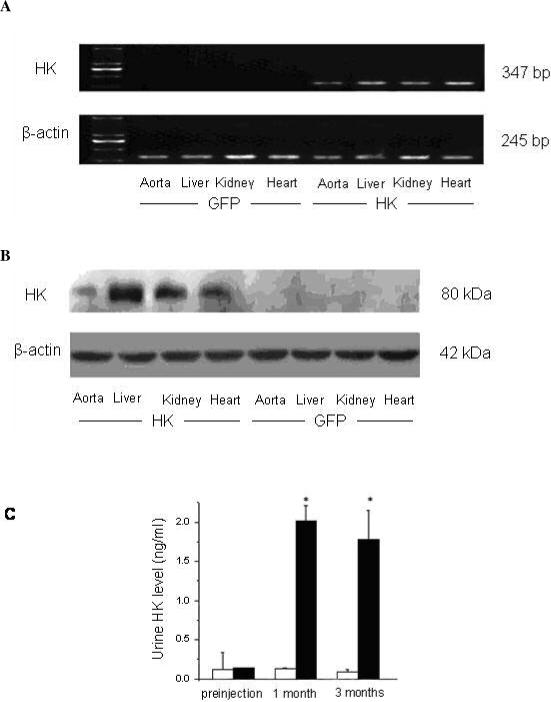
Figure 1
Figure 1
rAAV-HK mediates human tissue kallikrein expression in 5/6 nephrectomized rats. (A) HK mRNAs were detected by RT-PCR in 5/6 nephrectomized rats three months after gene delivery. RT-PCR was performed on 1 μg of total RNA from heart, aorta, kidney and liver. HK mRNA (374 bp) and β-actin control (245 bp) are shown. HK mRNA was detected in tissues from rAAV-HK-treated rats, but not rAAV-GFP treated rats. Results are representative of three independent experiments. (B) HK protein expression was determined by western blotting of tissues from 5/6 nephrectomized rats three months after gene delivery. HK protein was detected in tissues of rAAV-HK treated rats, but not in rAAV-GFP treated rats. The blot is representative of 4 independent experiments. (C) HK levels determined by ELISA on urine collected from rats prior to gene therapy and at one and three months after injection (white bars, rAAV-GFP; black bars, rAAV-HK). Urinary HK levels were detected only in rAAV-HK-treated rats. Results are expressed as mean ± SEM (n=6 per group); *p<0.01 vs. preinjection and rAAV-GFP.
Figure 2
Figure 2
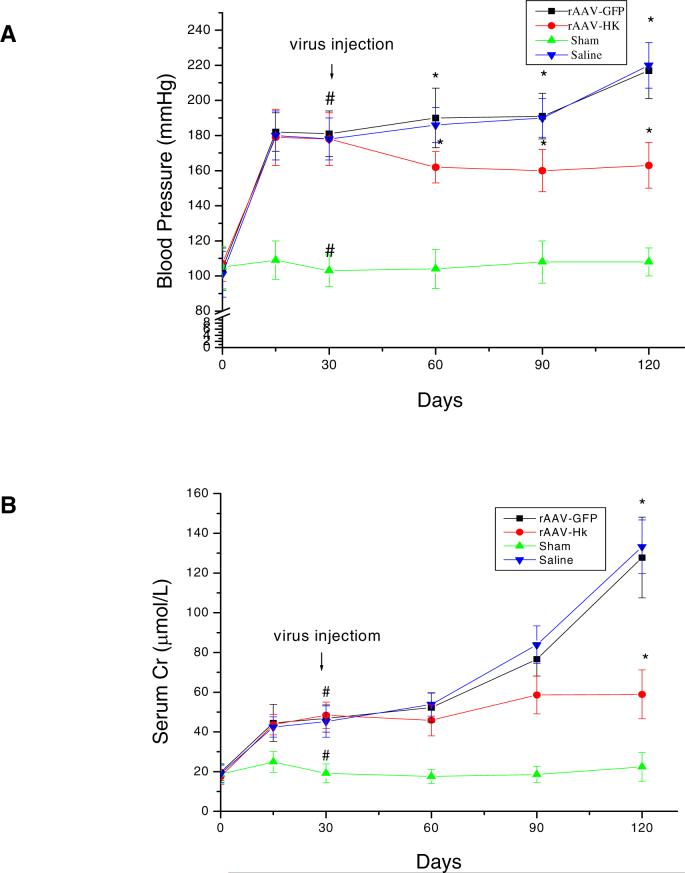
rAAV-HK gene delivery lowers systolic blood pressure and improves renal function in 5/6 nephrectomized rats. (A) Systolic blood pressure was measured in all rats at the indicated time points using the tail-cuff method. 5/6 nephrectomy results in an approximately 80 mmHg increase in systolic blood pressure. rAAV-HK gene delivery lowers systolic blood pressure, while blood pressure in saline and rAAV-GFP treated rats continues to rise. (B) Serum creatinine levels were measured in all rats at the indicated time points. 5/6 nephrectomy results in elevation in SCr levels and chronic and progressive renal failure. rAAV-HK treatment attenuates the renal failure in 5/6 nephrectomized rats. Values are expressed as mean ± SEM (n=6 for each group); * p<0.001 vs. sham, # p<0.001 vs. saline and rAAV-GFP.
Figure 3
Figure 3
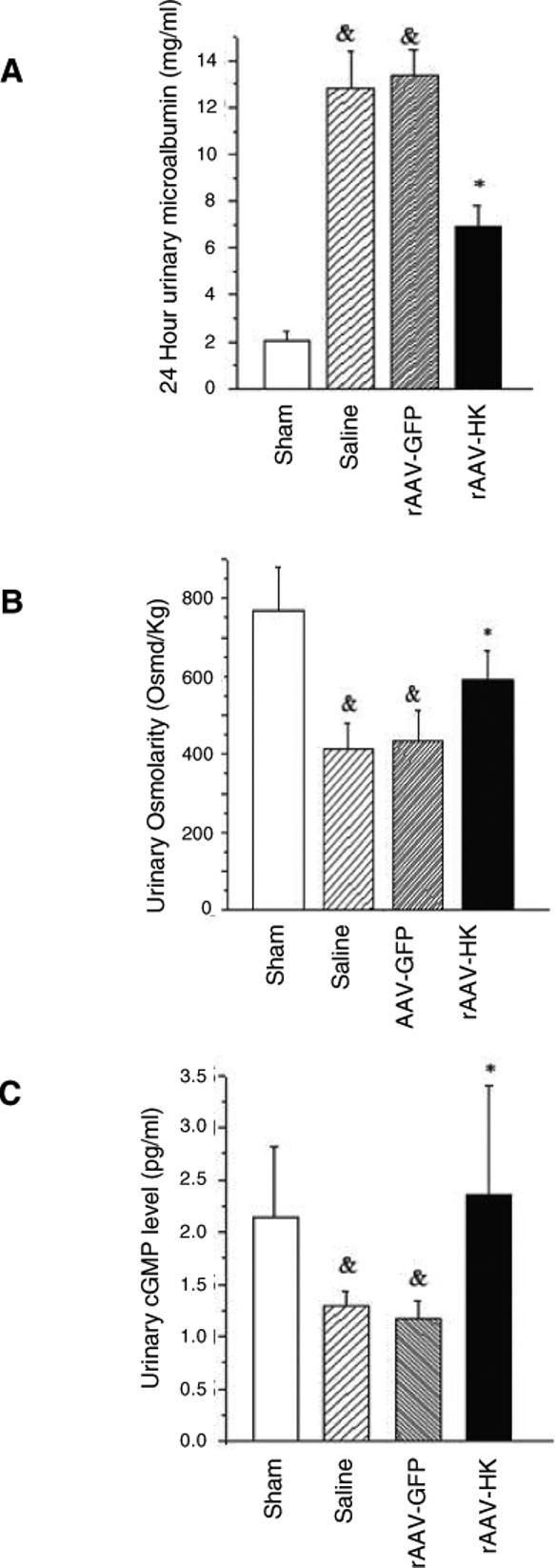
rAAV-HK gene therapy attenuates changes in urinary microalbumin excretion, osmolarity, and cGMP levels in 5/6 nephrectomized rats. Twenty-four hour urinary microalbumin excretion (A), urinary osmolarity (B) and urinary cGMP levels (C) were measured in 5/6 nephrectomized rats three months after gene delivery. rAAV-HK treatment attenuated the rise in microalbumin excretion and the reduction in urinary osmolarity and cGMP levels observed after 5/6 nephrectomy. Data are expressed as mean ± SEM (n=6 per group); # p<0.05 vs. sham; * p<0.05 vs. saline and rAAV-GFP.
Figure 4
Figure 4
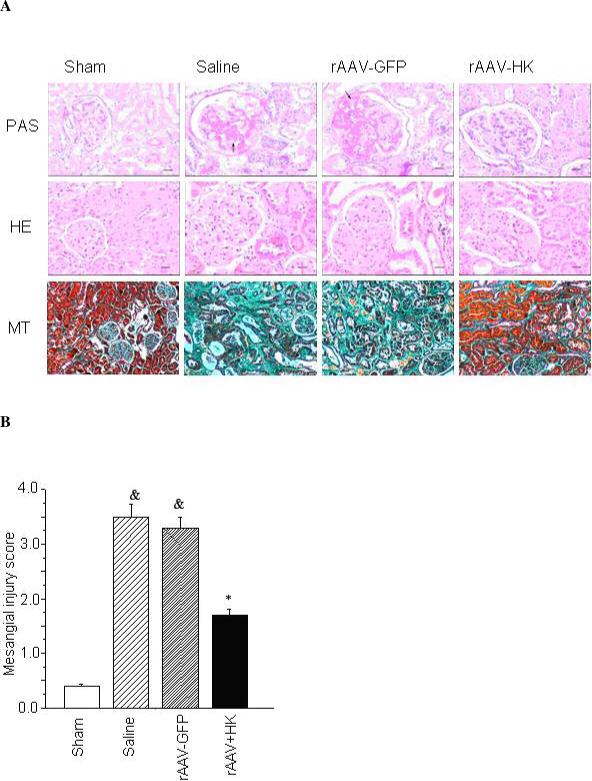
rAAV-HK gene therapy attenuates changes on kidney morphology associated with 5/6 nephrectomy. (A) Kidney tissue sections were stained with periodic acid-schiff (PAS) reagent, hematoxylin and eosin (HE) or Masson's Trichrome (MT) as indicated. PAS and HE stained sections are shown at 200× magnification (scale bar, 10 μm). Sections stained with MT are shown at 40× magnification (scale bar, 50 μm). (B) PAS stained sections were evaluated for the severity of glomerular sclerosis according to the MIS system established by Raij et al [27]. rAAV-HK treatment attenuated the morphological changes in the kidneys of 5/6 nephrectomized rats. Data are expressed as mean ± SEM (n=6 per group); # p<0.05 vs. sham; * p<0.05 vs. saline and rAAV-GFP.
Figure 5
Figure 5
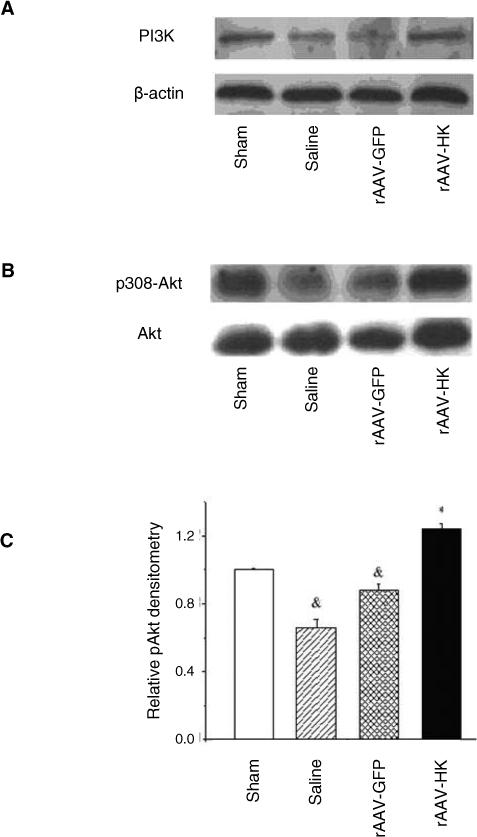
5/6 nephrectomy and rAAV-HK gene delivery alter renal PI3K/Akt signaling pathways. Representative western blots show that PI3K expression (A) and p308-Akt phosphorylation (B) are reduced in control 5/6 nephrectomy rats but restored by rAAV-HK treatment. (C) Densitometric analysis of p308-Akt phosphorylation detected by western blotting. Results are expressed as mean ± SEM (n=6 per group); * p<0.05 vs. saline and rAAV-GFP controls; # p<0.05 vs. sham control.
Figure 6
Figure 6
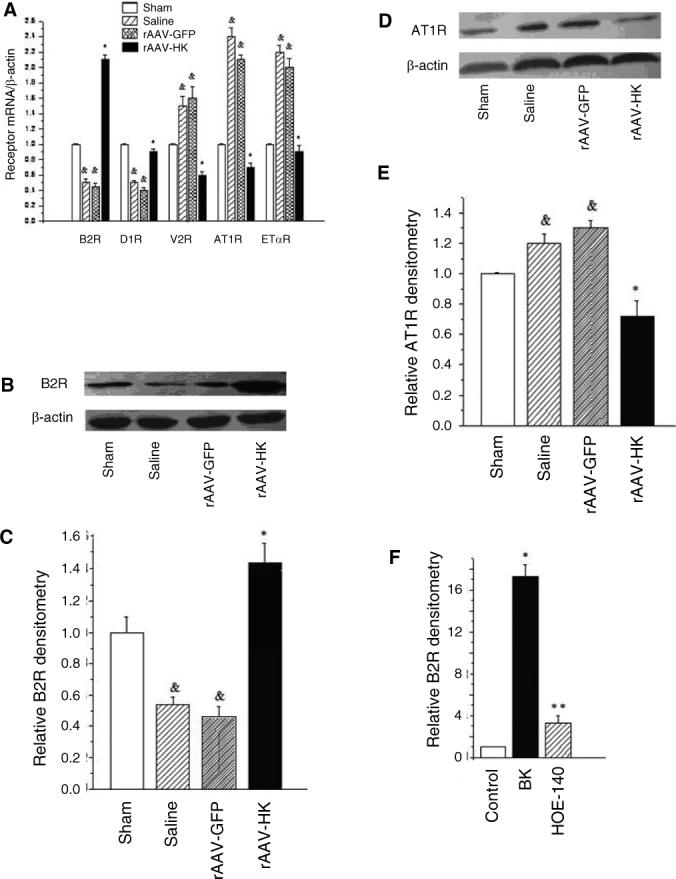
5/6 nephrectomy and rAAV-HK gene therapy alter rat kidney G-protein coupled receptor mRNA expression. (A) Real-time PCR showing mRNA levels for B2R, D1R, AT1R, ETAR, and V2R in kidneys of 5/6 nephrectomized rats three months after gene delivery. The ratio of each mRNA/β-actin is shown. Representative western blots of B2R (B) and AT1R (D) expression in kidney in 5/6 nephrectomized rats after three months of gene delivery. Densitometric quantification shows levels of B2R (C) and AT1R (E) expression (normalized to β-actin) in rat kidneys after three months of gene delivery. rAAV-HK treatment reverses the decrease of B2R and increase in AT1R observed after 5/6 nephrectomy. Data are expressed as mean ± SEM (n=4=5 per group); & p<0.05 vs. sham; * p<0.05 vs. saline and GFP controls. (F) HEK293 cells were treated with vehicle, bradykinin (BK) (10 nM), or BK and HOE-140 (10 nM each) for 72 hours and B2R expression was determined by real-time PCR. Results shown are mean ± SEM (n=4−5 per group); * p<0.01 vs. control; ** p<0.01 vs. bradykinin.
Figure 7
Figure 7
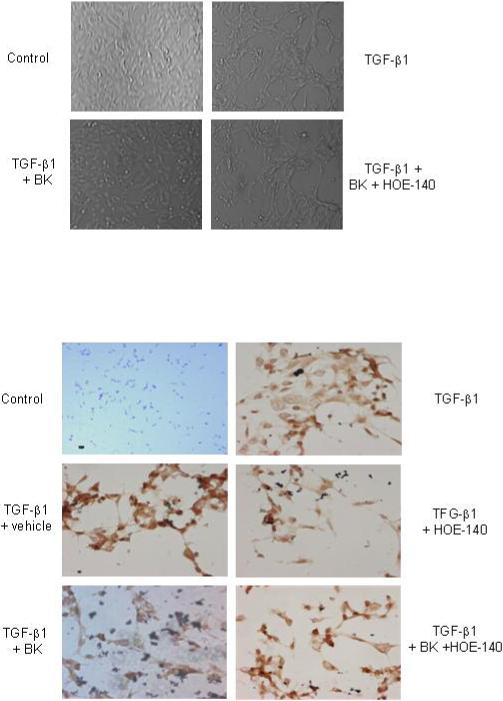
Bradykinin attenuates markers of tubular epithelial-mesenchymal transdifferentiation (TEMT) induced by TGF-β1 in HK-2 cells. (A) HK-2 cells were incubated for 48 hrs with TGF-β1 (10 ng/ml) with/without BK (10nM) and B2R antagonist HOE-140 (10nM) as indicated. (B) Anti-α-SMA staining of HK-2 cells treated with TGF-β1, BK, and/or HOE-140 as indicated. Cells were stained with antibodies. Control HK-2 cells are α-SMA negative, while TGF-β1 incubation results in TEMT, an effect that is attenuated by BK. BK effects are blocked by HOE-140. Results shown are representative of three independent experiments.
Figure 8
Figure 8
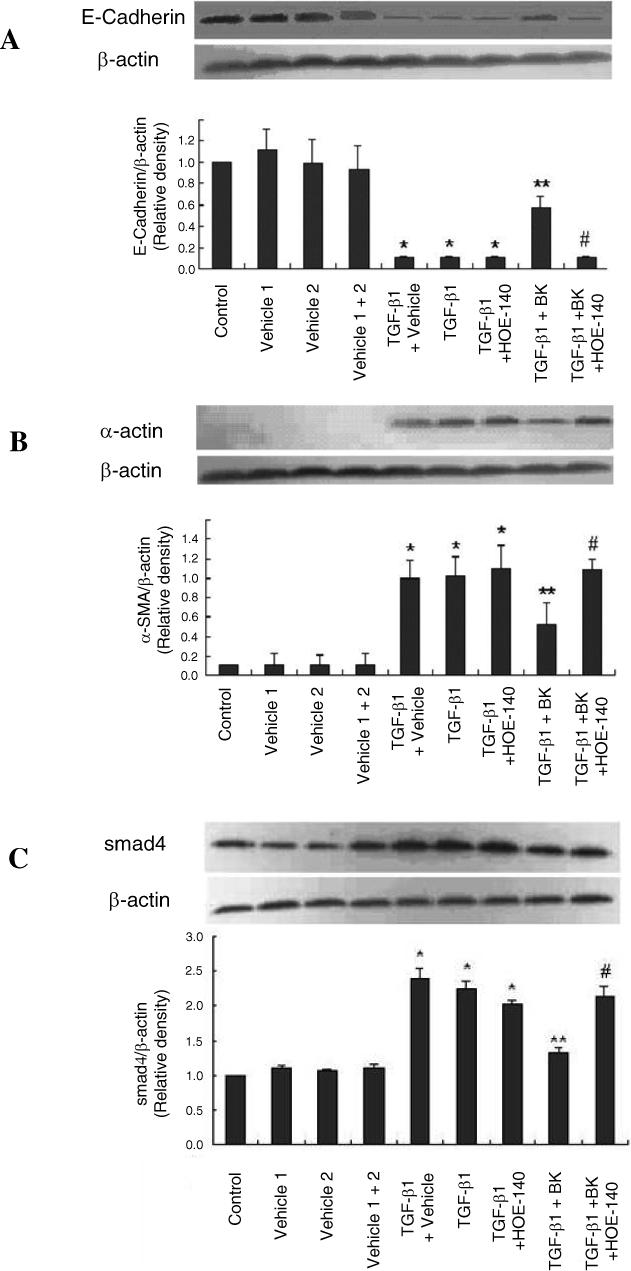
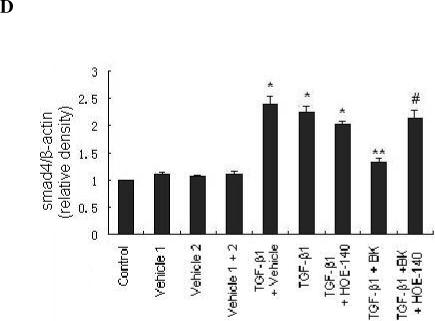
Bradykinin attenuates expression of TEMT markers induced by TGF-β1 in HK-2 cells through the B2R receptor. HK-2 cells were incubated for 48 hrs with TGF-β1 (10 ng/ml) with or without vehicle, BK (10nM) and B2R antagonist HOE-140 (10nM) as indicated. Representative western blots for E-cadherin (A), α-SMA (B), and smad4 (C) are shown. Densitometric quantification of western blots stained with E-cadherin, α-SMA, and smad4 antibodies is shown normalized to β-actin. Data are expressed as mean ± SEM (n=6 per group); * p<0.01 vs. all controls; ** p<0.01 vs. TGF-β1; # p<0.05 vs. TGF-β1 + BK.
Figure 8
Figure 8
Bradykinin attenuates expression of TEMT markers induced by TGF-β1 in HK-2 cells through the B2R receptor. HK-2 cells were incubated for 48 hrs with TGF-β1 (10 ng/ml) with or without vehicle, BK (10nM) and B2R antagonist HOE-140 (10nM) as indicated. Representative western blots for E-cadherin (A), α-SMA (B), and smad4 (C) are shown. Densitometric quantification of western blots stained with E-cadherin, α-SMA, and smad4 antibodies is shown normalized to β-actin. Data are expressed as mean ± SEM (n=6 per group); * p<0.01 vs. all controls; ** p<0.01 vs. TGF-β1; # p<0.05 vs. TGF-β1 + BK.

References

    1. Moeller S, Gioberge S, Brown G. ESRD patients in 2001: global overview of patients, treatment modalities and development trends. Nephrol. Dial. Transplant. 2002;17(12):2071–2076. - PubMed
    1. Xue JL, et al. Forecast of the Number of Patients with End-Stage Renal Disease in the United States to the Year 2010. J Am Soc Nephrol. 2001;12(12):2753–2758. - PubMed
    1. Scicli AG, C.O. Renal kallikrein-kinin system. Kidney Int. 1986;29(1):120–130. - PubMed
    1. Margolius HS. Tissue kallikreins and kinins: regulation and roles in hypertensive and diabetic diseases. Annu Rev Pharmacol Toxicol. 1989;29:343–64. - PubMed
    1. Margolius HS, et al. Urinary kallikrein excretion in hypertensive man. Relationships to sodium intake and sodium-retaining steroids. Circ Res. 1974;35(6):820–5. - PubMed

Publication types

MeSH terms