Review
. 2008 Dec;55(8):1265-73.
doi: 10.1016/j.neuropharm.2008.02.019. Epub 2008 Mar 14.

Lipid rafts, cholesterol, and the brain

Affiliations
Review

Lipid rafts, cholesterol, and the brain

Zeljka Korade et al. Neuropharmacology. 2008 Dec.

Abstract

Lipid rafts are specialized membrane microdomains that serve as organizing centers for assembly of signaling molecules, influence membrane fluidity and trafficking of membrane proteins, and regulate different cellular processes such as neurotransmission and receptor trafficking. In this article, we provide an overview of current methods for studying lipid rafts and models for how lipid rafts might form and function. Next, we propose a potential mechanism for regulating lipid rafts in the brain via local control of cholesterol biosynthesis by neurotrophins and their receptors. Finally, we discuss evidence that altered cholesterol metabolism and/or lipid rafts play a critical role in the pathophysiology of multiple CNS disorders, including Smith-Lemli-Opitz syndrome, Huntington's, Alzheimer's, and Niemann-Pick Type C diseases.


Figures
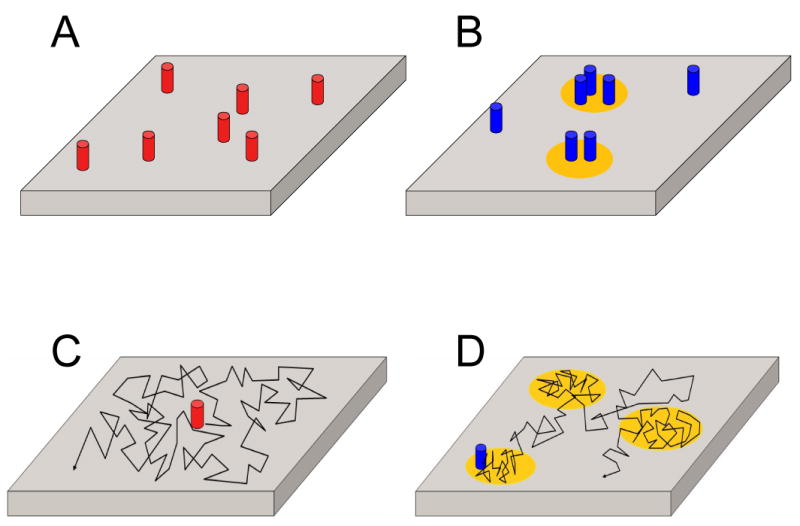
Figure 1
Figure 1. Properties of lipid rafts that can be probed by FRET and diffusion-based measurements
Bulk membrane is depicted in gray, lipid rafts in yellow, raft-associated proteins in blue, and proteins that exist in the absence of rafts in red. The movement of proteins by diffusion within the plane of the membrane is indicated by the black lines. (A) In the absence of lipid rafts, a random protein distribution is expected. This gives rise to either no FRET or a FRET signal that shows a characteristic dependence on the surface density of labeled proteins. A similar result would be expected for proteins that are neither enriched nor excluded from lipid rafts. (B) The association of proteins with lipid rafts brings them within FRET proximity. For FRET to be able to detect such domains, at least one donor-labeled and one acceptor-labeled protein must localize within the same lipid raft. (C) For proteins undergoing classical free diffusion, diffusion is not hindered in any way. (D) One way that lipid rafts can impact protein diffusion is by transiently confining them to liquid ordered domains. This can be detected experimentally by testing for cholesterol-dependent, confined diffusion.
Figure 2
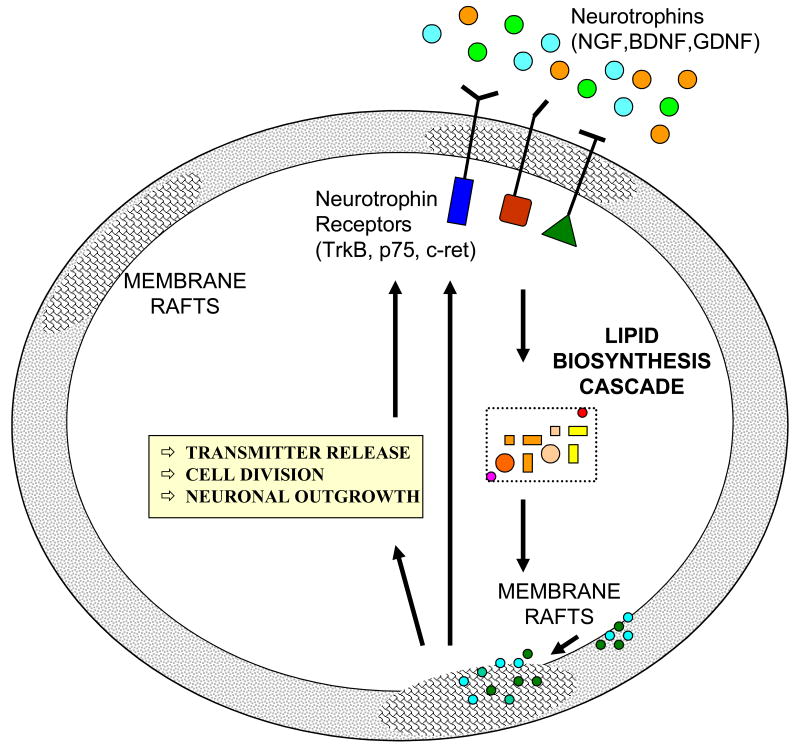
Figure 2. Proposed feed-forward and feedback regulation of the lipid raft – neurotrophin signaling cascade
Binding of neurotrophins leads to activation of their respective receptors and transcriptional regulation of lipidogenic enzymes in the nervous tissue. The altered lipid biosynthesis will lead to altered organization/composition of lipid rafts and changes in neurotransmitter release, cell division, and neuronal outgrowth. Finally, altered microdomain structure will also affect the insertion and signaling of the neurothrophin receptors, thus completing the lipid-raft/neurotrophin regulatory cycle.

References

    1. Allende D, Vidal A, McIntosh TJ. Jumping to rafts: gatekeeper role of bilayer elasticity. Trends Biochem Sci. 2004;29:325–330. - PubMed
    1. Anderson RG, Jacobson K. A role for lipid shells in targeting proteins to caveolae, rafts, and other lipid domains. Science. 2002;296:1821–1825. - PubMed
    1. Bacia K, Schwille P, Kurzchalia T. Sterol structure determines the separation of phases and the curvature of the liquid-ordered phase in model membranes. Proc Natl Acad Sci U S A. 2005;102:3272–3277. - PMC - PubMed
    1. Bae SH, Lee JN, Fitzky BU, Seong J, Paik YK. Cholesterol biosynthesis from lanosterol. Molecular cloning, tissue distribution, expression, chromosomal localization, and regulation of rat 7-dehydrocholesterol reductase, a Smith-Lemli-Opitz syndrome-related protein. J Biol Chem. 1999;274:14624–14631. - PubMed
    1. Barenholz Y. Cholesterol and other membrane active sterols: from membrane evolution to “rafts”. Prog Lipid Res. 2002;41:1–5. - PubMed

Publication types