


EGFR mutations in lung adenocarcinomas: clinical testing experience and relationship to EGFR gene copy number and immunohistochemical expression
- PMID: 18403609
- PMCID: PMC2329789
- DOI: 10.2353/jmoldx.2008.070178
EGFR mutations in lung adenocarcinomas: clinical testing experience and relationship to EGFR gene copy number and immunohistochemical expression
Abstract
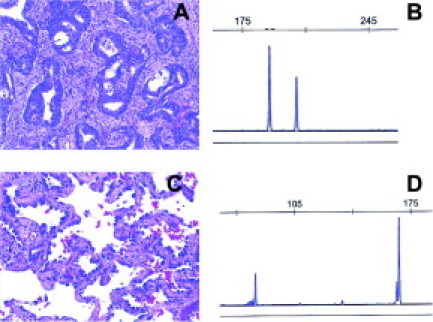
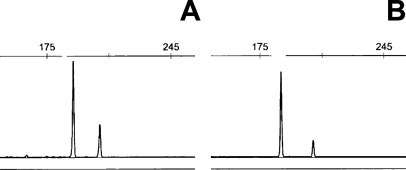
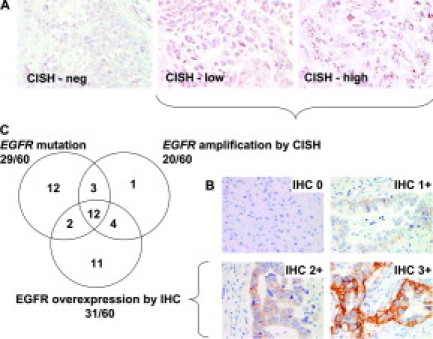
Lung adenocarcinomas responsive to epidermal growth factor receptor (EGFR) tyrosine kinase inhibitors possess EGFR mutations and often increased EGFR copy number. We prospectively studied 334 clinical cases using polymerase chain reaction-based assays to detect deletions within exon 19 and the L858R mutation in exon 21, which together account for approximately 90% of EGFR mutations. Seventy-eight (23%) of these tumors had an EGFR mutation, with 55 (71%) exon 19 deletions and 23 (29%) exon 21 L858R mutations. We were able to compare mutant and normal EGFR alleles and found a preferential amplification of the mutant allele. The association of mutations with EGFR amplification (determined by chromogenic in situ hybridization) and EGFR expression (determined by immunohistochemistry) was further examined in a subset of 60 tumors. EGFR amplification (> or =5 EGFR signals per nucleus) was seen in 15 of 29 (52%) EGFR-mutated tumors but in only five of 31 (6%) non-mutated tumors (P = 0.006). EGFR overexpression was strongly associated with amplification but was statistically independent of EGFR mutation. Most patients with EGFR mutations (17 of 29, 59%) never smoked compared with 13% (four of 31) of patients lacking such mutations (P = 0.0003). The association of amplification with smoking status was marginal and was nonexistent with EGFR expression. Thus, these results indicate that EGFR amplification, preferentially of the mutant allele, often accompanies EGFR mutation, whereas EGFR immunohistochemical staining associates with amplification but cannot predict EGFR mutation status.
Figures
References
-
- Lynch TJ, Bell DW, Sordella R, Gurubhagavatula S, Okimoto RA, Brannigan BW, Harris PL, Haserlat SM, Supko JG, Haluska FG, Louis DN, Christiani DC, Settleman J, Haber DA. Activating mutations in the epidermal growth factor receptor underlying responsiveness of non-small-cell lung cancer to gefitinib. N Engl J Med. 2004;350:2129–2139. - PubMed
-
- Paez JG, Janne PA, Lee JC, Tracy S, Greulich H, Gabriel S, Herman P, Kaye FJ, Lindeman N, Boggon TJ, Naoki K, Sasaki H, Fujii Y, Eck MJ, Sellers WR, Johnson BE, Meyerson M. EGFR mutations in lung cancer: correlation with clinical response to gefitinib therapy. Science. 2004;304:1497–1500. - PubMed
-
- Pao W, Miller V, Zakowski MF, Doherty J, Politi K, Sarkaria I, Singh B, Heelan R, Rusch V, Fulton L, Mardis E, Kupfer D, Wilson R, Kris M, Varmus H. EGF receptor gene mutations are common in lung cancers from “never smokers” and correlate with sensitivity of tumors to gefitinib (Iressa) and erlotinib (Tarceva) Proc Natl Acad Sci USA. 2004;101:13306–13311. - PMC - PubMed
-
- Shigematsu H, Lin L, Takahashi T, Nomura M, Suzuki M, Wistuba II, Fong KM, Lee H, Toyooka S, Shimizu N, Fujisawa T, Feng Z, Roth JA, Herz J, Minna JD, Gazdar AF. Clinical and biological features associated with epidermal growth factor receptor gene mutations in lung cancers. J Natl Cancer Inst. 2005;97:339–346. - PubMed
Publication types
MeSH terms
Substances
Grants and funding
LinkOut - more resources
Full Text Sources
Other Literature Sources
Medical
Research Materials
Miscellaneous
