Randomized Controlled Trial
. 2008 Jun;39(6):1814-20.
doi: 10.1161/STROKEAHA.107.508184. Epub 2008 Apr 10.

Effects of action observation on physical training after stroke

Affiliations
Randomized Controlled Trial

Effects of action observation on physical training after stroke

Pablo Celnik et al. Stroke. 2008 Jun.

Abstract

Background and purpose: In healthy humans, observation of another individual performing a motor training task (action observation [AO]) facilitates, in the observer, the effects of physical training (PT) on motor memory formation. It is not known whether this facilitatory process, of potential value for neurorehabilitation, occurs after stroke.

Methods: Eight chronic stroke patients completed this crossover-randomized investigation. A transcranial magnetic stimulation protocol that tests formation of motor memories was used to determine the effects of PT alone and in combination with AO in 2 different forms: congruent (PT+AO(congruent)) and incongruent (PT+AO(incongruent)) to the practiced task.

Results: The magnitude of motor memory formation was larger with PT+AO(congruent) than with PT alone or PT+AO(incongruent). This effect was associated with a differential corticomotor excitability change in the muscles acting as agonist and antagonist of the trained/observed movements.

Conclusions: These results indicate that congruent AO in association with physical training can enhance the effects of motor training after stroke.


Conflict of interest statement

Conflicts of Interest Disclosures: None of the authors have any conflicts of interest to disclose.

Figures
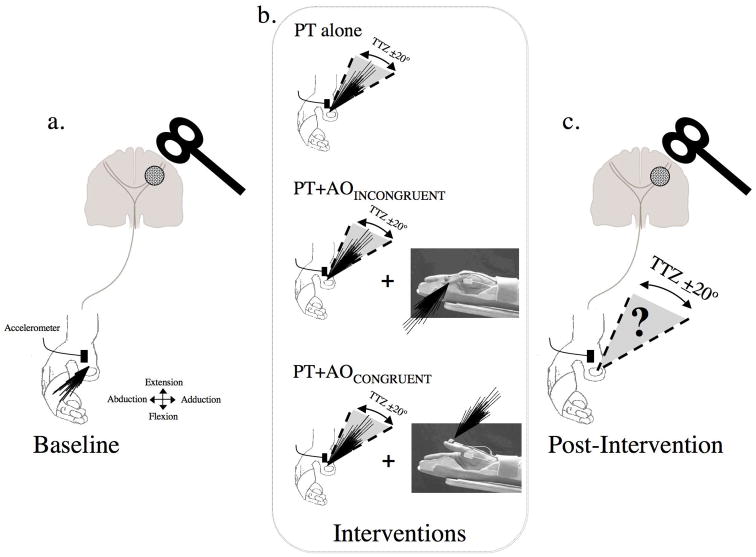
Fig. 1
Fig. 1
Graphic representation of the experimental set up. a) Baseline. Black lines depict the direction of individual TMS-evoked thumb movements, in this example a combination of flexion and abduction. b) Interventions. Patients perform: (1) physical training (PT) alone (represented by a drawing of a thumb and black lines showing the direction of the practice movements), (2) PT+AOINCONGRUENT (same drawing as in PT plus a still picture obtained from the video presented during the experiments showing the thumb in flexion position and black lines depicting the observed movements direction, opposite to the physically trained motions), and (3) PT+AOCONGRUENT (shown by the same drawing as in PT plus a still picture with the thumb in extension position and black lines depicting the direction of the observed movements). In the 3 experimental sessions, the physical training component consisted of thumb movements practiced in a direction opposite to the baseline TMS-evoked movement direction (in the sketch this is represented by the TTZ, a training target zone defined as a window of ± 20° centered on the mean training direction. c) Post-intervention. The percent of TMS-evoked thumb movements falling within the TTZ, the primary outcome measure, was calculated.
Fig 2
Fig 2
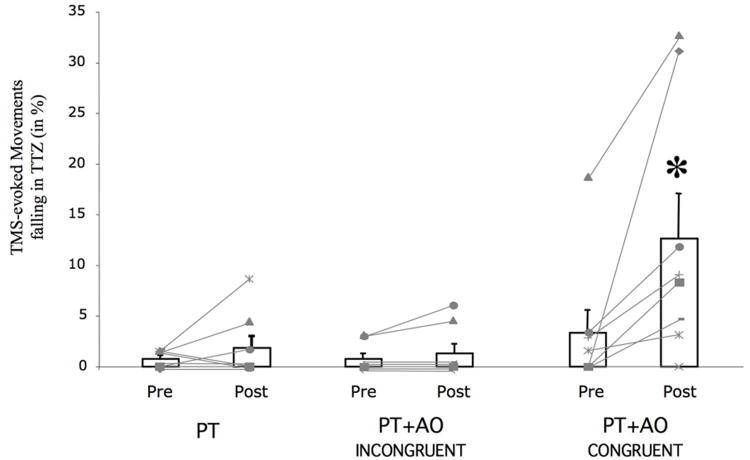
Percent of intervention-dependent TMS-evoked thumb movements falling in the TTZ (bar graph, n=8; mean ± SEM). Note the increase in the percentage of TMS-evoked thumb movements falling in the TTZ when MT+AOCONGRUENT is performed. *, p< 0.02. In light gray, the percent of movements in TTZ for each subject is shown. Seven of eight subjects experience an increased in TMS-evoked motions following the trained and observed directions in the PT+AOCONGRUENT condition.
Fig. 3
Fig. 3
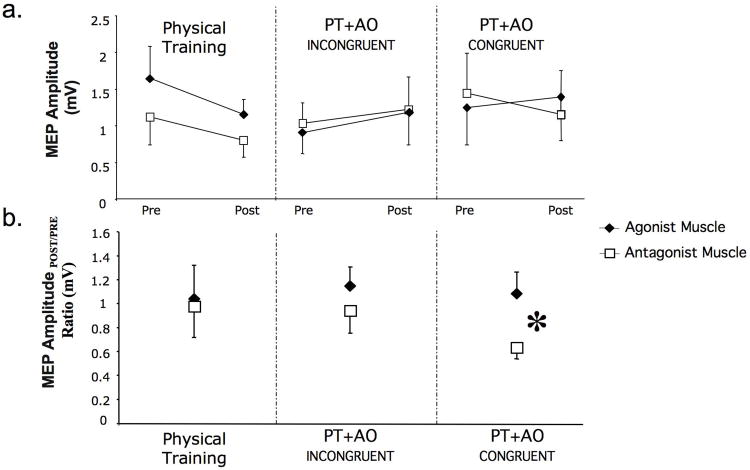
Corticomotor excitability changes as measured by motor evoked potential amplitudes (MEP). In 3a, absolute MEP amplitudes for the agonist and antagonist muscles to the physically practice direction is shown at baseline (pre) and after (post) each intervention in the 3 sessions. After PT alone MEP amplitude decreased similarly for both muscles and have minimal changes after PT+AOINCONGRUENT. In the PT+AOCONGRUENT condition, MEP amplitude for the agonist muscle had a slight increased whereas the antagonist muscle decreased. This differential modulation of excitability is evidenced in the MEPPOST-/PRE- INTERVENTION ratio (3b). Here, only PT+AOCONGRUENT elicited a significant different ratio. *, p< 0.03.

References

    1. Gallese V, Fadiga L, Fogassi L, Rizzolatti G. Action recognition in the premotor cortex. Brain. 1996;119(Pt 2):593–609. - PubMed
    1. Fogassi L, Ferrari PF, Gesierich B, Rozzi S, Chersi F, Rizzolatti G. Parietal lobe: From action organization to intention understanding. Science. 2005;308:662–667. - PubMed
    1. Gangitano M, Mottaghy FM, Pascual-Leone A. Phase-specific modulation of cortical motor output during movement observation. Neuroreport. 2001;12:1489–1492. - PubMed
    1. Maeda F, Kleiner-Fisman G, Pascual-Leone A. Motor facilitation while observing hand actions: Specificity of the effect and role of observer's orientation. J Neurophysiol. 2002;87:1329–1335. - PubMed
    1. Iacoboni M, Molnar-Szakacs I, Gallese V, Buccino G, Mazziotta JC, Rizzolatti G. Grasping the intentions of others with one's own mirror neuron system. PLoS Biol. 2005;3:e79. - PMC - PubMed

Publication types

MeSH terms