


LKB1 and AMPK and the regulation of skeletal muscle metabolism
- PMID: 18403917
- PMCID: PMC2887290
- DOI: 10.1097/MCO.0b013e3282fb7b76
LKB1 and AMPK and the regulation of skeletal muscle metabolism
Abstract
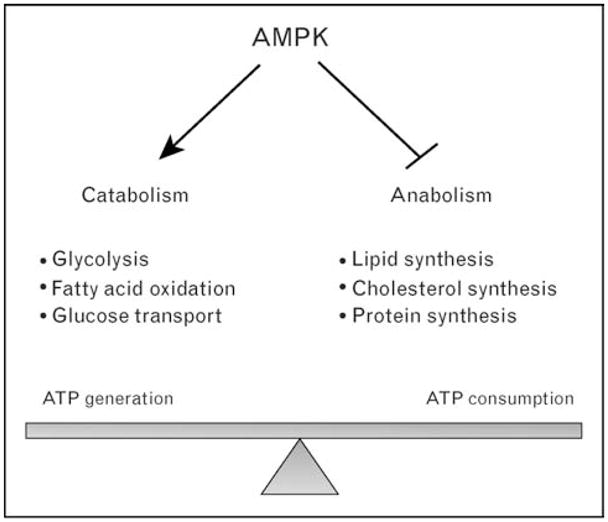
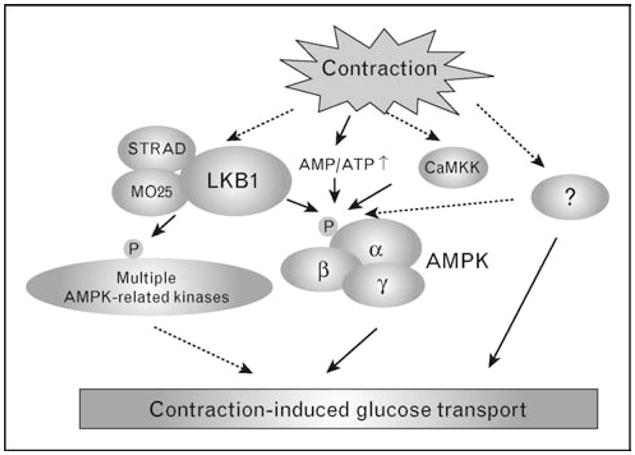
Purpose of review: To address the role of LKB1 and AMP-activated protein kinase (AMPK) in glucose transport, fatty acid oxidation, and metabolic adaptations in skeletal muscle.
Recent findings: Contraction-mediated skeletal muscle glucose transport is decreased in muscle-specific LKB1 knockout mice, but not in whole body AMPKalpha2 knockout mice or AMPKalpha2 inactive transgenic mice. Chronic activation of AMPK by 5-aminoimidazole-4-carboxamide-1-beta-D-ribofuranoside (AICAR) and beta-guanadinopropionic acid enhances mitochondrial function in skeletal muscle, but AICAR or exercise-induced increases in mitochondrial markers are preserved in skeletal muscles from whole body AMPKalpha2 or muscle-specific LKB1 knockout mice. Pharmacological activation of AMPK increases glucose transport and fatty acid oxidation in skeletal muscle. Therefore, chronic activation of AMPK may be beneficial in the treatment of obesity and type 2 diabetes.
Summary: LKB1 and AMPK play important roles in regulating metabolism in resting and contracting skeletal muscle.
Figures
Similar articles
-
Activity of LKB1 and AMPK-related kinases in skeletal muscle: effects of contraction, phenformin, and AICAR.Am J Physiol Endocrinol Metab. 2004 Aug;287(2):E310-7. doi: 10.1152/ajpendo.00074.2004. Epub 2004 Apr 6. Am J Physiol Endocrinol Metab. 2004. PMID: 15068958
-
LKB1 and the regulation of malonyl-CoA and fatty acid oxidation in muscle.Am J Physiol Endocrinol Metab. 2007 Dec;293(6):E1572-9. doi: 10.1152/ajpendo.00371.2007. Epub 2007 Oct 9. Am J Physiol Endocrinol Metab. 2007. PMID: 17925454
-
Deficiency of LKB1 in skeletal muscle prevents AMPK activation and glucose uptake during contraction.EMBO J. 2005 May 18;24(10):1810-20. doi: 10.1038/sj.emboj.7600667. Epub 2005 May 5. EMBO J. 2005. PMID: 15889149 Free PMC article.
-
Transgenic models--a scientific tool to understand exercise-induced metabolism: the regulatory role of AMPK (5'-AMP-activated protein kinase) in glucose transport and glycogen synthase activity in skeletal muscle.Biochem Soc Trans. 2003 Dec;31(Pt 6):1290-4. doi: 10.1042/bst0311290. Biochem Soc Trans. 2003. PMID: 14641045 Review.
-
Bypassing the glucose/fatty acid cycle: AMP-activated protein kinase.Biochem Soc Trans. 2003 Dec;31(Pt 6):1157-60. doi: 10.1042/bst0311157. Biochem Soc Trans. 2003. PMID: 14641016 Review.
Cited by
-
Effect of LKB1 deficiency on mitochondrial content, fibre type and muscle performance in the mouse diaphragm.Acta Physiol (Oxf). 2011 Apr;201(4):457-66. doi: 10.1111/j.1748-1716.2010.02226.x. Epub 2011 Jan 19. Acta Physiol (Oxf). 2011. PMID: 21073663 Free PMC article.
-
Differential expression patterns of genes associated with metabolisms, muscle growth and repair in Pectoralis major muscles of fast- and medium-growing chickens.PLoS One. 2022 Oct 3;17(10):e0275160. doi: 10.1371/journal.pone.0275160. eCollection 2022. PLoS One. 2022. PMID: 36190974 Free PMC article.
-
Multi-regulatory network of ROS: the interconnection of ROS, PGC-1 alpha, and AMPK-SIRT1 during exercise.J Physiol Biochem. 2017 Nov;73(4):487-494. doi: 10.1007/s13105-017-0576-y. Epub 2017 Jul 14. J Physiol Biochem. 2017. PMID: 28707280 Review.
-
Cellular Feimin enhances exercise performance by suppressing muscle thermogenesis.Nat Metab. 2025 Jan;7(1):84-101. doi: 10.1038/s42255-024-01176-8. Epub 2025 Jan 2. Nat Metab. 2025. PMID: 39747484
-
Exercise-Regulated Mitochondrial and Nuclear Signalling Networks in Skeletal Muscle.Sports Med. 2024 May;54(5):1097-1119. doi: 10.1007/s40279-024-02007-2. Epub 2024 Mar 25. Sports Med. 2024. PMID: 38528308 Free PMC article. Review.
References
-
- Carling D, Zammit VA, Hardie DG. A common bicyclic protein kinase cascade inactivates the regulatory enzymes of fatty acid and cholesterol biosynthesis. FEBS Lett. 1987;223:217–222. - PubMed
-
- Hardie DG, Carling D, Carlson M. The AMP-activated/SNF1 protein kinase subfamily: metabolic sensors of the eukaryotic cell? Annu Rev Biochem. 1998;67:821–855. - PubMed
-
- Carling D. The AMP-activated protein kinase cascade: a unifying system for energy control. Trends Biochem Sci. 2004;29:18–24. - PubMed
-
- Kemp BE, Mitchelhill KI, Stapleton D, et al. Dealing with energy demand: the AMP-activated protein kinase. Trends Biochem Sci. 1999;24:22–25. - PubMed
-
- Stapleton D, Mitchelhill KI, Gao G, et al. Mammalian AMP-activated protein kinase subfamily. J Biol Chem. 1996;271:611–614. - PubMed
Publication types
MeSH terms
Substances
Grants and funding
LinkOut - more resources
Full Text Sources
Research Materials
