Estimating cell depth from somatic mutations
- PMID: 18404205
- PMCID: PMC2275312
- DOI: 10.1371/journal.pcbi.1000058
Estimating cell depth from somatic mutations
Abstract
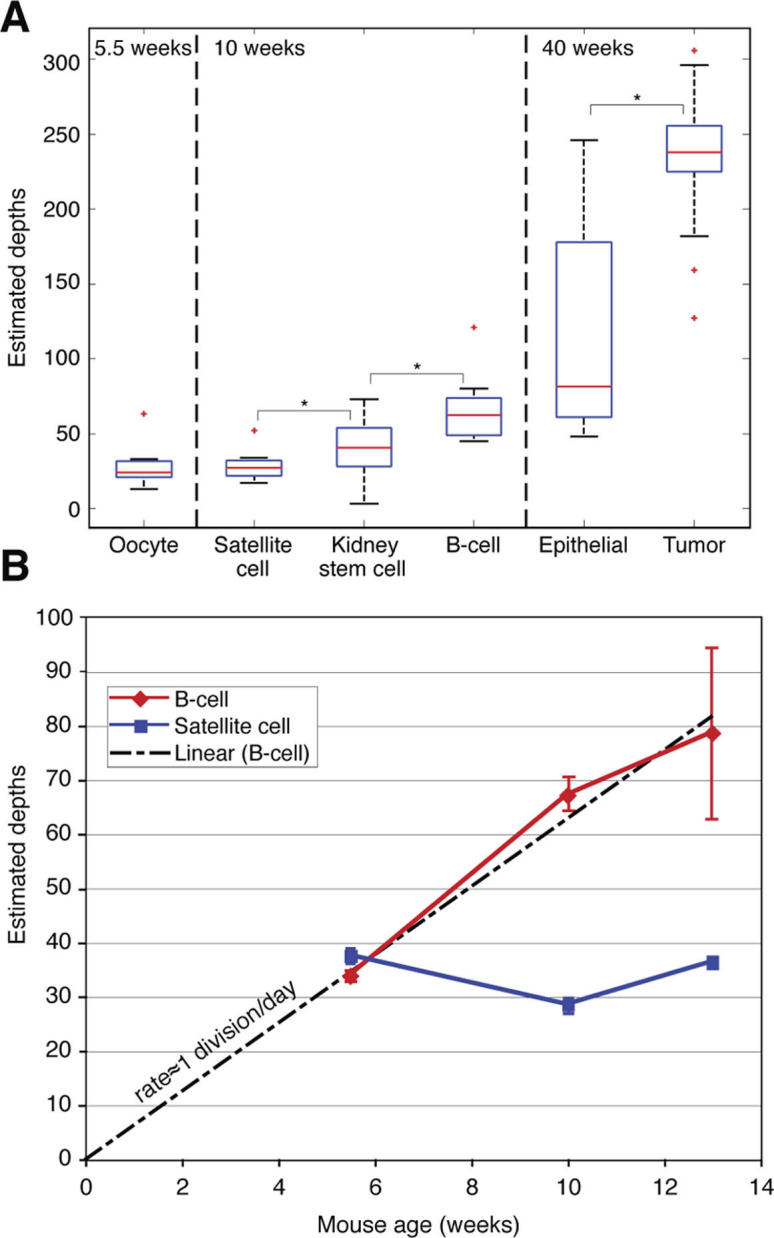
The depth of a cell of a multicellular organism is the number of cell divisions it underwent since the zygote, and knowing this basic cell property would help address fundamental problems in several areas of biology. At present, the depths of the vast majority of human and mouse cell types are unknown. Here, we show a method for estimating the depth of a cell by analyzing somatic mutations in its microsatellites, and provide to our knowledge for the first time reliable depth estimates for several cells types in mice. According to our estimates, the average depth of oocytes is 29, consistent with previous estimates. The average depth of B cells ranges from 34 to 79, linearly related to the mouse age, suggesting a rate of one cell division per day. In contrast, various types of adult stem cells underwent on average fewer cell divisions, supporting the notion that adult stem cells are relatively quiescent. Our method for depth estimation opens a window for revealing tissue turnover rates in animals, including humans, which has important implications for our knowledge of the body under physiological and pathological conditions.
Conflict of interest statement
The authors have declared that no competing interests exist.
Figures
References
-
- Sulston JE, Schierenberg E, White JG, Thomson JN. The embryonic cell lineage of the nematode Caenorhabditis elegans. Dev Biol. 1983;100:64–119. - PubMed
-
- Salipante SJ, Horwitz MS. A phylogenetic approach to mapping cell fate. Curr Top Dev Biol. 2007;79:157–184. - PubMed
-
- Vogel F MA. Human genetics. Berlin: Springer-Verlag; 1996.
-
- Drost JB, Lee WR. Biological basis of germline mutation: comparisons of spontaneous germline mutation rates among drosophila, mouse, and human. Environ Mol Mutagen. 1995;25:48–64. - PubMed
-
- Bromham L, Penny D. The modern molecular clock. Nat Rev Genet. 2003;4:216–224. - PubMed
Publication types
MeSH terms
LinkOut - more resources
Full Text Sources