The emergence and fate of horizontally acquired genes in Escherichia coli
- PMID: 18404206
- PMCID: PMC2275313
- DOI: 10.1371/journal.pcbi.1000059
The emergence and fate of horizontally acquired genes in Escherichia coli
Abstract
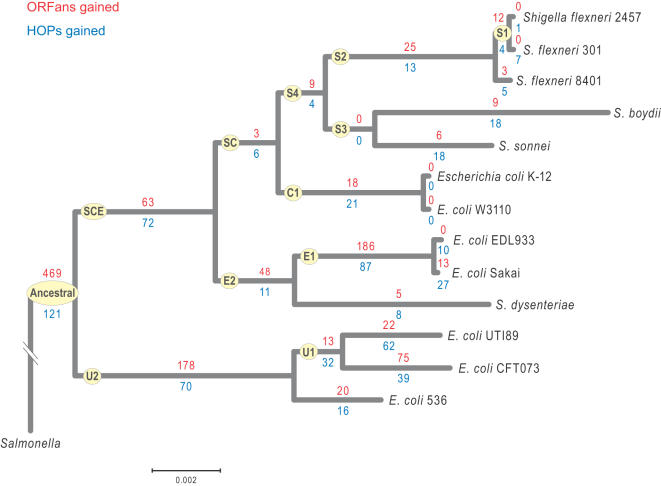
Bacterial species, and even strains within species, can vary greatly in their gene contents and metabolic capabilities. We examine the evolution of this diversity by assessing the distribution and ancestry of each gene in 13 sequenced isolates of Escherichia coli and Shigella. We focus on the emergence and demise of two specific classes of genes, ORFans (genes with no homologs in present databases) and HOPs (genes with distant homologs), since these genes, in contrast to most conserved ancestral sequences, are known to be a major source of the novel features in each strain. We find that the rates of gain and loss of these genes vary greatly among strains as well as through time, and that ORFans and HOPs show very different behavior with respect to their emergence and demise. Although HOPs, which mostly represent gene acquisitions from other bacteria, originate more frequently, ORFans are much more likely to persist. This difference suggests that many adaptive traits are conferred by completely novel genes that do not originate in other bacterial genomes. With respect to the demise of these acquired genes, we find that strains of Shigella lose genes, both by disruption events and by complete removal, at accelerated rates.
Conflict of interest statement
The authors have declared that no competing interests exist.
Figures
References
-
- Nakabachi A, Yamashita A, Toh H, Ishikawa H, Dunbar HE, et al. The 160-kilobase genome of the bacterial endosymbiont Carsonella. Science. 2006;314:267. - PubMed
-
- Waterston RH, Lindblad-Toh K, Birney E, Rogers J, Abril JF, et al. Initial sequencing and comparative analysis of the mouse genome. Nature. 2002;420:520–562. - PubMed
Publication types
MeSH terms
Substances
Grants and funding
LinkOut - more resources
Full Text Sources
Other Literature Sources